Michigan Residential PlumbingEmergency Plumbing RepairsMichigan Service Areas
(313) 736-9553
Menu
Call to confirm current availability in Flint

Genesee CountyMid-Michigan

Flint Plumber | Licensed Residential Plumbing Services

Johns Plumbing Michigan provides licensed residential plumbing services throughout Flint and Genesee County.

We're available 24/7 for emergency repairs, drain cleaning, water heater service, leak detection, and all residential plumbing needs. Michigan-licensed and fully insured. Call tel:+13137369553 anytime for same-day service in Flint.

Flint Plumber | Licensed Residential Plumbing ServicesMichigan Residential Plumbing

Michigan licensed and insured. Serving Flint and Genesee County. Available 24/7 for emergency plumbing with response within 90 minutes. Every repair backed by our workmanship guarantee.

What Plumbing Services Does Johns Plumbing Michigan Provide in Flint?

Johns Plumbing Michigan provides emergency and scheduled residential plumbing services throughout Flint and Genesee County. Our licensed technicians handle burst pipes, frozen pipe repair, water heater failures, drain cleaning, sewer line services, leak detection, fixture repairs, and gas line work for homeowners across Flint's neighborhoods.

Flint's housing stock, much of it built between the 1920s and 1960s, creates unique plumbing challenges. Aging cast iron drain lines, clay tile sewer laterals, and galvanized supply pipes have exceeded their expected lifespans.

Combined with Michigan's harsh winters and clay-heavy soil that shifts with freeze-thaw cycles, homeowners face recurring issues that require professional expertise. We also provide lead service line inspection and water quality consultation for homes built before 1986, reflecting our understanding of Flint's infrastructure history.

Whether you're dealing with a basement flooding emergency from snowmelt, a frozen pipe in an uninsulated crawl space, or simply need routine water heater maintenance, we serve all Flint ZIP codes and surrounding communities including Burton, Grand Blanc, and Swartz Creek.

Emergency Plumbing Services in Flint, Michigan

Johns Plumbing Michigan provides 24/7 emergency plumbing service throughout Flint and Genesee County. We typically arrive within 60-90 minutes for urgent situations and understand the life-safety and property-protection stakes when plumbing systems fail.

Burst pipes from freeze-thaw cycles demand immediate shutoff and repair before thousands of gallons flood your basement. Flint's extended sub-zero stretches cause pipes in uninsulated crawl spaces, exterior walls, and unheated garages to freeze solid.

Expansion cracks the pipe, and when ice melts, water sprays under full city pressure. We bring pipe repair materials, soldering equipment, and PEX crimping tools to stop the flow and restore your water service the same day.

Sewage backing into your basement through floor drains or toilets creates a biohazard requiring immediate extraction and line clearing. Clay tile sewer laterals installed in pre-1970 Flint homes crack under soil movement, allowing roots to infiltrate and trap debris until the line plugs completely. Our camera inspection identifies the blockage location; hydro-jetting clears roots and buildup; trenchless repair options minimize yard excavation.

Gas leaks near water heaters, furnaces, or appliances require evacuation and 911 notification first, then immediate shutoff at the meter and professional leak detection. We pressure-test lines, locate leaks with electronic sniffers, and replace damaged sections to restore safe operation.

Flooded basements from sump pump failures happen during spring snowmelt when pumps cycle continuously and motors burn out. We stock replacement pumps, install battery backup systems, and verify discharge lines aren't frozen at the exit point, a common Flint failure mode when discharge water refreezes in the pipe.

No hot water in winter qualifies as emergency service when temperatures drop below freezing and families face bathing and sanitation challenges. Water heater pilot light failures, tripped breakers, failed thermostats, or sediment blockages preventing ignition all require same-visit diagnosis and repair.

Frozen pipes at risk of bursting, identified by no water flow from specific fixtures and frost on exposed sections, need controlled thawing before cracks occur. We never use open flames; heat tape and warm air prevent the thermal shock that splits copper and PEX lines.

Call (313) 736-9553 immediately for burst pipes, sewage backup, gas leaks, basement flooding, or frozen pipes showing ice formation. We're available 24/7 with fully stocked trucks ready to respond to emergency calls across Flint, Burton, and surrounding Genesee County communities.

How fast do you need someone?

Check all situations that apply in your Flint home. We'll determine the fastest, most appropriate response.

Call now

Damage compounds by the minute.

Same day

Livable for hours, not days.

Schedule

Book it before it escalates.

Residential Plumbing Services in Flint

Johns Plumbing Michigan handles every residential plumbing need in Flint and Genesee County, from routine repairs to full system replacements. Our licensed technicians work on Flint's unique housing stock daily, from pre-war bungalows with original cast iron stacks to mid-century ranches with galvanized supply lines.

We group our services into emergency response (burst pipes, sewage backups, gas leaks), preventive maintenance (water heater flushing, drain cleaning, sump pump testing), and system upgrades (re-piping, fixture replacement, water heater installation). This approach reflects how homeowners actually experience plumbing, some problems demand immediate response, others benefit from scheduled service, and some represent planned improvements.

Drain Cleaning & Clog Removal addresses slow-draining sinks, backed-up toilets, and main line blockages. Flint's aging cast iron and clay tile drain systems accumulate decades of buildup. We use cable snaking for fixture-level clogs and hydro jetting for main line scale removal.

Water Heater Repair & Replacement covers tank and tankless systems, pilot light failures, insufficient hot water, and leaking tanks. Hard water deposits shorten water heater lifespan in Flint. We repair when cost-effective and recommend replacement when tanks near end-of-life.

Leak Detection & Pipe Repair finds hidden leaks behind walls, under slabs, and in crawl spaces using acoustic and thermal imaging equipment. We repair pinhole leaks, replace corroded sections, and handle full re-piping for homes with failing galvanized supply lines.

Sewer Line Services include camera inspection, root removal, trenchless repair, and traditional excavation replacement. Clay tile sewer laterals in older Flint neighborhoods crack under soil movement and tree root intrusion. Camera inspection identifies the problem location before we dig.

Fixture Installation & Repair handles toilets, faucets, garbage disposals, sump pumps, and sink replacements. Running toilets waste water and money. Sump pump failures cause basement flooding during spring snowmelt, common in Genesee County's clay-heavy soil.

Gas Line Services cover gas leak detection, line installation for appliances, pressure testing, and shutoff valve work. Gas work requires licensed expertise, never attempt DIY gas line repair.

See detailed service information below for specific scenarios, symptoms, and when to call for each service type.

Complete Plumbing Service Guide for Flint Homeowners

Johns Plumbing Michigan provides comprehensive residential plumbing services throughout Flint and Genesee County, covering drain and sewer line work, water heater repair and replacement, leak detection and pipe repair, fixture installation, and gas line services. Below is detailed coverage of each service category, methods used, and when Flint homeowners typically need each service.

Residential plumbing service technician with tools and equipment ready to serve Flint Michigan homeowners

Drain Cleaning & Clog Removal Services in Flint

Drain cleaning addresses clogs in kitchen sinks, bathroom fixtures, shower drains, toilets, main sewer lines, and basement floor drains. Flint's hard water accelerates mineral buildup inside drain pipes, while older cast iron lines accumulate decades of grease, soap scum, and corrosion scale that narrow the pipe diameter over time.

For simple fixture clogs, cable snaking uses a flexible steel cable with a cutting head to break through blockages and pull debris back through the drain opening. This method works for hair clogs in bathroom sinks and tubs, food debris in kitchen drains, and toilet paper buildups. When buildup coats the entire pipe interior, common in Flint homes with original 1920s-1960s cast iron stacks, hydro jetting uses high-pressure water streams (up to 4,000 PSI) to scour pipe walls clean and flush accumulated scale into the main sewer line.

Video camera inspection reveals what's happening inside drain lines when recurring clogs return within weeks. The camera shows whether roots have penetrated clay tile laterals, whether cast iron has corroded through from the inside, or whether a section has sagged and created a belly that traps water and debris. This diagnostic step prevents repeated service calls for the same problem by identifying whether cleaning will solve the issue or whether pipe replacement is needed.

Multiple slow drains throughout the house typically indicate main line problems rather than individual fixture clogs. When the kitchen sink, bathroom tub, and basement floor drain all back up simultaneously, the blockage sits downstream in the shared drain stack or sewer lateral.

Gurgling sounds from toilets when running the washing machine confirm this. Air trapped behind the clog bubbles up through the nearest vent.

Water Heater Repair & Replacement Services

Flint's cold incoming water temperatures during winter force water heaters to work harder than in warmer climates, accelerating wear on heating elements and increasing sediment accumulation. Hard water deposits calcium and magnesium inside tank bottoms, creating a layer that insulates the heating element from the water and forces longer heating cycles that drive up energy costs.

Tank water heater repair addresses pilot light failures, thermostat malfunctions, pressure relief valve leaks, and anode rod deterioration. When a pilot light won't stay lit, the thermocouple, a safety sensor that detects flame presence, may have failed or shifted out of position. Replacing it takes 30-45 minutes and restores normal operation.

Anode rods attract corrosive elements in hard water to protect the steel tank; once consumed, tank corrosion accelerates. Replacing the anode rod every 3-5 years extends tank life in Flint's hard water conditions.

Tankless water heater installation eliminates standby heat loss and provides endless hot water for larger families, but requires adequate gas line capacity and venting infrastructure. Flint homes with basement water heaters may need gas line upgrades and new vent penetrations through exterior walls. Tankless units also require annual descaling maintenance in hard water areas to prevent mineral buildup inside the heat exchanger.

Water heater replacement becomes necessary when tanks leak from corrosion, when sediment buildup blocks drain valves, or when repair costs approach 50% of replacement cost on units over 10 years old. Sizing matters. Undersized tanks run out of hot water during showers, while oversized tanks waste energy heating water that sits unused.

A 40-gallon tank typically serves 2-3 people; 50 gallons serves 3-4; 75+ gallons serves larger families. Tankless sizing depends on peak flow rate (gallons per minute) and the temperature rise needed to heat Flint's 40-50°F winter groundwater to 120°F output.

Leak Detection & Pipe Repair Services

Leak detection in Flint homes starts with obvious visual inspection. Water stains on ceilings indicate overhead pipe failures, puddles near water heaters or under sinks show fixture leaks, and wet basement walls suggest foundation cracks or exterior drainage problems. Hidden leaks require acoustic detection (listening devices that amplify the sound of water escaping under pressure) or thermal imaging cameras that show temperature differences where water saturates insulation.

Slab leaks occur when copper supply lines embedded in concrete floor slabs develop pinhole leaks from corrosion or ground movement. Warm spots on floors over heated slab areas, unexplained water meter movement with all fixtures off, and sudden drops in water pressure all indicate possible slab leaks. Accessing these requires breaking through concrete, repairing or replacing the damaged section, pressure testing, then patching the floor.

Frozen pipe repair becomes urgent when thawing begins and cracks become floods. Pipes in uninsulated crawl spaces, exterior walls, and unheated garages split when water inside expands during freezing. The damage appears when thawing occurs.

Pressure rebuilds and water sprays through the split. Immediate main water shutoff (typically located in basement near front foundation wall) limits damage. Repairs range from pipe patching for small splits to section replacement for burst pipes with multiple cracks.

Re-piping entire homes makes sense when multiple leaks occur within months, when original galvanized steel pipes restrict flow from interior corrosion, or when lead solder concerns exist in pre-1986 copper installations. Flint's lead service line replacement program addressed connections from street mains to homes, but interior plumbing may still contain lead solder or galvanized pipes that trapped lead particles during the water crisis. Whole-house re-piping with PEX tubing takes 2-3 days for typical ranch homes and eliminates future corrosion concerns.

Sewer Line Services

Sewer camera inspection inserts a waterproof camera on a flexible cable through cleanout access points to document sewer line condition from house to municipal connection. The camera reveals root intrusion through clay tile joints, collapsed sections from soil settlement, bellied sections that trap water and waste, or complete blockages from years of grease buildup. This diagnostic step provides decision-making evidence for whether cleaning will work or whether excavation and replacement are necessary.

Tree root removal uses hydro jetting to cut roots that have penetrated clay tile laterals seeking moisture. Roots follow vapor trails from cracked pipe joints and grow into dense mats that catch toilet paper and solid waste.

Hydro jetting cuts these roots and flushes them downstream, but roots regrow within 1-3 years unless the pipe joints are sealed. Chemical root treatments slow regrowth but don't address the underlying joint cracks.

Trenchless sewer line repair preserves landscaping by inserting a new pipe lining inside the existing damaged lateral or by bursting the old pipe and pulling new pipe through the same path. Pipe lining installs an epoxy-impregnated fabric tube inside the existing pipe, then inflates and cures it to form a new seamless pipe within the old one. This works when the existing pipe remains structurally intact but has joint leaks or root intrusion.

Pipe bursting fractures the old clay tile line while simultaneously pulling HDPE replacement pipe through. Useful when the old line has collapsed sections or severe root damage.

Traditional excavation remains the only option when video inspection reveals bellied sections or when trenchless methods can't navigate severe offsets. Excavation involves trenching from house to street connection, removing damaged pipe sections, installing new PVC or HDPE sewer line with proper slope, backfilling, and landscape restoration. Clay-heavy soil in Flint creates hydrostatic pressure that can shift pipes over decades, causing sags and bellies that trap waste.

Fixture Installation & Repair Services

Toilet repairs address running toilets (flapper valve fails to seal, allowing tank water to continuously leak into bowl), toilets that won't flush (flapper opens but water drains too slowly due to partial clogs), and leaking tank-to-bowl gaskets. Running toilets waste 1-2 gallons per minute, over 1,400 gallons per day. Replacing the flapper takes 10 minutes and costs under $20.

When wax rings fail, toilets leak at the floor connection, causing subfloor rot and ceiling damage in rooms below. Re-seating the toilet with a new wax ring stops the leak.

Faucet repair addresses dripping from worn cartridge seals or O-rings, low flow from mineral buildup inside aerators, and handle leaks from packing nut loosening. Single-handle cartridge faucets develop drips when internal rubber seals wear from hard water minerals.

Replacing the cartridge takes 30-45 minutes. Faucet replacement becomes necessary when corroded valve bodies leak or when repair parts are discontinued for older fixtures.

Garbage disposal installation requires dedicated electrical circuits and proper drain connections. When disposals jam from eggshells, potato peels, or metal objects, the reset button on the disposal bottom restores operation after removing the obstruction. Disposal leaks occur at sink flange connections or dishwasher inlet connections and require resealing or gasket replacement.

Sump pump installation and repair prevent basement flooding during spring snowmelt and summer storm runoff. Pumps sit in basement floor pits and activate when water reaches the float switch level.

Battery backup systems run when power fails during storms, essential for homes in low-lying areas near the Flint River. Testing pumps monthly (pour bucket of water into pit to trigger float switch) confirms readiness before spring thaw.

Gas Line Services

Gas line installation connects natural gas or propane-fueled water heaters, dryers, ranges, and fireplaces to the home's gas supply. This work requires licensed plumbers and permits.

Improper gas line installation creates fire and explosion risks. Black iron pipe traditionally serves as gas line material, though flexible CSST (corrugated stainless steel tubing) allows easier routing through walls and framing.

Gas leak detection starts with the smell of natural gas (mercaptan added for safety, smells like rotten eggs). If you smell gas, evacuate immediately, call 911 from outside, then call your plumber once the fire department confirms the area is safe. Never use electrical switches or phones inside a gas-filled space.

Sparks can ignite gas. Gas leak testing uses electronic detectors or soap solution applied to connections to locate escaping gas.

Gas line pressure testing confirms new installations and repairs hold pressure without leaks before appliances connect. Technicians pressurize the line above normal operating pressure, close valves, and monitor gauges for pressure drops that indicate leaks. Michigan code requires pressure testing and inspections before final approval.

Need plumbing service in Flint or Genesee County? Call (313) 736-9553 for same-day appointments, emergency response, and licensed work on all residential systems.


Repair or Replace? Decision Framework for Flint

Honest guidance based on equipment age, repair cost, and expected remaining life. We recommend what makes sense for you, not what maximizes our invoice.

Tank Water HeaterLifespan: 10-12 years
When repair makes sense
Age < 8 years and repair < $500
When replacement is better
Age 10+ years, or repair > $600, or multiple issues
Replacement benefits
New units: 15-20% energy savings, warranty coverage, avoid emergency breakdown
Michigan local context
Hard water in Michigan shortens tank lifespan—flush annually
Tankless Water HeaterLifespan: 15-20 years
When repair makes sense
Age < 12 years and single component failure
When replacement is better
Age 15+ years, or heat exchanger failure (typically $800-$1,200)
Replacement benefits
Newer models: better efficiency, longer warranty, improved flow rate
Michigan local context
Scale buildup from hard water is the main longevity factor
ToiletLifespan: 15-25 years
When repair makes sense
Age < 15 years, repairable components (flapper, fill valve, wax ring)
When replacement is better
Age 20+ years, cracks in bowl/tank, or frequent recurring issues
Replacement benefits
Modern low-flow: saves 13,000+ gallons/year, quieter flush, better design
Michigan local context
Pre-1994 toilets use 3.5-7 gallons per flush vs 1.28 today
Garbage DisposalLifespan: 8-12 years
When repair makes sense
Age < 6 years and motor hums but won't turn (often a jam)
When replacement is better
Age 8+ years, motor burned out, or leaking from housing
Replacement benefits
Replacement is fast ($200-$400 installed), modern units quieter and stronger
Michigan local context
Hard water doesn't affect these, but heavy use shortens lifespan
Sump PumpLifespan: 7-10 years
When repair makes sense
Age < 5 years, switch or discharge issue, not motor failure
When replacement is better
Age 7+ years, motor failure, or pump runs constantly
Replacement benefits
Backup systems prevent flooding, battery backups available for power outages
Michigan local context
Michigan spring thaw and heavy rain make sump pumps critical—test twice yearly
Clay/Cast Iron Sewer LineLifespan: 50-80 years (clay), 50-100 years (cast iron)
When repair makes sense
Isolated crack or root intrusion, single-spot repair feasible
When replacement is better
Age 50+ years with frequent backups, bellied sections, or multiple failures
Replacement benefits
PVC replacement: 100+ year lifespan, root-resistant, lower ongoing maintenance
Michigan local context
Tree roots seek moisture—clay/cast iron joints are vulnerable
FaucetLifespan: 15-20 years
When repair makes sense
Age < 10 years, cartridge/aerator replacement, single-handle drip
When replacement is better
Age 15+ years, body corrosion, or parts no longer available
Replacement benefits
Modern faucets: better water efficiency, easier cleaning, longer warranties
Michigan local context
Hard water scale is the main wear factor in Michigan—replace aerators regularly
Whole-House Re-PipingLifespan: 50+ years (copper), 100+ years (PEX)
When repair makes sense
Isolated pinhole leak in otherwise sound copper
When replacement is better
Multiple leaks in short time, galvanized steel (corrodes from inside), low pressure throughout
Replacement benefits
PEX: freeze-resistant, faster install, lower cost, no corrosion, easier future repairs
Michigan local context
Homes built before 1970 often have galvanized steel—corrodes within 40-60 years
Cost-Benefit Rule of Thumb
  • RepairIf equipment is < 70% through its lifespan and repair costs < 50% of replacement value.
  • ReplaceIf equipment has exceeded its lifespan or repair costs exceed 60% of replacement value.
  • EfficiencyOlder equipment often costs 20–40% more to operate annually in energy & water bills.
  • WarrantyNew equipment carries 5–10 year parts warranty vs 90-day typical repair guarantee.

Discuss your repair vs replace options: (313) 736-9553

Symptom Diagnosis & Problem Recognition in Flint, Michigan

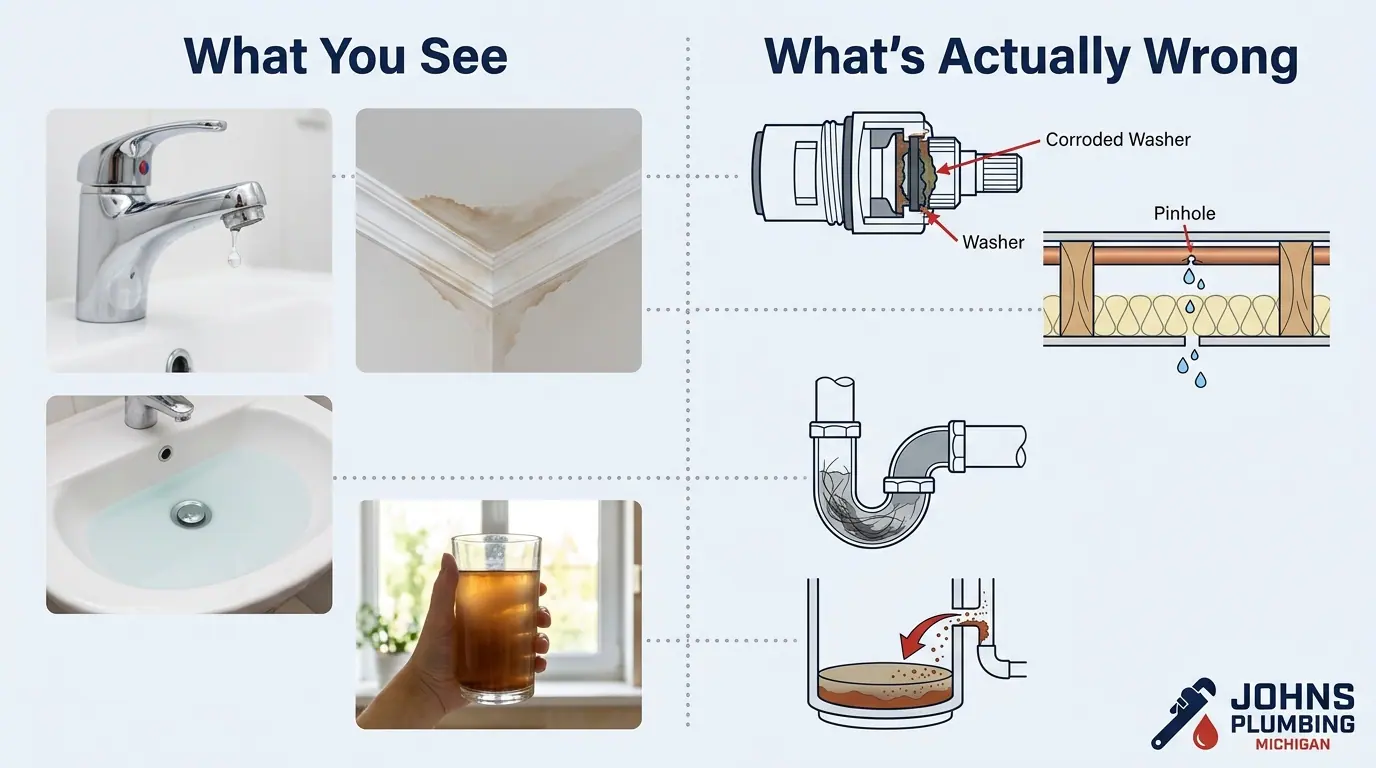
Several observable symptoms indicate underlying plumbing problems requiring professional evaluation. Water pressure changes, persistent slow drains, unusual noises, water discoloration, and unexplained moisture are the most common warning signs. Recognizing these symptoms early and understanding their urgency level helps Flint homeowners prevent minor issues from becoming costly emergencies, especially critical given the city's aging plumbing infrastructure from the 1920s-1960s housing stock.

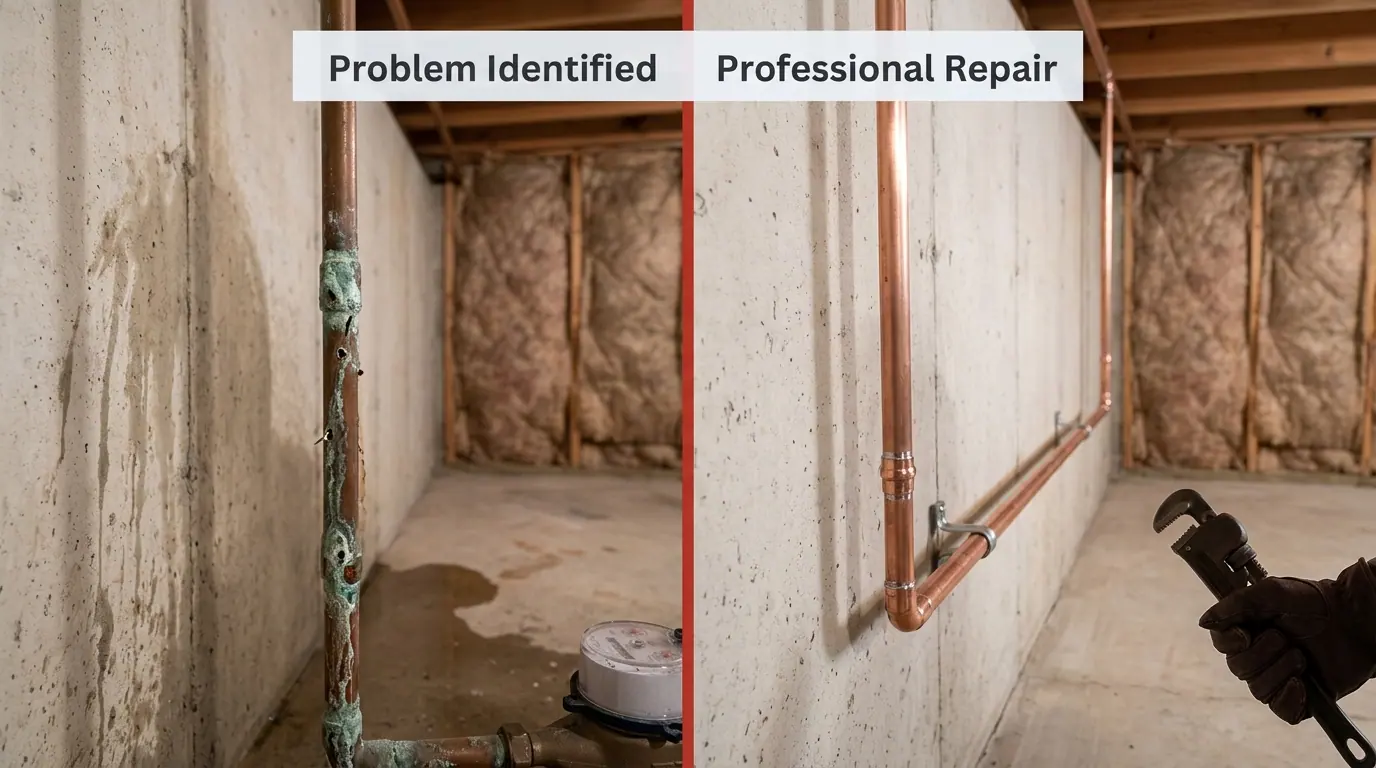
Split-view diagnostic visual showing common plumbing symptoms homeowners observe versus underlying causes professionals identify

Water Pressure Problems

Sudden loss of water pressure throughout your home often signals a main line leak or pressure regulator failure. When pressure drops only at specific fixtures, aerator clogs from Flint's mineral-heavy water are usually responsible, calcium and magnesium deposits accumulate faster here than in softer-water areas. Check aerators first by unscrewing and inspecting for white crusty buildup.

If pressure loss affects the whole house and your neighbors have normal pressure, you likely have a hidden leak between the meter and your home, or a failing pressure-reducing valve if you have one installed.

Pressure that fluctuates, surging then dropping, points to waterlogged pressure tanks in homes with well systems or air trapped in pipes after recent repairs. If the city recently worked on mains in your neighborhood, air pockets can cause temporary surging. Persistent pressure problems after 24-48 hours require camera inspection of your service line or pressure system diagnosis. Call (313) 736-9553 if whole-house pressure loss persists beyond a few hours or you notice wet spots in your yard near the service line.

Drainage Issues

Multiple slow drains throughout your home indicate main sewer line blockage rather than individual fixture problems. This is critical diagnostic knowledge many homeowners miss.

When your kitchen sink, bathroom tub, and basement floor drain all slow down simultaneously, the clog sits in your main lateral between your home and the municipal connection. Tree roots, collapsed clay tile sections common in pre-1980 Flint homes, or years of accumulated grease and debris create these systemic backups.

A single slow drain suggests a localized clog in that fixture's trap or branch line. Gurgling sounds from drains when you flush a toilet or run water elsewhere signal vent stack problems.

The plumbing system's air pressure balance is disrupted, preventing proper drainage. This often happens when small animals nest in roof vents or when original galvanized vent pipes corrode closed after decades of exposure.

Water Quality Symptoms

Brown or rusty water from cold taps points to corroded galvanized steel supply pipes, extremely common in Flint homes built before 1960. The rust you see is oxidized iron from pipe interiors.

These pipes have a 50-80 year lifespan and most in older Flint neighborhoods have exceeded it. If rust appears only from hot water taps, your water heater's anode rod has depleted and the tank itself is corroding from the inside.

Cloudy or milky water that clears from bottom to top in a glass is dissolved air. Harmless but indicates recent pressure changes in the system. Water that stays cloudy suggests sediment, usually from disturbed main line work or failing well components.

Foul-smelling water (sulfur/rotten egg odor) in homes with well systems indicates bacterial contamination in the well or water heater. Municipal water with chlorine smell beyond normal levels can mean the city recently flushed lines or increased treatment temporarily. Any metallic taste warrants testing, especially in pre-1986 homes where lead solder may be present.

Leak Indicators

Unexplained water bill increases, 30% or more above your seasonal average, signal hidden leaks long before you see visible water damage. A running toilet that refills every 10-15 minutes wastes up to 200 gallons daily and is one of the most common leak sources. Test by adding food coloring to the tank; if color appears in the bowl within 30 minutes without flushing, the flapper seal has failed.

Wet spots on ceilings, walls, or floors that appear without obvious source indicate concealed pipe leaks. In Flint's older homes, pinhole leaks in copper supply lines often start at soldered joints or where pipes contact dissimilar metals. Foundation cracks accompanied by persistent moisture suggest main line leaks outside, clay soil around Flint swells when saturated, creating pressure that cracks concrete.

Warm spots on floors (without radiant heating) reveal hot water line leaks under slabs. Mold or mildew growth in areas that should stay dry confirms ongoing moisture problems requiring immediate investigation.

Emergency Symptoms

Sewage backing up through basement floor drains or lowest fixtures in your home demands immediate professional response. This is raw wastewater creating health hazards.

The blockage sits in your main sewer lateral or the municipal connection has failed. Gas smell (rotten egg odor added to natural gas) near water heaters, gas lines, or appliances requires evacuation and emergency calls to both the gas company and a licensed plumber.

No water to any fixtures when neighbors have normal service can mean your main shutoff closed accidentally, a service line break, or frozen pipes about to burst.

Continuous water flow from burst pipes, common in Flint during January-February cold snaps when exterior wall pipes or crawl space lines freeze then rupture, causes catastrophic water damage within hours. Locate your main shutoff (typically in the basement near the front foundation wall where the service line enters) and close it immediately, then call for emergency repair. For any of these symptoms, call (313) 736-9553 immediately. Sewage exposure, gas leaks, and burst pipes create life-safety risks and property damage that escalate rapidly.

Noise and Vibration

Banging or hammering sounds when you shut off faucets quickly (water hammer) indicate loose pipes or failed air chambers that normally cushion pressure surges. This accelerates joint failure over time as repeated shock stresses connections. Whistling or squealing when water flows suggests loose washers in valves or partially closed shutoff valves creating turbulence.

Popping, banging, or hissing from your water heater means sediment buildup on the tank bottom. Flint's hard water accelerates this. As the heating element fires, it superheats water trapped under the sediment layer, creating steam bubbles that collapse loudly. This reduces efficiency and shortens tank life.

Rattling pipes when appliances turn on indicate inadequate pipe fastening, vibration from water flow loosens already-corroded pipe hangers common in older homes. If the rattling started recently, suspect a failing appliance valve creating pressure fluctuations.

Gurgling from toilets when no one's using them signals main line or vent problems discussed earlier. Not sure what's causing unusual sounds?

Match your symptom to its likely cause

Find the symptom closest to what you are seeing in Flint. Click to reveal the diagnosis and urgency level.

Select a symptom to see your diagnosis

Cost & Pricing Transparency for Plumbing Services in Flint, Michigan

Emergency plumbing in Flint typically runs $110-$800 depending on job complexity, with most service calls landing in the $324-$466 range. Standard hourly rates range from $45-$150, but weekend, after-hours, and holiday service can double or triple that ($125-$170/hour). Costs vary based on problem severity, access difficulty, parts needed, and timing.

Service Call and Diagnostic Fee

Most Flint plumbers charge $75-$150 for a standard service call during business hours. This covers travel, initial diagnosis, and a written estimate before any repair work begins.

The fee typically applies toward the total if you proceed with repairs. Emergency service calls after 5pm, weekends, or holidays add $50-$100 to the base rate due to technician availability premiums.

What's included: arrival within the quoted timeframe, problem diagnosis, written estimate, explanation of repair options, and answers to your questions. The diagnostic fee does not include parts or actual repair labor. Those appear as separate line items once you approve the estimate.

Drain Cleaning Cost

Kitchen and bathroom sink clogs typically cost $150-$300 when the blockage sits in the P-trap or nearby branch line. Main sewer line cleaning runs $300-$500 for cable snaking, or $400-$800 for hydro jetting when roots or heavy buildup require more aggressive clearing. Camera inspection adds $200-$400 but often saves money by pinpointing the exact problem location before excavation.

Cost drivers include clog location (P-trap access versus main line under slab), severity (grease buildup versus tree roots), and method required (simple snake versus high-pressure jetting). Many Flint homes built before 1960 have clay tile sewer laterals that crack and admit roots.

These often need recurring cleaning or eventual replacement. Access difficulty matters: pulling a toilet to reach a closet bend adds $100-$150 in labor.

Hard water buildup common in Flint accelerates drain line scaling, especially in galvanized pipes from older homes. Preventive hydro jetting every 2-3 years ($300-$500) costs less than emergency main line failures that flood basements.

Water Heater Repair and Replacement

Repairing a tank water heater costs $200-$500 for common issues: thermostat replacement ($150-$250), heating element swap ($200-$350), pressure relief valve ($150-$250), or anode rod replacement ($200-$300). No-hot-water calls during Flint winters are urgent, expect same-day rates.

Replacement varies by type and size. Tank water heater installation runs $1,200-$2,500 depending on capacity (40-50 gallon typical for Flint homes), fuel type (natural gas or electric), and access.

Tankless units cost $2,500-$4,500 installed due to venting modifications and electrical or gas line upgrades. Genesee County requires permits for water heater replacement ($50-$75), adding that to the total.

What affects cost: Tank size needed for household (larger families need 50+ gallon), fuel type (gas requires proper venting in Flint's cold climate), installation location (basement versus crawl space access), code upgrades (older homes may need expansion tanks or shutoff valve additions), and disposal of old unit. Hard water in Flint shortens tank lifespan, budget for replacement every 8-12 years instead of the 10-15 year national average.

Leak Detection and Pipe Repair

Visible leak repairs range from $150-$400 for accessible supply line fixes (under sinks, behind toilets, exposed basement pipes). Hidden leak detection using acoustic equipment or thermal imaging adds $200-$500 but prevents tearing into walls blindly. Once located, repair costs depend on access: cutting drywall, removing flooring, or excavating under slabs adds $300-$800 in restoration beyond the pipe fix itself.

Pinhole leaks in copper pipes, common in homes with aggressive water chemistry, cost $200-$400 per repair if caught early. Galvanized pipe leaks in pre-1960 Flint homes often require full section replacement ($500-$1,500) because the pipe's interior has corroded throughout, not just at the visible leak point.

Main water line repair from the street to your home runs $1,500-$4,000 depending on depth, distance, and whether the line crosses under driveways or landscaping. Frozen pipe repairs that burst cost $500-$1,500 when drywall or insulation replacement is factored in.

Sewer Line Services

Sewer camera inspection costs $200-$400 and shows the exact condition of your lateral line, worth it before buying an older Flint home. Traditional excavation and replacement of a sewer lateral runs $3,000-$7,000 depending on length (typical Flint lots need 40-60 feet from house to street), depth (frost line requirements), and restoration (driveway cuts add $1,000-$2,000).

Trenchless sewer line replacement, pipe bursting or slip-lining, costs $5,000-$12,000 but eliminates most excavation. Clay tile sewer lines in Flint's older neighborhoods often crack from soil movement and tree root intrusion, making trenchless methods attractive when access permits. Many properties built before 1970 share sewer laterals with neighbors; replacement requires coordinating with adjacent property owners and may split costs.

Root removal via hydro jetting costs $400-$800 and needs repeating every 1-3 years if tree roots remain. Permanent solutions require removing the tree or replacing the cracked pipe section.

Fixture Installation and Repair

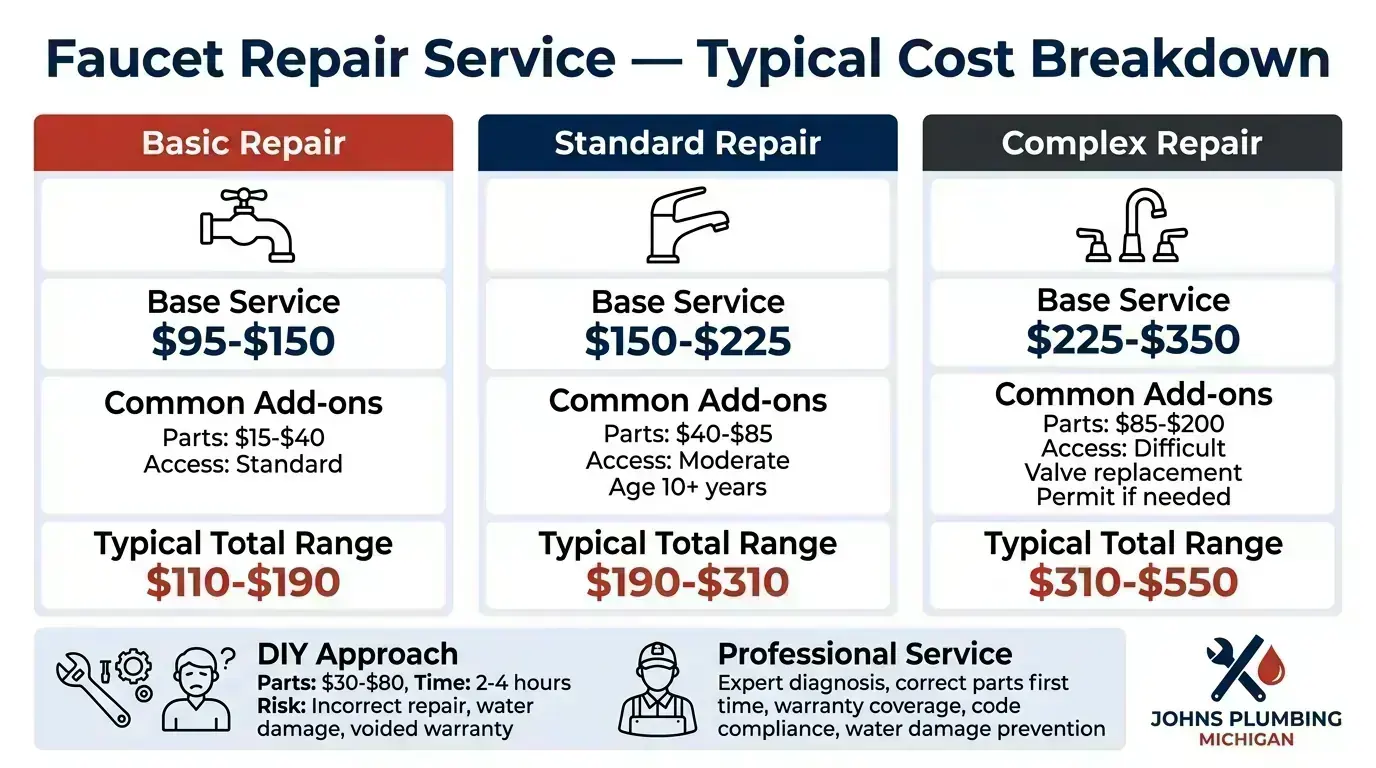
Toilet repairs cost $150-$300 for common issues: flapper replacement, fill valve, or wax ring reseal. Toilet installation runs $250-$500 including disposal of the old unit. Faucet repair (cartridge or washer replacement) costs $150-$300; new faucet installation runs $200-$450 depending on fixture quality and whether supply line replacement is needed.

Garbage disposal installation costs $250-$450 for standard units, more if electrical circuits need upgrading. Sump pump installation runs $500-$1,200 depending on pump type (pedestal versus submersible), basin excavation needs, and whether battery backup is added (recommended in Flint for spring snowmelt reliability).

Emergency and After-Hours Pricing

Emergency service outside business hours (weekdays after 5pm, weekends, holidays) adds 50-100% to standard rates. A $150 daytime service call becomes $225-$300 after hours. Hourly labor rates jump from $75-$100 to $125-$170.

Burst pipes, sewage backups, gas leaks, and no-water situations in winter justify the premium. Property damage from waiting costs far more.

We provide upfront pricing before starting emergency work. You'll see the after-hours premium clearly itemized so there's no confusion when the water's shut off and the problem needs fixing now.

Flint Cost Factors

Genesee County permit requirements add $50-$150 to jobs requiring permits (water heaters, gas line work, main line repairs). Many Flint homes built 1920s-1960s have plumbing access challenges (tight crawl spaces, finished basements covering pipes, or cast iron stacks embedded in walls) that increase labor time.

Hard water scaling shortens fixture and water heater lifespans. Clay-heavy soil causes pipe joint movement requiring more frequent sewer line maintenance than newer developments with modern materials.

Winter frozen pipe emergencies cluster January-February when extended cold snaps hit. Spring snowmelt creates sump pump and basement flooding calls March-April. Scheduling non-emergency work during slower months (late fall, early winter before hard freeze) sometimes yields better availability and pricing.

We provide free estimates for scheduled work and written quotes before starting repairs. No hidden fees.

Labor, materials, permits, and disposal charges appear as separate line items you approve before we begin. For financing options on larger projects like water heater replacement or sewer line work, ask when you call.

Call (313) 736-9553 for an accurate estimate based on your specific situation. We'll ask about the problem, your home's age, and accessibility to give you a realistic cost range before the truck rolls.

Cost & Pricing Transparency in Flint, Michigan

Typical price ranges in Flint

Ranges reflect access difficulty, parts, time and whether a permit applies. Select a category below to view costs.

Sink or shower drain cleaning
$150 - $275
Main sewer line cleaning
$350 - $600
Sewer camera inspection
$275 - $400

Service Process & What to Expect in Flint, Michigan

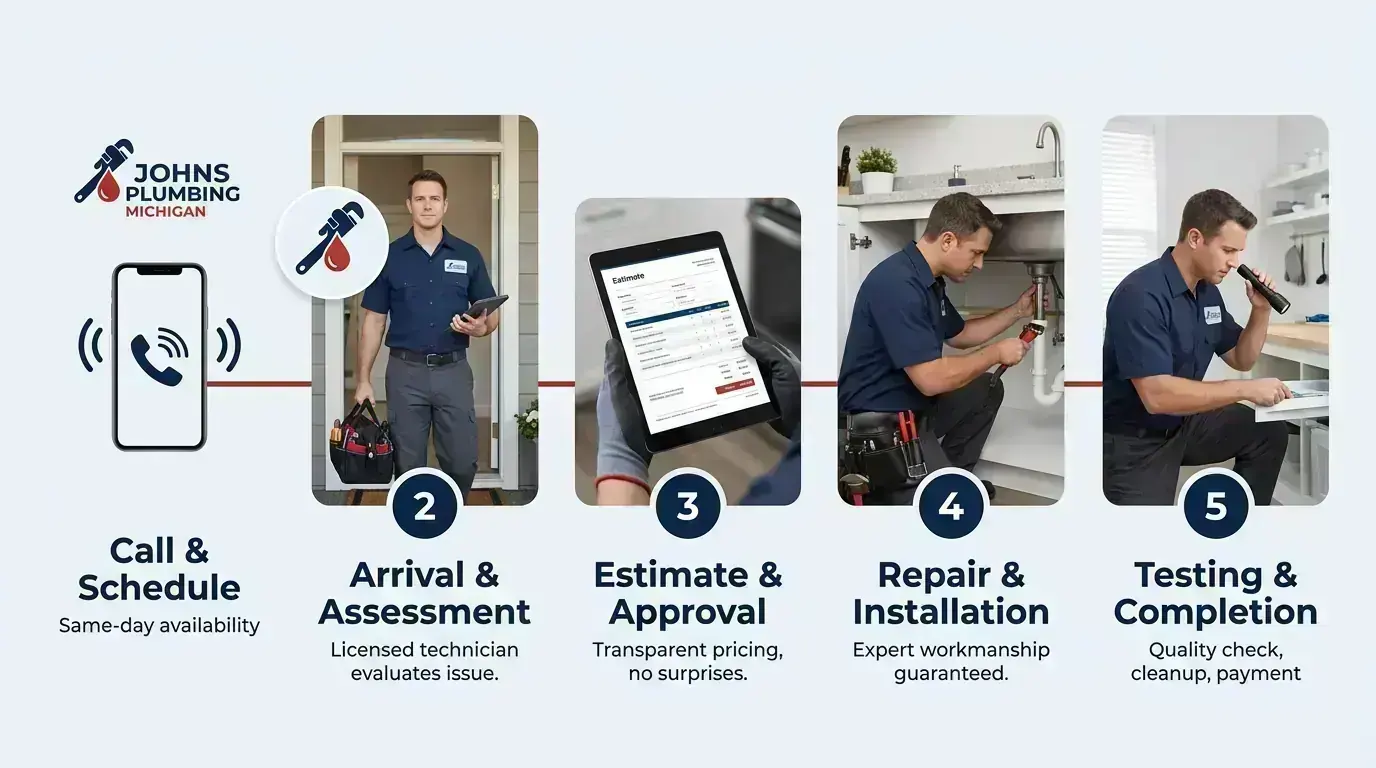
When you contact Johns Plumbing Michigan, you get a transparent service experience from first call through completion. Initial phone assessment determines urgency and sets appointment windows, technicians arrive with diagnostic tools and present written estimates before starting work, property protection measures stay in place throughout the job, and final testing confirms proper function before payment and cleanup.

Service delivery process showing customer call, technician arrival, estimate approval, repair work, and quality verification

Scheduling Your Service

Call (313) 736-9553 anytime for emergency situations or to schedule non-urgent work. During the call, we ask about symptoms you're observing (slow drains, water discoloration, strange noises, visible leaks), when the problem started, and whether you've attempted any temporary fixes. This helps us dispatch the right technician with appropriate equipment.

Emergency calls in Flint typically receive response within 60-90 minutes. Scheduled service offers morning (8am-12pm) or afternoon (12pm-5pm) windows, with confirmation call 30 minutes before arrival. For lead pipe inspection requests or work requiring Genesee County permits, we coordinate timing with city inspection schedules during the booking call.

Technician Arrival and Assessment

Our technician arrives in a marked service van with Michigan license verification available on request. They introduce themselves, confirm the problem description, and ask to see the affected area. For basement work in Flint's older homes, they check access to shutoff valves, water heater, and main drain cleanout locations near the foundation wall where service lines typically enter.

Initial assessment uses visual inspection, pressure testing, acoustic leak detection, or camera inspection depending on the symptom. For frozen pipe situations common in Flint winters, technicians locate freeze points using temperature sensors before attempting thaw procedures. This diagnostic phase takes 15-30 minutes for straightforward issues, up to 60 minutes for hidden leaks or sewer line problems requiring camera insertion.

Written Estimate and Work Approval

Before any repair begins, you receive a written estimate detailing labor hours, parts needed, and total cost. The estimate explains what work addresses the immediate problem versus what constitutes preventive maintenance (example: drain cleaning resolves the backup; replacing corroded trap prevents future leaks). You approve or decline each line item.

For homes with aging cast iron or galvanized pipes, common in Flint's 1920s-1960s housing stock, we identify sections at end-of-life that will fail soon. Estimates separate urgent replacement from work you can schedule later, avoiding pressure while giving honest longevity assessments. No work starts without your signature on the estimate.

During the Repair Work

Technicians lay drop cloths protecting floors from the entry point to the work area. Water gets shut off at the fixture, branch line, or main depending on repair scope. You don't need to stay in the room during work, but we ask someone remain available in the home for questions about pipe routing or fixture preferences.

Drain cleaning produces minimal noise; pipe cutting and fitting assembly are louder but brief. For water heater replacement in basement installations, old units get drained before removal (takes 20-30 minutes).

Sewer line camera work requires accessing the main cleanout, typically in basement floor or exterior foundation wall. We explain each step before it happens and pause work if you have concerns.

Testing and Quality Verification

After repairs complete, technicians test the work before calling it finished. Drain cleaning gets followed by hot water flush to confirm flow.

New fixture installations run through full cycles checking for leaks at connections. Water heater replacements include pressure testing, thermostat calibration, and pilot light verification (gas) or element testing (electric).

For leak repairs and pipe replacements, we pressurize the system and inspect joints for 10-15 minutes before closing walls or covering access points. Sewer line repairs include camera re-inspection showing the fixed section.

You're invited to observe testing. We want you confident the problem is resolved before we leave.

Completion, Cleanup, and Warranty

Work areas get cleaned of debris, old parts, and packing materials before we consider the job complete. Basement floors are swept, and any water from testing gets mopped. Old water heaters, demolished fixtures, and cut pipe sections are loaded for disposal unless you want to keep salvageable parts.

Payment is due upon completion via cash, check, or card. You receive an itemized invoice matching the approved estimate, plus warranty documentation.

Most repairs carry a one-year workmanship guarantee; manufacturer warranties on new fixtures and water heaters vary by brand (typically 6-12 years). For work requiring Genesee County permits, we provide copies of approved permit paperwork and final inspection sign-off.

Follow-Up and Ongoing Support

If problems recur within the warranty period, call (313) 736-9553 for no-charge return service. For questions about operation (new fixture settings, water heater temperature adjustment, shutoff valve location), reach out anytime. We'd rather answer a quick question than have you second-guess the repair.

Seasonal maintenance reminders go out before Flint's freeze season (late October) and spring thaw (late March) suggesting sump pump testing, pipe insulation checks, and water heater flushing. These aren't sales calls. They're genuinely useful timing for the preventive work that keeps emergency calls from happening.

Risk Prevention and Maintenance in Flint, Michigan

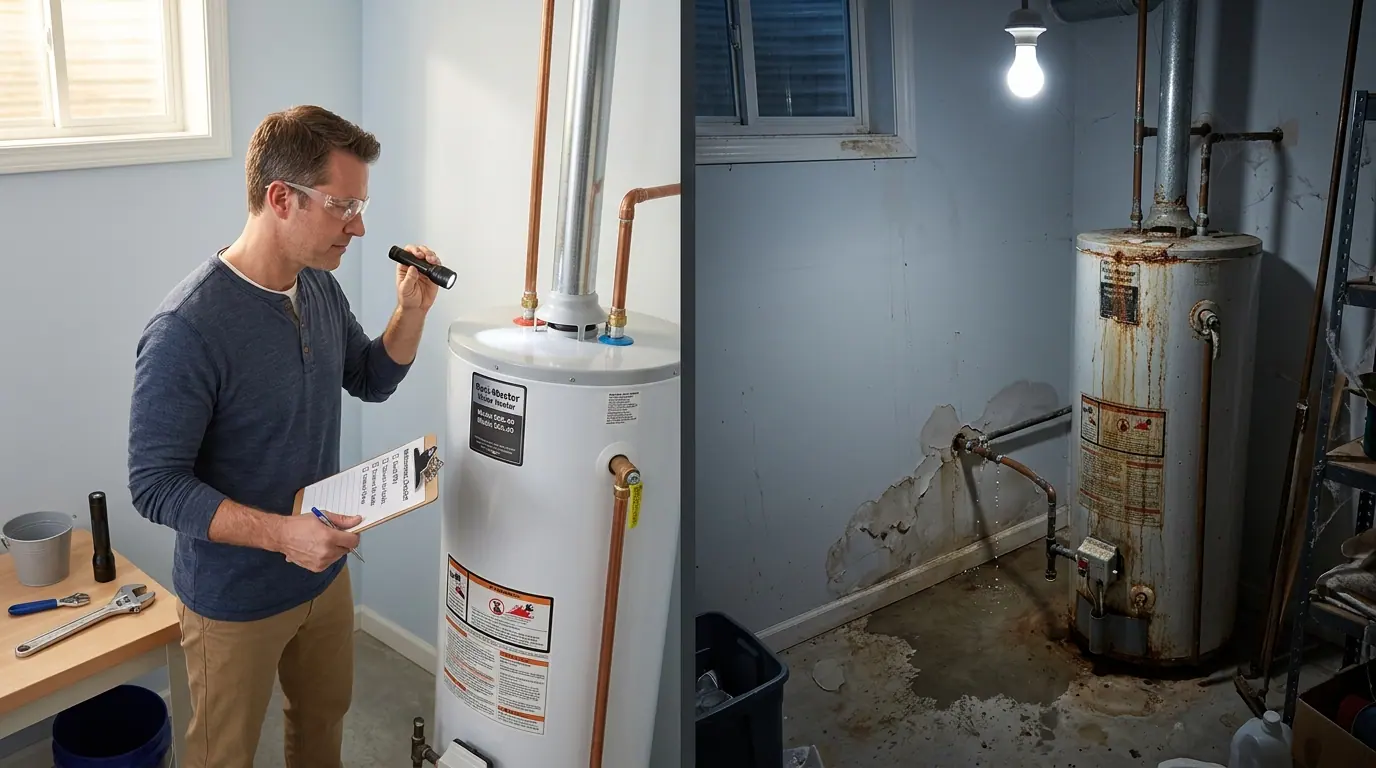
Flint homeowners need proactive plumbing maintenance tied to local environmental conditions: lead pipe monitoring in pre-1986 homes, frozen pipe prevention during Michigan's harsh winters, sump pump testing before spring snowmelt, and water heater flushing to combat hard water sediment buildup. Clay-heavy soil and aging 1920s-1960s infrastructure require regular drain and sewer line maintenance to prevent costly failures.

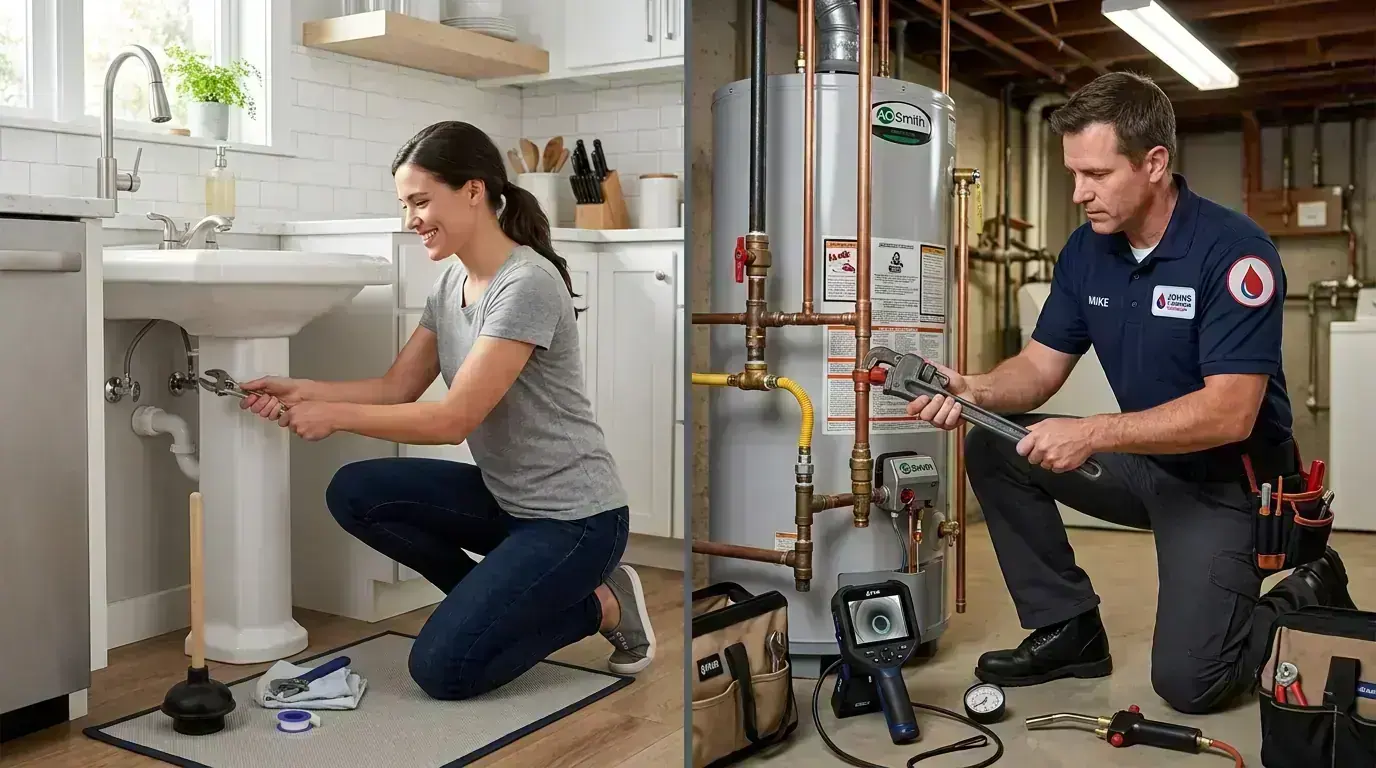
Comparison visual showing homeowner performing preventive maintenance versus consequences of neglect in residential plumbing

Lead Pipe and Water Quality Monitoring

If your home was built before 1986, check for lead solder in copper joints, galvanized steel pipes that trap lead particles, or remaining lead service line segments. Even after 11,000+ service line replacements, interior plumbing may still contain lead. Test water annually through Genesee County Health Department or a certified lab.

Install NSF/ANSI 53-certified filters on drinking water taps and replace cartridges every 3-6 months. Flush pipes for 1-2 minutes after long stagnation periods (overnight, weekends) before using water for drinking or cooking. If selling your home, provide buyers with recent lead test results and documentation of any pipe replacements.

Frozen Pipe Prevention Schedule

Insulate exposed pipes in basements, crawl spaces, garages, and exterior walls before November. Use foam pipe sleeves rated for Michigan's sub-zero temperatures. Seal drafts around plumbing penetrations through foundation walls.

Cold air infiltration accelerates freezing. Disconnect garden hoses and shut off outdoor faucet supply valves by mid-October. Open the drain valve on each outdoor faucet to drain residual water.

During cold snaps (below 20°F sustained), let faucets on exterior walls drip slightly overnight, moving water resists freezing. Keep thermostat at 55°F minimum when traveling in winter. Open cabinet doors under sinks on exterior walls to allow warm air circulation.

Sump Pump Testing and Maintenance

Test your sump pump monthly by pouring 5 gallons of water into the pit. Pump should activate within seconds and clear water in under a minute. Spring snowmelt and summer storms in Flint create hydrostatic pressure that pushes water through foundation walls.

Sump pump failures cause immediate basement flooding. Clean the pit of debris every six months.

Check the discharge line for freezing in winter; install a freeze-proof discharge pipe that drains completely after each cycle. Consider battery backup systems; power outages during storms eliminate sump pump protection exactly when you need it most. Replace pumps every 7-10 years before they fail.

Water Heater Flushing for Hard Water Areas

Flush tank water heaters every 6 months to remove sediment from Flint's mineral-heavy water supply. Calcium and magnesium deposits settle at the bottom of the tank, insulating the heating element and forcing longer heating cycles that waste energy and accelerate corrosion. Shut off power (electric) or gas supply, connect a garden hose to the drain valve, and drain 2-3 gallons into a bucket.

If sediment chunks appear, continue draining until water runs clear. For tankless systems, descale annually using manufacturer-approved flushing kits. Hard water shortens water heater lifespan from 12-15 years down to 8-10 years without regular maintenance.

Seasonal Drain Maintenance

Run hot water through all drains weekly to prevent grease buildup in kitchen lines and soap scum accumulation in bathroom drains. Pour 1/2 cup baking soda followed by 1 cup vinegar down each drain monthly, wait 15 minutes, then flush with hot water, this breaks down organic matter before it hardens into clogs.

Avoid chemical drain cleaners in Flint's older cast iron and galvanized pipes; harsh chemicals accelerate corrosion. Install mesh strainers in all sinks and tubs to catch hair and debris. Schedule professional drain cleaning every 18-24 months to clear accumulation in main lines before it causes backups.

Clay Soil and Sewer Line Inspection

Flint's clay-heavy glacial till expands when saturated and contracts during dry periods, placing lateral pressure on buried sewer lines that cracks joints over time. Sandy pockets underneath pipes allow sagging and bellying. Schedule sewer camera inspection every 5 years for homes built before 1980 with clay tile laterals.

Tree roots from mature maples and willows infiltrate joints seeking moisture. Root intrusion is the leading cause of recurring clogs in Flint's older neighborhoods. Spring and fall hydro jetting removes root tendrils and sediment buildup before they create complete blockages.

Gas Line and Carbon Monoxide Detection

Install carbon monoxide detectors on every floor and near sleeping areas. Test monthly and replace batteries annually. If your water heater, furnace, or stove runs on natural gas, schedule annual inspection of gas connections, pressure regulators, and shutoff valves.

Look for physical signs: hissing sounds near gas lines, dead vegetation along underground runs, or sulfur/rotten egg odor (added odorant). Never ignore gas smell, evacuate immediately, call 911 from outside, then contact your plumber after the gas company secures the line.

For professional plumbing maintenance, annual inspections, or issues beyond DIY prevention, call (313) 736-9553. Our licensed technicians provide preventive service that protects Flint homes from costly emergency repairs.

Service Area Coverage

Johns Plumbing Michigan serves all of Flint and Genesee County, including ZIP codes 48502, 48503, 48504, 48505, 48506, 48507, 48550, 48551, 48552, 48553, 48556, and 48557. Our service radius extends to surrounding communities within 15 miles: Burton (4 miles), Beecher (5 miles), Mount Morris (7 miles), Grand Blanc (8 miles), Swartz Creek (8 miles), Flushing (8 miles), Davison (9 miles), Clio (11 miles), Goodrich (12 miles), Lake Fenton (12 miles), Lennon (12 miles), and Otisville (13 miles).

We maintain response coverage across all Flint neighborhoods, from older housing stock near downtown to newer developments on the city's outskirts. Our technicians know Genesee County's plumbing patterns. Where lead service lines were common, which areas face basement flooding from clay soil, and where frozen pipe emergencies cluster during January-February cold snaps.

Most Flint service calls receive same-day response during business hours. Emergency calls get technicians on-site within 60-90 minutes, even late nights and weekends. Drive time from our service area rarely exceeds 25 minutes to any Flint address.

Serving all of Flint and Genesee County. Call (313) 736-9553 to confirm we cover your specific address and schedule service.

Service Area Coverage in Flint, Michigan

Local Plumbing Challenges in Flint, Michigan

Flint faces three major plumbing challenges: legacy lead contamination from pre-1986 homes, extreme freeze-thaw damage from Michigan winters, and failing infrastructure from 1920s-1960s housing stock. These conditions create recurring problems you won't find in newer Michigan cities.

Over 11,000 lead service lines were replaced by July 2025, but homes built before 1986 may still have lead solder in copper joints or lead particles trapped inside galvanized steel pipes. The 2014 water crisis brought national attention to this problem, but homeowners still need lead testing and pipe inspection, especially when remodeling or experiencing low water pressure that suggests corroded interior lines. Free lead service line replacement remains available through the city for residents with active water accounts.

Flint's housing stock predates modern freeze-protection standards. Homes from the 1920s-1960s often have supply lines running through uninsulated basements, exterior walls, and crawl spaces. When January temperatures drop to -10°F during lake-effect cold snaps, these pipes freeze and burst, flooding basements before you realize the line failed.

Unlike newer developments with PEX piping in insulated chases, older Flint homes have rigid copper or galvanized lines that crack under expansion pressure. Pipes in unheated garages and beneath kitchen sinks against exterior walls freeze first.

Clay-heavy glacial soil surrounding Flint creates two problems. First, clay expands when saturated during spring snowmelt, then contracts during summer dry periods. This cycle cracks pipe joints and bellies sewer laterals over decades.

Second, the same clay traps tree roots near the surface where they infiltrate cracked joints in aging clay tile sewer lines. Homes built before 1960 typically have clay tile laterals that crack naturally after 60-70 years; add root intrusion and you get recurring backups that snaking won't permanently fix. Burton, Beecher, and Mount Morris face similar soil conditions, but Flint's older housing density concentrates the problem.

Dealing with lead pipe concerns, frozen line damage, or aging sewer failures in Flint? Call (313) 736-9553 for inspection and repair solutions built for Genesee County's unique infrastructure challenges.

Local Plumbing Challenges in Flint, Michigan

DIY vs Professional Plumber: When to Call a Flint Plumber

DIY is appropriate for simple, accessible repairs without permits, gas lines, or main water system involvement, but work requiring code compliance, specialized tools, or affecting hidden systems needs licensed professional service to protect your home and insurance coverage in Flint.

Simple DIY-Appropriate Tasks:

Unclogging sink or tub drains with a plunger or hand-crank drain snake is safe when the clog is in the trap or visible drain line. Stop if water backs up in other fixtures, that signals a main line problem beyond DIY scope.

Replacing toilet flappers, fill valves, or flapper chains addresses running toilets wasting water. These parts snap into place without soldering or cutting pipes.

If the tank-to-bowl seal leaks or the toilet rocks on the floor, call a professional. Those repairs require removing the toilet and inspecting the wax ring and flange.

Tightening visible pipe connections under sinks or behind toilets with an adjustable wrench stops minor drips from loose compression fittings. If tightening doesn't work or you see corrosion, the fitting may need replacement, professional work to avoid cross-threading or over-torquing that cracks the pipe.

Professional-Only Scenarios:

Water heater work requires permits in Michigan and involves gas lines (explosion risk), electrical connections (shock hazard), or pressure relief systems (scalding risk). Insurance policies often deny claims for water damage from unlicensed water heater installations. Our licensed technicians handle code-compliant installations and maintain required permits.

Gas line repairs or installations are licensed work under Michigan law. Natural gas leaks create explosion and carbon monoxide hazards. Even small leaks accumulate in enclosed spaces. We pressure-test all gas line work and inspect for leaks using electronic detectors, required safety protocols you can't replicate.

Main water line or sewer line work requires excavation permits, municipal connection approval, and pressure testing. Flint's clay-heavy soil shifts over time, creating stress on buried pipes.

Improper backfill or inadequate compaction causes future settling and pipe sagging. We coordinate with the city, obtain permits, and restore turf and pavement per local requirements.

Re-piping or pipe replacement behind walls requires opening drywall, soldering or PEX connections, pressure testing for leaks, and patching walls. Insurance requires licensed work for coverage. Flint's 1920s-1960s homes often hide knob-and-tube wiring, asbestos insulation, or lead paint behind walls, hazards requiring professional handling.

Decision Framework:

If work requires a permit → call a licensed professional to avoid code violations and inspection failures.

If the job involves gas lines, main water systems, or buried pipes → call a professional for safety and liability protection.

If the repair requires opening walls, floors, or specialized tools (torches, PEX crimpers, sewer cameras) → call a professional for proper execution and code compliance.

If the system affects insurance-covered property (water heater, main lines, sewage systems) → call a professional to protect your coverage and avoid claim denials.

Not sure if your issue is DIY-safe? Call (313) 736-9553 for a free assessment before attempting work that could escalate into emergency repairs or code violations.

DIY vs Professional Plumber in Flint, Michigan

Licensed & Insured Plumber Requirements in Michigan

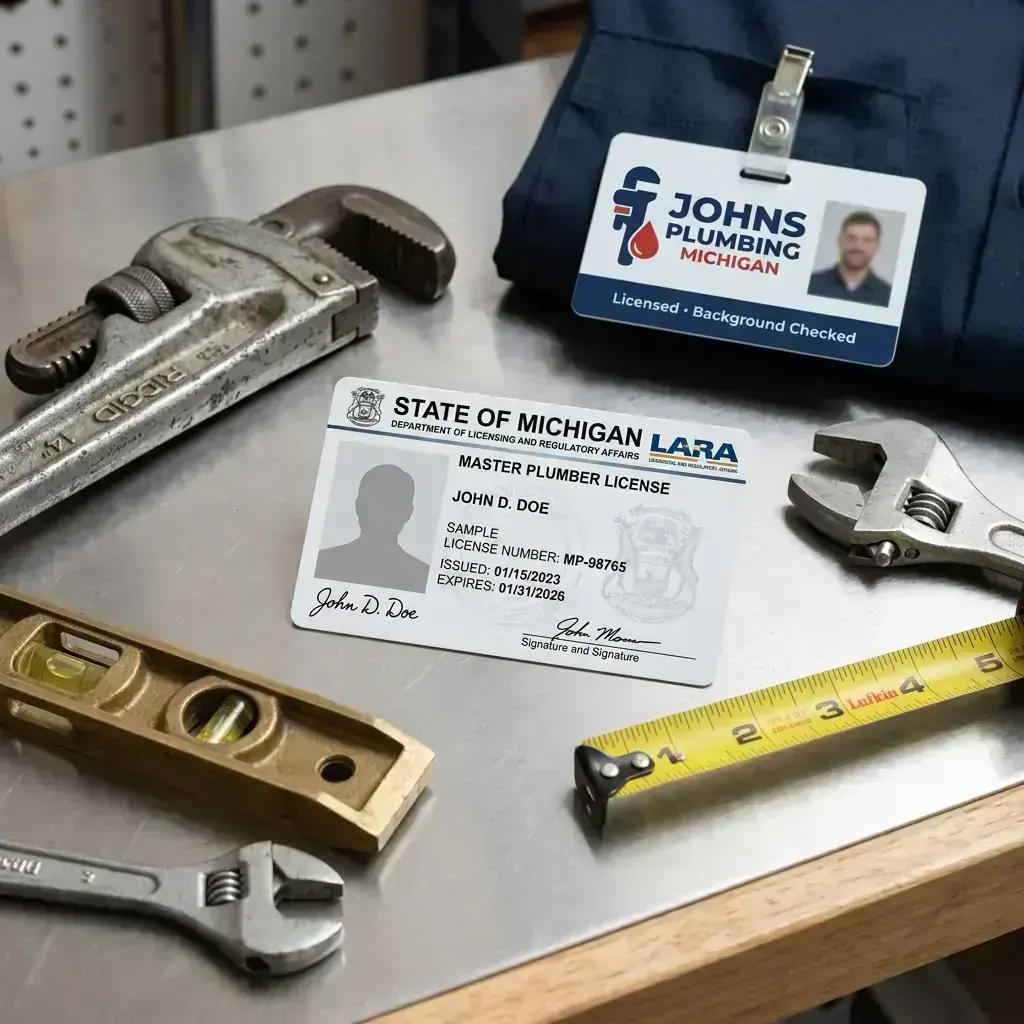
Michigan requires plumbers hold either a Journeyman license (four-year apprenticeship plus state examination) or Master license (two years Journeyman experience plus additional Master examination). The Michigan Department of Licensing and Regulatory Affairs (LARA) issues and regulates these licenses statewide, including all plumbers working in Flint and Genesee County. Before hiring any plumber, verify their credentials through LARA's public license lookup or ask for their license number directly.

Journeyman Plumbers complete a four-year apprenticeship program combining on-the-job training with classroom instruction in Michigan plumbing code, pipe materials, fixture installation, and system design. They pass a state examination demonstrating competency in residential and commercial plumbing. Journeymen work under supervision or independently on most residential repairs and installations.

Master Plumbers hold the highest credential. After working two years as licensed Journeymen, they pass a rigorous Master examination covering advanced system design, code interpretation, and project management.

Only Master Plumbers can pull permits for major work and supervise other plumbers. In Flint, where plumbing work often involves lead pipe inspection, aging cast iron replacement, or sewer line repair requiring permits, Master Plumber oversight ensures code compliance.

Insurance requirements protect you financially. Michigan plumbers must carry general liability insurance covering property damage during work (broken fixtures, water damage from mistakes, access damage to walls or floors).

Workers compensation insurance protects you from liability if a plumber or apprentice gets injured on your property. If an unlicensed handyman gets hurt working on your pipes, you face potential medical cost liability, licensed plumbers eliminate that risk.

Why licensing matters: Flint's housing stock and infrastructure create complex plumbing scenarios requiring professional judgment. Lead service line work, frozen pipe repair in uninsulated crawl spaces, and clay tile sewer replacement all require understanding Michigan plumbing code, proper materials, and safe installation practices. Unlicensed work voids permits, fails inspections, and creates insurance claim problems when failures occur.

Licensed Master Plumber serving Flint. Call (313) 736-9553 to verify our credentials and schedule guaranteed code-compliant work.

Licensed & Insured Plumber Requirements in Flint, Michigan

Nearby Cities We Serve

Johns Plumbing Michigan serves Flint as our home base and covers surrounding Genesee County communities within a 15-mile radius. Burton, Beecher, Mount Morris, Grand Blanc, Swartz Creek, Flushing, Davison, and Clio all receive same-day service. We also reach Goodrich, Lake Fenton, Lennon, and Otisville, typically within 25 minutes of our Flint location.

Whether you're dealing with frozen pipes in Davison or need water heater service in Grand Blanc, our licensed technicians respond to all nearby communities with the same emergency availability and service standards. Call (313) 736-9553 to confirm we cover your area and schedule service.

Nearby Cities We Serve in Flint, Michigan

FAQ

How much does emergency plumbing cost in Flint?

Emergency plumbing in Flint typically costs $110-$800 depending on complexity, with most jobs averaging $324-$466. After-hours, weekend, and holiday service runs $125-$170 per hour, often double or triple standard rates. Simple fixes like toilet repairs cost $150-$500, while major work like water heater replacement or repiping costs more.

Is Flint's water safe to use in 2025?

Yes. Flint's water has met all federal and Michigan safety standards since July 2016, including Michigan's stricter 12 ppb lead limit.

Over 11,000 lead service lines were replaced by July 2025. However, pre-1986 homes may still have lead solder or galvanized pipes that trap lead particles, so continued filter use and periodic testing remain recommended precautions.

What should I do if my pipes freeze?

Shut off your main water supply immediately (usually in the basement near the front foundation wall), open faucets to relieve pressure, and call a licensed plumber. Never use open flames to thaw pipes.

Rapid temperature changes cause bursting. Keep your thermostat at 55°F minimum during cold spells and let faucets drip slightly during extreme cold.

Do you inspect and work on lead pipes in Flint homes?

Yes. Our technicians inspect lead service lines, lead solder in copper joints (common in pre-1986 homes), and galvanized pipes that may trap lead particles.

The city offers free lead service line replacement for residents with active water accounts. We coordinate with the city program and handle interior plumbing lead inspection and remediation.

Where is the main water shutoff in Flint homes?

Most Flint homes have the main shutoff in the basement near the front foundation wall where the service line enters. Some older homes have shutoffs in crawl spaces or exterior meter pits. Locate your shutoff before an emergency. Knowing its location saves critical minutes when a pipe bursts or fixture fails.

How long does a typical plumbing repair take in Flint?

Simple repairs like faucet cartridge replacement or toilet flapper fixes take 30-60 minutes. Drain cleaning runs 1-2 hours depending on clog location. Water heater replacement takes 2-4 hours.

Sewer line camera inspection and cleaning takes 2-3 hours. Emergency frozen pipe thawing and repair varies widely based on access and damage extent. We provide time estimates during initial assessment.

Do I need a permit for plumbing work in Genesee County?

Michigan requires permits for water heater replacement, main water line work, sewer line repair, gas line installation or modification, and any work adding new fixtures. Simple repairs like faucet replacement, toilet repair, or drain cleaning typically don't require permits. Licensed plumbers coordinate permit applications and inspections, never hire unlicensed contractors who skip this step.

Why do so many Flint homes have basement flooding problems?

Flint's clay-heavy soil and spring snowmelt create hydrostatic pressure that forces water through foundation walls and floor drains. Sump pump failures during heavy rain cause immediate flooding.

Many Flint homes were built on low-lying lots near the Flint River watershed. Regular sump pump testing, battery backup systems, and backwater valve installation prevent most flooding incidents.

Questions not answered here? Call (313) 736-9553 for specific guidance on your Flint plumbing situation.

Johns Plumbing Michigan has served Flint homeowners with Michigan-licensed residential plumbing services available 24/7. From emergency frozen pipe repair to routine water heater maintenance, our experienced technicians respond throughout Genesee County and typically arrive within 60-90 minutes for urgent calls. Call (313) 736-9553 now to schedule service or get immediate emergency help. We're ready to solve any plumbing issue in Flint, Michigan.

Call (313) 736-9553 · Flint