Detroit Plumber | Licensed Residential Plumbing Services
Johns Plumbing Michigan provides licensed residential plumbing services throughout Detroit and Wayne County.
Michigan-licensed and fully insured, we serve all Detroit ZIP codes with 24/7 emergency response for burst pipes, sewage backups, frozen pipe thawing, and major leaks common in Detroit's aging housing stock. Call (313) 736-9553 anytime for same-day service. We're available day or night, including weekends and holidays.
Michigan licensed Master Plumber serving Detroit. Fully insured with liability and workers' compensation coverage. Available 24/7 for emergency service throughout Wayne County with typical response within 60-90 minutes. All work backed by our workmanship guarantee.
Residential Plumbing Services in Detroit
Johns Plumbing Michigan provides 24/7 emergency plumbing and scheduled residential services throughout Detroit, Wayne County. Our licensed technicians handle everything from burst pipe emergencies and water heater failures to drain cleaning, fixture repairs, and sewer line services for homeowners across Detroit's neighborhoods.
Detroit's aging housing stock, much of it built before 1980, presents unique challenges. Homes with original galvanized steel or cast iron plumbing systems often experience low water pressure, rust-colored water, and recurring leaks as pipes corrode after 40-80 years. We work extensively with these older systems, whether you need targeted repairs, leak detection in hidden pipes, or complete re-piping to modern materials.
Spring thaw and heavy rainfall frequently overwhelm Detroit's combined sewer system, pushing water and sewage back through basement floor drains. Our emergency response includes sewage backup cleanup, sewer line camera inspection, and solutions to prevent future basement flooding.
Winter brings frozen pipe risks throughout the metro. Exposed pipes in crawl spaces, exterior walls, and unheated garages regularly freeze during December through February cold snaps. We offer pipe winterization before freezing weather, emergency frozen pipe thawing when you've lost water, and burst pipe repair when freezing causes line failure. Hard water from the Great Lakes accelerates mineral buildup in water heaters and pipes, reducing equipment lifespan.
We flush water heaters to remove sediment, repair or replace units affected by scaling, and recommend water treatment where warranted. Tree root intrusion into aging clay or cast iron sewer lines creates blockages requiring hydro jetting or trenchless repair, common in established neighborhoods with mature trees. We also coordinate with Detroit Water and Sewerage Department's lead service line replacement program, assisting homeowners who need interior plumbing upgrades to connect to new copper lines.
Emergency Plumbing Services in Detroit, Michigan
Johns Plumbing Michigan provides 24/7 emergency plumbing response throughout Detroit and Wayne County, typically arriving within 60-90 minutes of your call. We handle burst pipes, sewage backups, gas leaks, flooded basements, water heater failures, frozen pipe thawing, and major leaks any time, day, night, weekends, or holidays.
A burst pipe spraying water across your basement requires immediate shutoff and repair to prevent structural damage and mold growth. Sewage backing up through floor drains or toilets, common in Detroit's older combined sewer system during heavy rain or spring thaw, creates health hazards and requires urgent clearing before contamination spreads. If you smell gas (a sulfur or rotten-egg odor near appliances or lines), evacuate immediately, call 911 from outside, then contact us for emergency gas line shutoff and repair.
Frozen pipes are a regular January-February crisis in Detroit when temperatures drop below 20°F for extended periods. Exposed pipes in crawl spaces, exterior walls, or unheated basements freeze and often burst once they thaw, flooding entire floors. We provide emergency pipe thawing before rupture occurs and 24-hour burst pipe repair when prevention fails.
No hot water during Michigan winters isn't just inconvenient. It's a safety issue, especially for homes with children or elderly residents. We diagnose and repair water heater failures immediately, whether it's a pilot light issue, thermostat failure, or tank leak requiring replacement.
Call immediately if you experience multiple fixtures backing up simultaneously (signals main sewer line blockage), water pooling around your water heater, visible water spraying from pipes or fixtures, sewage odor inside your home, or complete loss of water pressure. These scenarios escalate rapidly. Waiting until morning or Monday often triples damage costs.
We serve all Detroit ZIP codes including downtown 48226, Midtown 48201, and neighborhoods across the city with the same rapid emergency response. Our trucks carry diagnostic equipment, replacement parts, and repair materials to resolve most emergencies on the first visit without follow-up appointments.
Call (313) 736-9553 now for 24/7 emergency plumbing service in Detroit. We answer every call personally, no answering service delays when you're dealing with flooding or sewage backup.
How fast do you need someone?
Check all situations that apply in your Detroit home. We'll determine the fastest, most appropriate response.
Johns Plumbing Michigan handles the complete spectrum of residential plumbing work throughout Detroit, from routine fixture repairs to complex system replacements. We specialize in the challenges unique to Detroit's housing stock, aging galvanized pipes, deteriorating cast iron drains, and infrastructure built decades before modern plumbing codes.
Our service range reflects the real plumbing demands Detroit homeowners face. Drain cleaning and clog removal addresses everything from slow kitchen sinks to main sewer line blockages caused by tree root intrusion in established neighborhoods.
Water heater repair and replacement covers tank and tankless systems, with special attention to hard water damage common in Great Lakes homes. Leak detection and pipe repair uses acoustic and thermal imaging to find hidden leaks behind walls and under slabs, then repairs or replaces corroded galvanized steel and cast iron sections.
Sewer line services include camera inspection, hydro jetting, and trenchless replacement for Detroit's aging combined sewer systems that often suffer from root intrusion and pipe deterioration. Fixture installation and repair keeps toilets, faucets, garbage disposals, and sump pumps functioning reliably, critical during spring basement flooding season. Gas line services handle installation for appliances, leak detection, and pressure testing to Michigan code standards.
We group our work into emergency response (burst pipes, sewage backups, no heat in winter) and scheduled maintenance (preventive inspections, system upgrades, seasonal winterization). This systems-level approach helps homeowners understand how drain problems often connect to main line issues, or how water heater age affects leak risk in older homes.
See detailed service information below for specific coverage of each plumbing system, including micro sub-services, symptom recognition, and when to schedule service versus calling immediately.
Complete Plumbing Service Guide for Detroit Homeowners
Johns Plumbing Michigan provides comprehensive residential plumbing services throughout Detroit, covering emergency repairs, routine maintenance, and full system installations across drain and sewer systems, water heaters, leak detection, pipe repair, fixtures, and gas lines. The service coverage below details methods, decision factors, and Detroit-specific considerations for each major plumbing system in your home.
Drain Cleaning & Clog Removal Services in Detroit
Detroit homeowners need drain cleaning when individual fixtures drain slowly, multiple drains back up simultaneously, or foul odors emerge from drains, signals ranging from simple clogs to main line blockages. Kitchen sink drains accumulate grease and food debris over time, bathroom sinks collect hair and soap buildup, and shower drains trap hair and mineral deposits from Detroit's hard water. Toilet clogs usually involve foreign objects or excessive paper, while floor drains in basements can back up during spring flooding when the city's combined sewer system overwhelms.
We use cable snaking for standard clogs in individual fixtures, a rotating metal cable breaks through blockages in sink traps, tub drains, and toilet traps. Hydro jetting addresses more stubborn problems: high-pressure water (3,000+ PSI) scours pipe interiors clean, removing grease buildup, mineral scale from hard water, and tree roots that invade cracked joints in older clay or cast iron sewer lines common in pre-1980 Detroit neighborhoods.
Video camera inspection reveals exactly what's blocking the line. We feed a waterproof camera through the drain to see root intrusion, pipe collapse, or offset joints that require repair rather than just cleaning.
When multiple drains clog simultaneously or water backs up in basement floor drains during heavy rain, the problem sits in your main sewer line, not individual fixtures. Tree roots from mature maples and oaks infiltrate cracked joints in aging cast iron or clay sewer pipes, creating blockages that worsen over time.
Cast iron pipes installed 60-80 years ago corrode from the inside, developing rough surfaces that catch debris and accelerate clog formation. These conditions require hydro jetting to clear roots and scale, often followed by camera inspection to assess whether the pipe needs repair or replacement.
Simple fixture clogs respond to cable snaking in 30-60 minutes. Main line cleaning with hydro jetting takes 2-4 hours depending on blockage severity and line length. If camera inspection after cleaning reveals structural damage (cracks, root intrusion points, or corroded sections) we discuss repair options: traditional excavation to replace damaged sections or trenchless methods like pipe lining that avoid tearing up your yard.
Water Heater Repair & Replacement Services
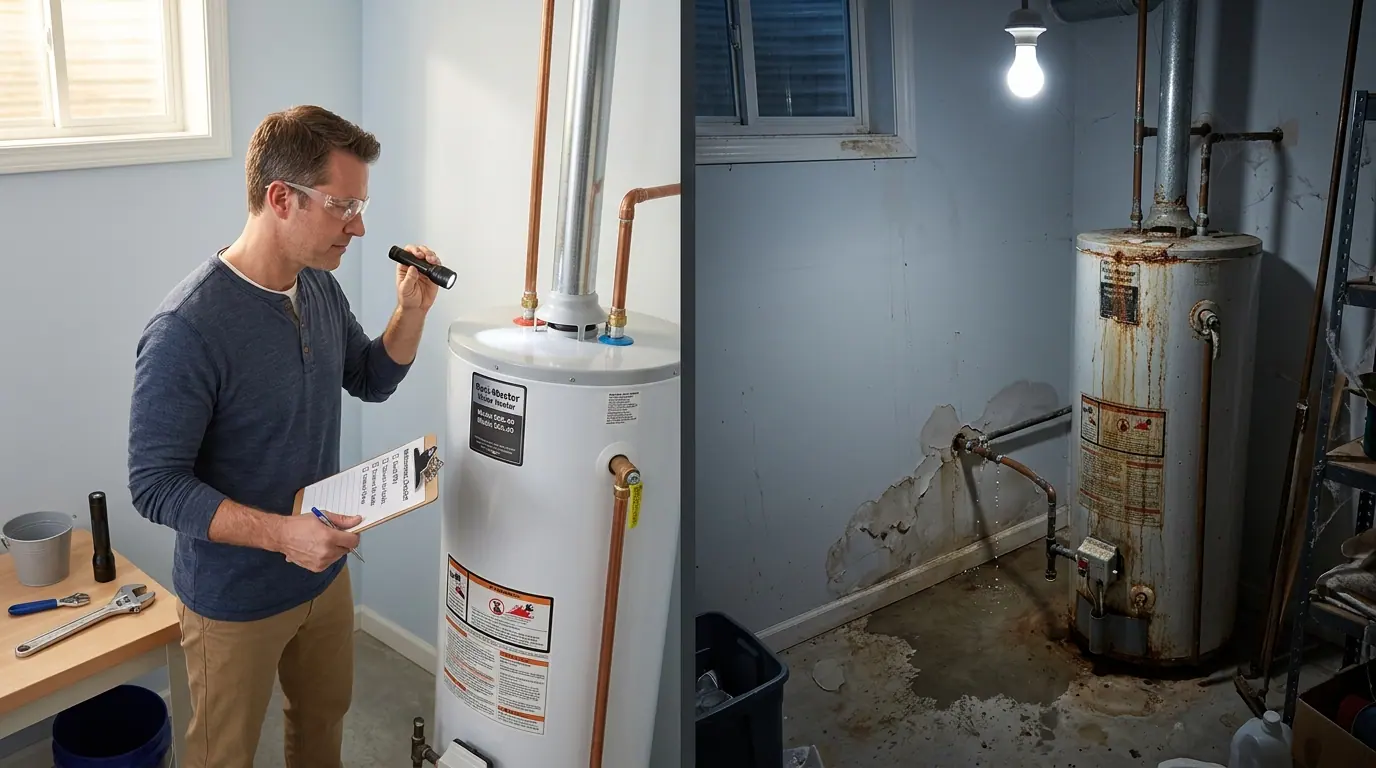
Water heater service becomes necessary when units reach 8-12 years old, when you experience no hot water or insufficient hot water, when the tank leaks, or when strange noises (banging, popping, hissing) indicate sediment buildup. Detroit's hard water accelerates mineral accumulation inside tanks, reducing efficiency and shortening lifespan. Units here often fail earlier than the manufacturer's rated lifespan suggests.
Tank water heater repair addresses pilot light issues (won't stay lit due to faulty thermocouple), thermostat problems (water too hot or not hot enough), and relief valve leaks. Anode rod replacement extends tank life by 2-3 years when caught early. The sacrificial metal rod prevents tank corrosion but dissolves over time, especially in hard water conditions.
We also flush tanks to remove sediment that causes banging noises and reduces heating efficiency. However, once a tank leaks from the bottom or sidewall, replacement is the only option, tank failures aren't repairable because the inner lining has corroded through.
Tankless water heater installation provides endless hot water and saves space in Detroit's often-cramped basements, but requires adequate gas line capacity or electrical service upgrades. Tankless units cost more upfront ($1,800-$3,500 installed versus $800-$1,500 for tank units) but last 20+ years and reduce energy costs by 20-30% since they don't maintain a 40-50 gallon reservoir at temperature 24/7. For Detroit homes built before 1980 with undersized gas lines, tankless installation may require gas line upgrades, a factor we assess during the estimate.
The repair-versus-replace decision hinges on three factors: unit age, repair cost, and efficiency. If your tank water heater is under 8 years old and needs a $200-400 repair, repairing makes sense.
If the unit is 10+ years old and needs a $400+ repair, replacement saves money long-term because older tanks nearing end-of-life often develop multiple problems in quick succession. Tankless units rarely need repairs before year 10 but require annual descaling in hard water areas to prevent mineral buildup in the heat exchanger.
Sizing matters for replacement units. A household with 1-2 people manages fine with a 30-40 gallon tank or a single tankless unit rated for 6-7 gallons per minute. Families with 3-4 people need 50 gallon tanks or 8-9 GPM tankless capacity.
For homes with 5+ occupants or multiple bathrooms running simultaneously, 75-gallon tanks or dual tankless units prevent running out of hot water during morning showers. Need water heater service in Detroit? Call (313) 736-9553 for sizing consultation and same-day installation.
Leak Detection & Pipe Repair Services
Leak detection services locate hidden leaks when you notice unexplained water bill increases (20%+ over typical usage), hear running water when all fixtures are off, see wet spots on walls or ceilings, find mold growth in unexpected areas, or experience low water pressure throughout the house. Detroit's freeze-thaw cycles stress older pipes. Copper pipes develop pinhole leaks after 40-50 years, galvanized steel pipes corrode internally after 50-60 years, and PEX or PVC pipes can crack if exposed to freezing temperatures in crawl spaces or exterior walls.
We start with visual inspection of accessible pipes in basements, crawl spaces, and under sinks. For hidden leaks behind walls or under concrete slabs, acoustic leak detection uses sensitive microphones to hear water escaping under pressure. Leaks produce distinct sounds that guide us to the source.
Thermal imaging cameras detect temperature differences caused by water seeping through walls or pooling under slabs, showing up as cold spots on the thermal image. For slab leaks under concrete basement floors common in Detroit ranch homes from the 1950s-1970s, these non-invasive methods pinpoint the leak location before we break concrete.
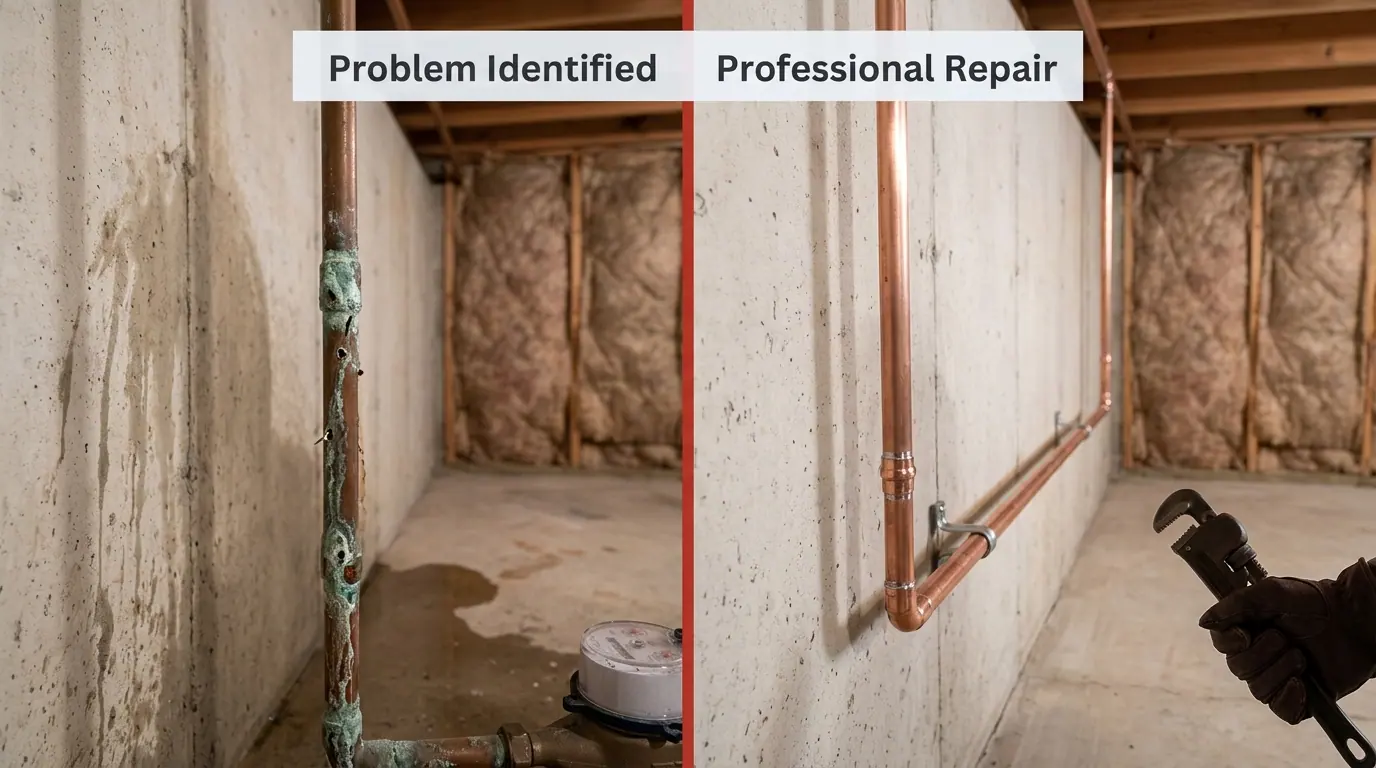
Pipe repair techniques depend on leak severity and location. Small pinhole leaks in accessible copper pipes get patched with repair clamps or epoxy sleeves, a permanent fix that takes 30-60 minutes. Larger leaks or corroded sections require cutting out the damaged pipe and soldering in new copper pipe, which takes 2-4 hours depending on access.
Epoxy pipe lining seals pinhole leaks throughout a pipe run without demolition. We clean and dry the interior, then coat it with epoxy that hardens into a new inner pipe surface. This works well for multiple pinhole leaks in copper or galvanized pipes but costs more than spot repairs ($80-150 per linear foot versus $200-400 for a single patch).
When water bill history shows steady increases, multiple leaks appear, or pipes are 60+ years old with widespread corrosion, re-piping (replacing all supply lines) makes more sense than chasing individual leaks. Detroit homes with original galvanized steel pipes, common in houses built 1920s-1960s, eventually need re-piping because galvanized corrodes from inside out, narrowing the pipe diameter and reducing water pressure while rust particles discolor water.
Partial re-piping (replacing exposed basement pipes and risers to second floor) costs $1,500-3,500, while whole-house re-piping runs $3,500-8,000 depending on home size and wall access. Main water line leaks from the street to your house require excavation unless the line runs under concrete, where we use trenchless pipe bursting to replace it without tearing up driveways or landscaping.
Frozen pipe repair becomes urgent during Detroit's December-February cold snaps. Pipes freeze when temperatures drop below 20°F for extended periods, especially in unheated crawl spaces, exterior walls, or uninsulated basements.
We thaw frozen pipes with electric heat tape or warm air (never open flame, that can burst pipes). If the pipe already burst, we shut off water at the main, drain the system, cut out the damaged section, and install new pipe, emergency work typically completed within 3-4 hours to prevent flooding and water damage.
Sewer Line Services
Sewer line problems reveal themselves when multiple drains back up at once, toilets gurgle when you run the washing machine, sewage odors emerge from drains or yard, water backs up in basement floor drains, or you see soggy patches in the yard above the sewer line route. These symptoms point to main sewer line blockages or damage, not individual fixture clogs.
Sewer camera inspection is the diagnostic starting point. We insert a waterproof camera on a flexible cable through a cleanout or toilet, feeding it through your sewer line to the municipal connection point typically located at the property line or street.
The camera reveals tree root intrusion (roots enter through cracked joints or separations), pipe collapse (sections that have crushed or dropped), bellied sections (sagging pipe that collects waste and causes recurring backups), offset joints (pipe sections that have separated), and corrosion or cracks in cast iron or clay pipes. Inspection takes 30-60 minutes and produces a video recording showing exactly what's wrong and where.
Sewer line cleaning with hydro jetting removes tree roots, grease buildup, and scale that narrow the pipe. The high-pressure water stream (3,000-4,000 PSI) cuts through roots and scours pipe walls clean, far more effective than cable snaking for main lines.
Roots from Detroit's mature trees (maples, oaks, elms) aggressively seek moisture and nutrients in sewer lines, infiltrating any crack or joint separation in clay or cast iron pipes common in pre-1980 construction. Hydro jetting clears roots completely, but if the camera shows significant cracks or separations where roots entered, they'll return within 1-2 years without pipe repair.
Repair methods split into traditional excavation and trenchless techniques. Excavation involves digging a trench above the damaged pipe section (typically 3-8 feet deep), removing the damaged portion, and installing new PVC pipe. The permanent solution but requires tearing up landscaping, driveways, or sidewalks. Costs run $3,000-8,000 depending on depth, length, and surface restoration needs.
Trenchless pipe lining inserts an epoxy-coated liner through the existing pipe, inflates it against the pipe walls, and cures it to form a new pipe-within-a-pipe, no digging required except at access points. Lining costs $80-250 per linear foot and works well when the existing pipe hasn't collapsed. Pipe bursting splits the old pipe while simultaneously pulling new pipe through, slightly more expensive than lining but handles collapsed sections that lining can't.
The main sewer line runs from your house to the city connection point at the property line or street. Homeowners own and maintain the line up to that connection, the city maintains the municipal main beyond. If roots or damage sit on your side of the connection, you're responsible for repairs. Many Detroit homeowners discover this after sewage backs up and assume the city will fix it, only to learn the problem lies in their private lateral line.
Understanding where the connection sits prevents confusion and helps you plan for eventual sewer line replacement. Cast iron and clay lines typically last 50-80 years before needing replacement. Dealing with sewer line problems in Detroit? Call (313) 736-9553 for camera inspection and repair options.
Fixture Installation & Repair Services
Fixture services cover toilets, faucets, sinks, garbage disposals, bathtubs, showers, and sump pumps, the components homeowners interact with daily. Toilets require repair when they run continuously (wasting 200+ gallons per day), won't flush completely, leak at the base, or constantly refill. Running toilets usually need flapper replacement ($15 part, 20 minutes to replace) or fill valve adjustment.
Leaks at the base mean the wax ring seal has failed, a $150-250 repair requiring toilet removal, new wax ring installation, and re-seating. Toilets that won't flush despite plunging need auger snaking to clear clogs in the trap or drain line.
Toilet replacement makes sense when repairs exceed $200-300, when the porcelain cracks, or when you want water efficiency upgrades. Modern low-flow toilets (1.28 gallons per flush versus 3.5-7 gallons for pre-1990s models) cut water bills significantly in Detroit where water rates run high. Installation takes 2-3 hours and costs $300-600 including the fixture.
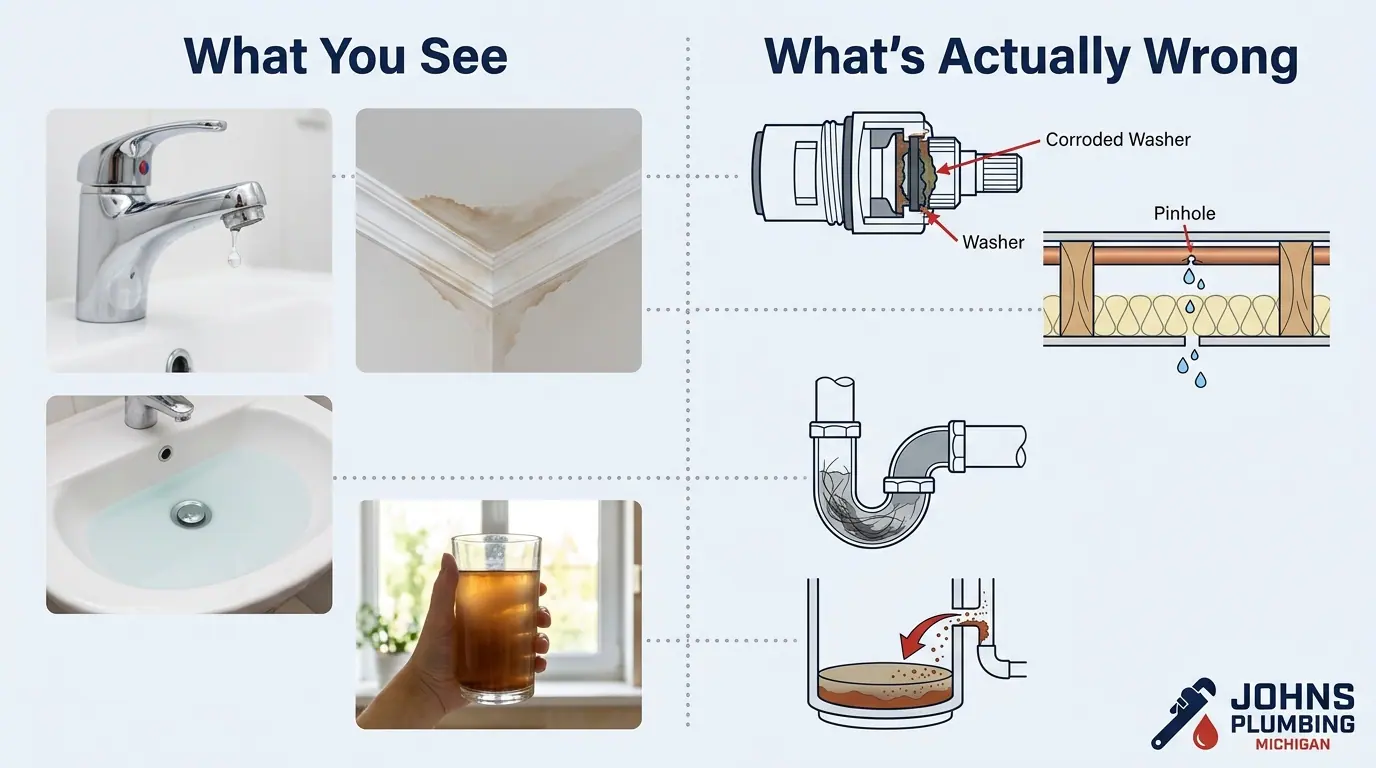
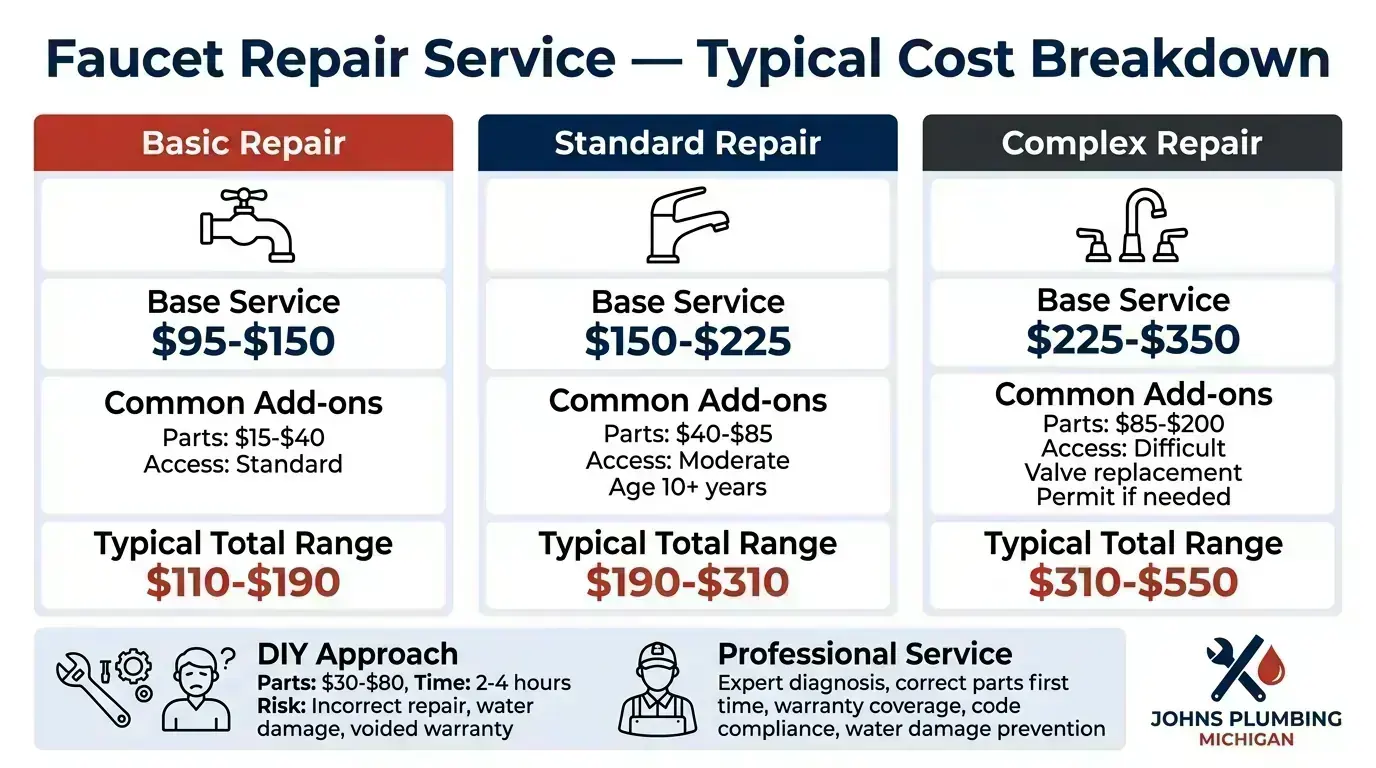
Faucet repair addresses drips (worn washers or cartridges), low water pressure (aerator clogs from hard water mineral buildup), and handle issues (stripped stems). Cartridge replacement fixes most drips for $150-250.
However, faucets older than 15 years often develop multiple problems (corroded internal parts, finish degradation, mounting looseness) making replacement more cost-effective than serial repairs. Faucet installation (including supply line connection and drain assembly) takes 1-2 hours and costs $200-450 depending on fixture complexity.
Garbage disposals jam from foreign objects, fail due to motor burnout, or leak at mounting connections. Jams get cleared by turning the disposal manually with an Allen wrench inserted in the bottom reset hole, often resolves in 10 minutes. Leaking disposals need gasket replacement at the sink mounting or dishwasher connection.
Motor failures require replacement, disposals aren't repairable once motors burn out. Replacement costs $250-450 installed and takes 1-2 hours.
Sump pump installation and repair matters critically in Detroit where basement flooding occurs during spring thaw and heavy rain events that overwhelm the combined sewer system. Sump pumps sit in basement floor pits and pump groundwater out before it floods your basement. Battery backup systems keep pumps running during power outages, essential since storms that cause flooding often knock out power.
We install primary pumps, battery backup pumps, and recommend annual testing before spring thaw season. Sump pump failures during flooding events require emergency service. Pumps typically fail due to stuck float switches, clogged discharge lines, or motor burnout after running continuously during major rain events.
Gas Line Services
Gas line work requires licensed plumbers with gas certification, Michigan law prohibits unlicensed work on gas systems due to explosion and carbon monoxide risks. We install gas lines for water heaters, furnaces, dryers, ranges, and fireplaces. We detect and repair gas leaks.
We pressure test systems after installation or when leaks are suspected. We replace corroded or damaged gas lines.
Gas leak detection starts when you smell natural gas (rotten egg odor from added mercaptan), hear hissing near gas lines, notice dead vegetation along underground gas line routes, or experience physical symptoms like nausea, headaches, or dizziness. If you smell gas, evacuate immediately, don't flip light switches or create sparks, call 911 from outside, then call (313) 736-9553 after the fire department clears the area. We use electronic gas detectors to pinpoint leak sources (connections, valve stems, corroded pipe sections) then shut off gas and repair the leak before restoring service.
Gas line installation for new appliances involves running black iron pipe from the meter or existing gas line to the appliance location, sizing pipe diameter correctly for BTU demand, installing shutoff valves, pressure testing the system to Michigan code requirements (holding 15 PSI for 15 minutes with zero pressure drop), and obtaining city inspection approval. Water heaters require ½-inch lines, dryers need ½-inch lines, ranges typically use ½-inch or ¾-inch depending on BTU output, and fireplaces vary by model.
Undersized gas lines cause appliances to underperform. Tankless water heaters are especially sensitive and won't heat water properly if the gas line can't deliver adequate volume.
Gas line pressure testing ensures leak-free installation. We cap all outlets, pressurize the system to 15 PSI using compressed air or nitrogen (never oxygen), monitor pressure with a gauge for 15+ minutes, and verify zero pressure drop.
Any pressure drop indicates a leak somewhere in the system (connections, joints, or pipe cracks) that must be located and repaired before the system passes inspection. Detroit requires permits and inspections for gas line work, ensuring safety standards are met.
Safety protocols for gas work include shutting off gas at the meter before any work begins, purging lines after installation to remove air before lighting pilots, checking all connections with soap solution to detect tiny leaks that electronic detectors might miss, and ensuring proper ventilation around gas appliances. Carbon monoxide detectors should be installed near gas appliances, faulty venting or incomplete combustion produces odorless, deadly carbon monoxide. We recommend annual gas line inspections for homes with systems 15+ years old or with corroded pipes visible in basements.
Repair or Replace? Decision Framework for Detroit
Honest guidance based on equipment age, repair cost, and expected remaining life. We recommend what makes sense for you, not what maximizes our invoice.
Tank Water HeaterLifespan: 10-12 years
When repair makes sense
Age < 8 years and repair < $500
When replacement is better
Age 10+ years, or repair > $600, or multiple issues
Replacement benefits
New units: 15-20% energy savings, warranty coverage, avoid emergency breakdown
Michigan local context
Hard water in Michigan shortens tank lifespan—flush annually
Tankless Water HeaterLifespan: 15-20 years
When repair makes sense
Age < 12 years and single component failure
When replacement is better
Age 15+ years, or heat exchanger failure (typically $800-$1,200)
Symptom Diagnosis & Problem Recognition in Detroit, Michigan
Several observable symptoms indicate underlying plumbing problems requiring professional evaluation. Water pressure changes, persistent slow drains, unusual noises, water discoloration, and unexplained moisture are the most common warning signs homeowners encounter. Recognizing these symptoms early and understanding their urgency level helps Detroit homeowners prevent minor issues from becoming costly emergencies, particularly important given the city's aging infrastructure, where galvanized pipes and cast iron drains often fail without obvious advance warning.
Water Pressure Problems
Sudden loss of water pressure throughout your home usually signals a main line issue, either a break in the service line between the street and your house, or a pressure regulator failure. Detroit homes built before 1980 often have galvanized steel service lines that corrode internally over 40-50 years, narrowing the pipe opening and choking water flow.
If only one fixture has low pressure, the cause is typically a clogged aerator or cartridge in that specific faucet. When cold water pressure is fine but hot water pressure drops significantly, your water heater's inlet valve or dip tube has likely failed.
Pressure problems in multiple fixtures suggest either corroded galvanized pipes restricting flow throughout your home's plumbing system, or a municipal water pressure issue affecting your block. Check with neighbors to rule out citywide problems before assuming it's your system. If it's isolated to your home and affects both hot and cold water, professional leak detection and pipe inspection will identify whether corrosion, mineral buildup, or hidden leaks are draining pressure.
Call (313) 736-9553 immediately if water pressure drops suddenly across the whole house, this often precedes a main line failure or major leak causing property damage.
Drainage Issues
A single slow drain is usually a localized clog in that fixture's trap or branch line, hair, soap buildup, or food debris blocking the pipe. Multiple slow drains throughout your home indicate a main drain line or sewer line blockage, often caused by tree root intrusion in Detroit's older neighborhoods with mature landscaping. Gurgling sounds when water drains suggest air is trapped in the line due to a partial blockage or vent stack problem disrupting proper drainage air pressure balance.
Water backing up in one fixture when you use another, such as toilet water rising when you run the washing machine, means your main drain line is partially blocked and can't handle normal flow volume. This progressively worsens as debris accumulates.
In Detroit homes with cast iron drain pipes (common in construction before 1980), interior pipe corrosion creates rough surfaces that catch debris and accelerate clog formation. If left unaddressed, main line clogs eventually cause sewage backups through basement floor drains during heavy use or rainfall when the municipal combined sewer system is stressed.
Schedule professional drain cleaning within 48 hours if multiple drains are slow or you hear gurgling. These symptoms indicate blockages that DIY methods rarely resolve completely.
Water Quality Symptoms
Brown or rust-colored water from your taps indicates corroded galvanized steel pipes shedding iron oxide scale into your water supply. This is extremely common in Detroit homes built before the 1970s that still have original galvanized plumbing. The corrosion accelerates once the protective zinc coating inside pipes wears away after 40-50 years.
Rusty water isn't immediately dangerous but signals pipes are failing. Pinhole leaks and pipe bursts typically follow within a few years as metal deteriorates.
Cloudy or milky-white water that clears after sitting usually means dissolved air in the lines (harmless), but persistent cloudiness can indicate sediment from a failing water heater or corroded pipes. Blue or green water stains around fixtures suggest copper pipe corrosion, often caused by acidic water chemistry. Black specks in water typically come from deteriorating rubber gaskets in your water heater or pressure tank.
If you notice persistent rusty water, especially after running water briefly, the problem won't resolve itself. Corrosion only accelerates. Call (313) 736-9553 for pipe assessment before small leaks become major failures requiring emergency service and water damage repairs.
Leak Indicators
Unexplained wet spots on walls, ceilings, or floors signal hidden leaks requiring immediate professional attention. Water follows gravity and structural pathways, so visible moisture often appears far from the actual leak source.
Ceiling stains directly below a bathroom suggest toilet wax ring failure or shower pan leaks, while basement ceiling moisture points to first-floor plumbing leaks. Foundation cracks with persistent dampness near them often indicate main water line leaks underground.
An unexplained water bill increase, 20% or more without usage changes, is one of the earliest leak detection indicators. Small leaks waste thousands of gallons monthly before producing visible symptoms.
Listen for the sound of running water when all fixtures are off; this confirms active leaks. Warm spots on floors suggest hot water line leaks, while foundation settling in Detroit's clay soil can stress rigid pipes until they crack at joints.
Mold or mildew growth behind cabinets or along baseboards almost always indicates chronic moisture from slow leaks. Don't dismiss small leaks as minor issues. They cause exponentially more damage over time than the immediate water waste suggests.
Call (313) 736-9553 for emergency leak detection if you see active water pooling, ceiling water stains spreading, or foundation water accumulation. These indicate major leaks causing structural damage.
Emergency Symptoms
Certain symptoms require immediate professional response to prevent catastrophic damage or safety hazards. Sewage backing up through drains into your home poses health risks from bacteria exposure and indicates complete main line blockage.
Gas odor anywhere in your home demands evacuating immediately, calling 911, then calling (313) 736-9553 once you're safely away from the building. Gas leaks can cause explosions.
Complete loss of water throughout your home usually means your main shutoff valve failed, the service line broke, or the municipal supply was interrupted. During Detroit winters (December through February), when temperatures regularly drop below freezing, this often signals frozen pipes that will burst as they thaw.
Flooding from any source requires immediate water shutoff and professional assessment. Standing water causes mold growth within 24-48 hours and compromises structural materials.
Visible water spraying from pipes, major leaks saturating walls or ceilings, or water heaters actively leaking from the tank (not just from connections) all require immediate emergency response to minimize property damage. These situations escalate rapidly. Minutes matter in preventing damage that takes weeks and thousands of dollars to repair.
Strange Noises
Banging or hammering sounds when you shut off faucets, called water hammer, occur when water flow stops abruptly and creates pressure shock waves through pipes. This is common in homes without proper air chambers or water hammer arrestors and can eventually damage pipe joints and connections. Persistent water hammer suggests mounting brackets have loosened, allowing pipes to bang against framing when pressure surges occur.
Hissing sounds near water heaters indicate sediment buildup on heating elements creating steam bubbles, or temperature-and-pressure relief valves partially opening. Popping or cracking from water heaters when they operate suggests mineral scale accumulation on the tank bottom, common in Detroit due to Great Lakes water hardness. These noises signal maintenance needs; left unaddressed, they accelerate water heater failure.
Gurgling from toilets when other fixtures drain indicates vent stack blockages or main line partial clogs disrupting air pressure in your drain system. Rattling pipes when water runs suggest loose mounting brackets or high water pressure exceeding safe levels (above 80 psi).
Schedule inspection at (313) 736-9553 if noises persist beyond occasional occurrences. They're early warnings before component failures occur.
Not sure what's causing unusual plumbing sounds? Call (313) 736-9553 for professional assessment. Early diagnosis prevents minor issues from becoming emergency repairs.
Match your symptom to its likely cause
Find the symptom closest to what you are seeing in Detroit. Click to reveal the diagnosis and urgency level.
Cost & Pricing Transparency for Plumbing Services in Detroit, Michigan
Plumbing service costs in Detroit typically range from $150-$400 for standard service calls, depending on the issue's complexity and urgency. Emergency calls outside business hours add $75-$200 to base rates. What you'll actually pay depends on specific factors: job scope, access difficulty, parts needed, permit requirements, and whether the work happens during regular hours or as an emergency.
Service Call & Diagnostic Fee
Most Detroit plumbers charge $150-$250 for a service call that includes arrival, diagnosis, and a written estimate. This fee usually applies toward repair costs if you proceed with the work. Emergency calls (nights, weekends, holidays) run $225-$400 because they pull technicians from off-duty time.
The diagnostic fee covers the technician's expertise in identifying root causes (not just symptoms), reviewing Detroit's older plumbing systems, and providing accurate scope assessment before work begins. If your issue requires a permit from Detroit's Buildings, Safety Engineering and Environmental Department, expect permit costs of $50-$150 added to your total, plus any inspection fees.
Drain Cleaning Costs
Kitchen sink clogs accessible through the trap typically cost $150-$225 to clear. Main sewer line cleaning requiring cable snaking through a cleanout runs $250-$450, while hydro jetting for stubborn blockages, common in Detroit's aging cast iron pipes where decades of buildup hardens, costs $350-$650.
What drives the range? Clog location (fixture trap vs. main line), access difficulty (whether we can reach a cleanout or need to remove a toilet), and root intrusion severity in older neighborhoods.
Many Detroit homes built before 1980 have cast iron drain lines where tree roots penetrate cracked joints, requiring camera inspection ($200-$350) before effective cleaning. The inspection reveals whether roots, pipe deterioration, or bellied sections cause recurring blockages, information that prevents throwing money at temporary fixes.
Water Heater Services
Repairing a tank water heater averages $300-$600 depending on the component. Thermostat or heating element replacement falls at the lower end; anode rod replacement or control valve work lands mid-range; multiple component failures approach the upper limit where replacement becomes more economical. Full water heater replacement costs $1,200-$2,800 installed, $1,200-$1,800 for standard 40-50 gallon tank units, $2,000-$2,800 for tankless systems.
Detroit's hard water accelerates mineral buildup, reducing water heater lifespan to 8-12 years (versus 12-15 in softer water areas). Replacement cost factors include tank capacity (larger families need 50+ gallon units), fuel type (gas units cost more upfront but operate cheaper than electric), venting requirements (power-vented tanks add $200-$400), and Wayne County permit fees. Water heater work requires permits in Detroit; budget an extra $75-$125 for permit and inspection.
Leak Detection & Pipe Repair
Finding hidden leaks costs $200-$450 for acoustic detection and moisture mapping. Thermal imaging for slab leaks or in-wall leaks runs $300-$500. Once located, repair costs depend on pipe material and access.
Accessible copper pipe repairs (small leaks, pinhole patches) cost $200-$400. Hidden leaks requiring drywall or slab access run $500-$1,200 including pipe repair and surface restoration.
Full re-piping for homes with failing galvanized steel, common in Detroit houses built before 1960, ranges from $4,000-$10,000 depending on home size and pipe accessibility. Galvanized pipes corrode internally after 40-50 years, causing low pressure and rust-colored water. Many Detroit homeowners face this replacement when buying older homes, and spreading the cost across multiple years by re-piping room-by-room ($1,500-$2,500 per bathroom or kitchen) makes the project more manageable.
Sewer Line Work
Camera inspection of your sewer line costs $200-$350 and reveals root intrusion, pipe cracks, or bellied sections causing recurring backups. Basic sewer line cleaning runs $250-$500, while hydro jetting for heavy root intrusion costs $400-$650.
Trenchless sewer line repair (pipe lining or bursting) costs $3,500-$8,000 for typical residential lines. Expensive but avoids excavating your yard.
Traditional dig-and-replace runs $3,000-$7,000 depending on depth, length, and landscape restoration. Detroit's mature trees and deteriorating cast iron pipes make sewer line work common in older neighborhoods. The city's lead service line replacement program covers water supply lines at no homeowner cost, but private sewer laterals remain the homeowner's responsibility.
Detroit's aging infrastructure affects pricing in specific ways. Homes built before 1980 often need permit-required work (re-piping galvanized systems, replacing cast iron drains) where Wayne County inspections add time and cost.
Basement flooding risks from the combined sewer system mean many homeowners install backwater valves ($800-$1,500) or sump pump systems ($600-$2,000) as preventive measures. Winter frozen pipe calls spike December through February, and emergency rates double during cold snaps when burst pipes overwhelm local plumbers.
We provide upfront written estimates before starting work, explaining what's included and what might trigger additional costs (hidden damage discovered during repair, permit fees, access complications). No surprise charges appear on your bill.
For larger projects like water heater replacement or re-piping, we offer financing options through approved lenders. Insurance claim assistance is available for sudden failures like burst pipes causing water damage.
Get an accurate estimate based on your specific situation: Call (313) 736-9553 to describe your issue and receive a detailed quote before we arrive, or schedule an on-site assessment where we'll inspect the problem, explain your options, and provide written pricing for your approval before beginning repairs.
Typical price ranges in Detroit
Ranges reflect access difficulty, parts, time and whether a permit applies. Select a category below to view costs.
Service Process & What to Expect in Detroit, Michigan
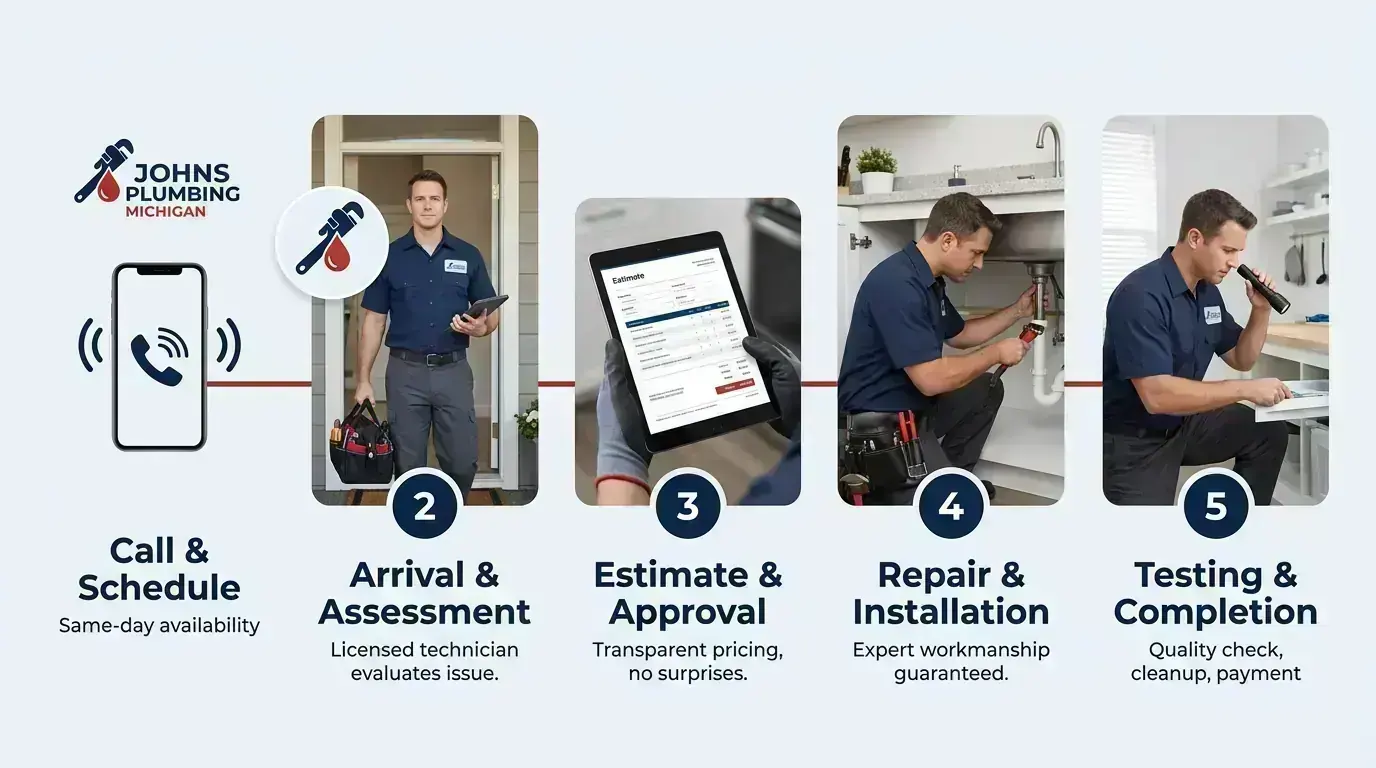
When you call Johns Plumbing Michigan for service in Detroit, you'll reach a live person (not voicemail) who collects your address, describes the problem, and schedules arrival within your preferred window, same-day for emergencies, typically next-business-day for routine work. We confirm appointments by text 30-60 minutes before arrival, giving you time to clear access paths without waiting all day.
Scheduling Your Service
Emergency calls dispatch immediately, our on-call technician contacts you within 5-10 minutes to confirm address and provide arrival ETA, usually 60-90 minutes across Wayne County. For scheduled work, we offer 2-hour appointment windows (morning 8-10 AM, midday 11 AM-1 PM, afternoon 2-4 PM) Monday through Friday, with Saturday slots available for non-emergency projects.
When scheduling, mention if we'll need basement access, street parking near your home, or entry through back/side doors. This helps us bring the right equipment and park efficiently on Detroit's narrow residential streets.
What Happens When We Arrive
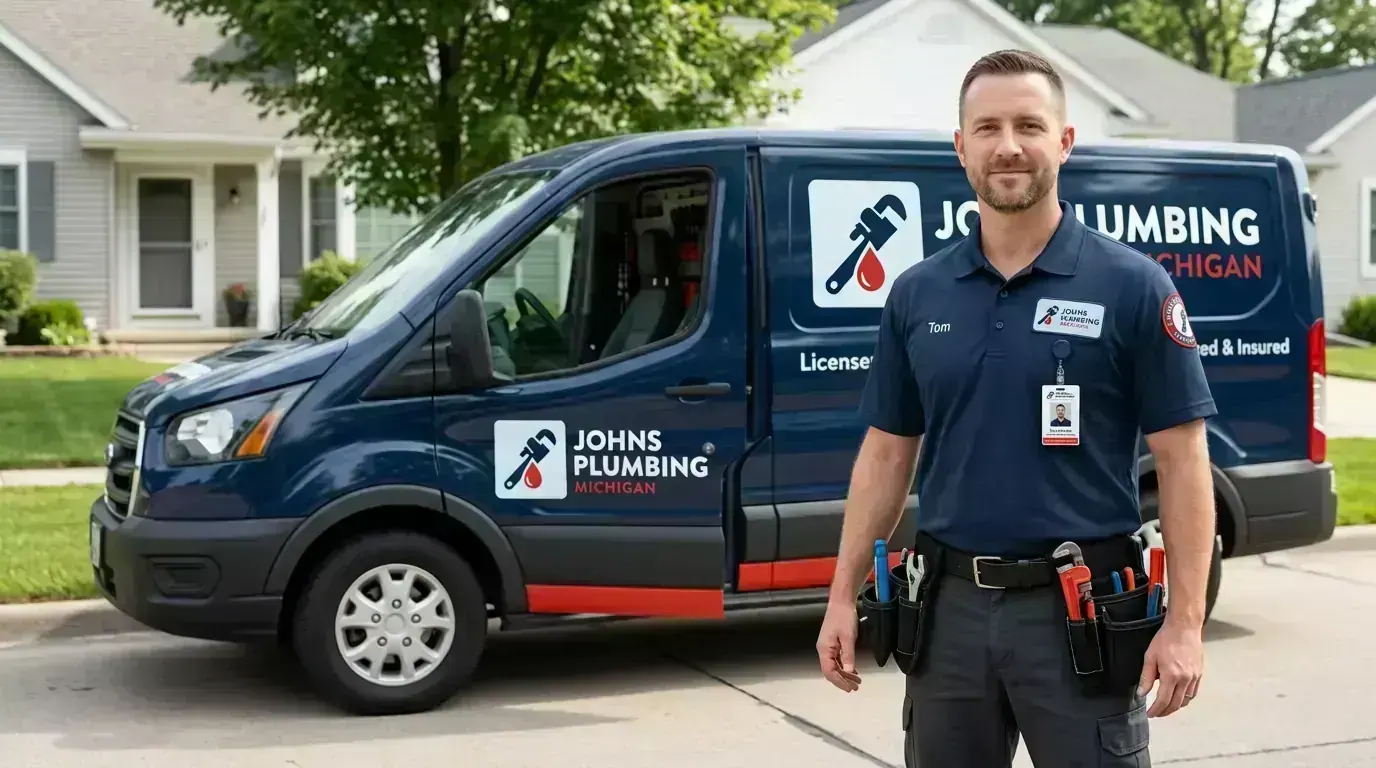
Our technician arrives in a marked vehicle, calls from outside to announce arrival, and introduces himself at your door with photo ID and business card. He'll ask you to show him the problem area, explain what you've observed (sounds, leaks, timing), and describe any DIY attempts. Before starting diagnostic work, he'll lay drop cloths if accessing crawlspaces or working under sinks, and ask you to show him water shutoff locations in case emergency isolation becomes necessary during assessment.
Assessment and Estimate Process
Diagnostic work begins with visual inspection, testing fixtures, checking water pressure, and, for hidden issues, using cameras or moisture meters to locate problems inside walls or underground. For drain clogs, we'll test multiple fixtures to determine if the blockage affects one drain or the main line (critical distinction in Detroit homes where old cast iron pipes often clog at the main).
After diagnosis, you receive a written estimate on-site detailing the problem, recommended solution, parts needed, labor hours, and total cost before any repair work begins. If permits are required (water heater replacement, re-piping, gas line work), we explain Detroit's BSEED permit process, coordinate filing, and schedule inspection. Permit costs are disclosed upfront in the estimate.
You're never obligated to approve work immediately. Take time to review the estimate, compare options if we've presented multiple solutions (repair vs. replace, standard vs. high-efficiency equipment), or get a second opinion. We'll leave the written quote with you and schedule work once you approve.
During the Repair
Once you approve the estimate, work begins the same day for emergencies or at your scheduled time for planned projects. The technician explains each major step as he works, particularly helpful for homeowners unfamiliar with plumbing systems. You don't need to supervise constantly, but we'll update you at milestones (pipe section removed, leak source identified, new fixture test-fitted) and call you over immediately if we discover additional problems requiring estimate revision.
Floor protection stays in place throughout the job. For work requiring water shutoff, we isolate the affected area when possible (shutting one fixture's supply valve rather than the whole house) and notify you before cutting main water.
Detroit's aging galvanized supply lines sometimes require extra care during shutoff. Corroded valves can seize or break, so we assess valve condition before turning and replace failed shutoffs as part of the repair when necessary.
Quality Testing and Cleanup
After installation or repair, we test the system thoroughly, running water through new drains for 5+ minutes checking for leaks, cycling water heaters through heating modes, pressure-testing repaired pipes at full flow. For sewer line work, we flush toilets and run multiple fixtures simultaneously to confirm the main line handles peak flow without backup. You're invited to observe testing and ask questions about operation, maintenance, or warranty coverage.
Cleanup includes hauling away old fixtures, parts, and debris (we don't leave water heaters or broken toilets for you to dispose of), sweeping work areas, and wiping down surfaces we've touched. Drop cloths come up last. The workspace should look as clean as we found it, minus the plumbing problem.
Payment and Warranty
Payment is due when work is complete and you've verified the repair solves the problem. We accept cash, check, all major credit cards, and offer financing options for projects over $1,000 through third-party lenders (application takes 5 minutes, approval often same-day). You'll receive an itemized invoice showing parts, labor, permit fees if applicable, and warranty terms.
All work carries a workmanship guarantee covering installation quality and our labor. Manufacturer warranties on parts (water heaters, fixtures, valves) transfer to you with documentation.
If something fails within the guarantee period due to installation error, we return and correct it at no charge. Normal wear, damage from freezing, or homeowner modifications void workmanship coverage.
After Service Support
We follow up by phone or text 3-5 days after major jobs (water heater installs, re-piping, sewer line replacement) to confirm everything's working properly. For any post-service questions or concerns, call our main line, the same number you used to schedule, not a separate warranty department. If you notice new symptoms or worry the original problem hasn't fully resolved, we'll return for inspection, typically same-day or next-business-day depending on urgency.
For Detroit-specific considerations: permit inspections for water heater and gas line work usually occur 3-5 business days after we file with BSEED; we coordinate inspector access with you and confirm code compliance before closeout. If you're participating in DWSD's lead service line replacement program, we can inspect your private lateral during our visit and provide documentation for city coordination if replacement is recommended.
Ready to schedule service? Call (313) 736-9553 to book your appointment. We'll walk you through exactly what to expect for your specific plumbing issue in Detroit.
Risk Prevention and Maintenance in Detroit, Michigan
Detroit homeowners can prevent most plumbing failures by addressing three critical factors: maintaining aging pipe systems, preparing for harsh winter freezes, and managing hard water effects on fixtures. Given that most Detroit homes were built before 1980 with galvanized steel or cast iron plumbing, proactive maintenance significantly extends system lifespan and avoids emergency repairs.
Water Heater Maintenance
Hard water from the Great Lakes region accelerates mineral buildup inside tank water heaters, reducing efficiency and shortening lifespan to 6-8 years instead of the typical 10-12. Flush your water heater every 6 months, twice as often as manufacturers recommend for soft water areas.
Attach a garden hose to the drain valve, run water into a bucket until it's clear (usually 10-15 gallons), and you've removed sediment that insulates the heating element and corrodes the tank. If you hear popping or rumbling sounds, sediment has already hardened on the bottom; professional flushing with descaling agent may be necessary.
Check the anode rod every 3 years. This sacrificial metal rod corrodes instead of your tank, but Detroit's mineral-heavy water depletes it faster.
Winterization for Frozen Pipe Prevention
December through February brings sustained below-freezing temperatures that freeze exposed pipes in crawl spaces, exterior walls, and unheated areas. Disconnect and drain all outdoor hoses by early November.
Shut off interior valves feeding outdoor faucets, then open the outdoor spigot to drain remaining water. Any water left in the line will freeze and crack the pipe.
Insulate pipes in unheated basements, crawl spaces, and along exterior walls using foam pipe sleeves (not just fiberglass, which absorbs moisture and loses insulating value). For pipes that froze last winter, add heat tape before the next cold season.
These thermostatically controlled cables prevent freezing in problem areas. During extended cold snaps below 10°F, let faucets drip overnight; moving water doesn't freeze as readily as standing water.
Drain and Sewer Line Maintenance
Detroit's mature tree population means roots constantly seek moisture in sewer lines, especially in homes with original clay or cast iron pipes. Pour a gallon of hot water down seldom-used basement floor drains monthly to keep the trap seal filled and prevent sewer gas entry. Avoid chemical drain cleaners.
They corrode already-aging cast iron pipes and don't remove tree roots, just push them temporarily. If you notice multiple slow drains or gurgling sounds when flushing toilets, schedule camera inspection before roots cause a complete blockage. Tree roots enter through joints and cracks; catching them early means hydro-jetting clears the line ($300-500), but waiting until sewage backs up into your basement means excavation and pipe replacement ($3,000-8,000).
Monitoring Galvanized Pipe Deterioration
Homes built before 1960 often have galvanized steel supply pipes that corrode internally over 50-70 years. Rust-colored water when you first turn on taps, declining water pressure, and frequent pinhole leaks signal advanced corrosion. Check your water pressure annually using a $15 pressure gauge threaded onto an outdoor faucet, healthy pressure reads 50-70 psi.
If pressure drops below 40 psi and you've ruled out municipal supply issues, internal pipe corrosion is likely narrowing flow. At this stage, plan for re-piping rather than patching individual leaks; once galvanized pipes start leaking, failures accelerate.
Spring Basement Flooding Prevention
Test your sump pump before spring thaw by pouring 5 gallons of water into the pit. The float should trigger the pump within seconds. If it doesn't activate or struggles to discharge water, replace it before snowmelt season.
Detroit's combined sewer system can overwhelm during heavy spring rain; consider installing a backwater valve on your basement floor drain if you've experienced sewage backups during storms. This one-way valve lets water exit but prevents sewer system overflow from pushing back through your drain ($500-800 installed, but prevents $10,000+ water damage).
Early Warning Signs Requiring Professional Assessment
Unexplained water bill increases of 20% or more suggest hidden leaks, Detroit Water and Sewerage Department bills by actual meter reading, so increases reflect real usage. Water stains on ceilings below bathrooms, damp spots on walls near plumbing fixtures, and persistent musty odors in basements warrant immediate inspection. If you smell rotten eggs (sulfur) or hear hissing near gas appliances, evacuate immediately and call both DTE Energy and a licensed plumber, never investigate gas odors yourself.
Schedule annual plumbing inspections if your home was built before 1970. A licensed plumber can camera-inspect sewer lines, test water pressure, check for hidden leaks, and assess remaining lifespan of galvanized or cast iron systems before they fail.
Prevent costly emergencies. Call (313) 736-9553 to schedule preventive maintenance or address early warning signs before they become urgent repairs.
Service Area Coverage
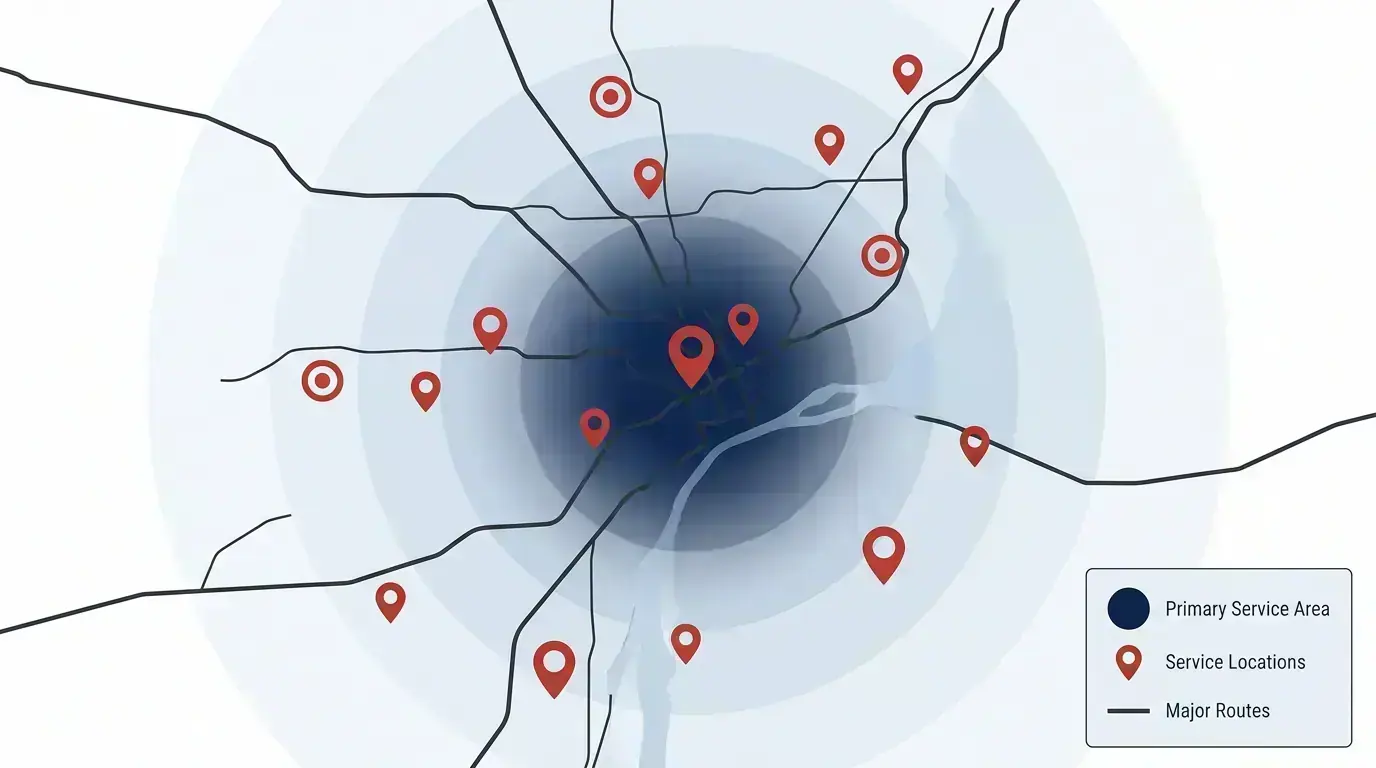
Johns Plumbing Michigan serves all of Detroit and Wayne County, covering ZIP codes 48201 through 48244, including 48255, 48260, and several downtown business district codes. Our service area extends throughout the metro region. We serve Highland Park (1.5 miles), Hamtramck (2.5 miles), Hazel Park, Ferndale, Oak Park, Dearborn, Huntington Woods, River Rouge, Center Line, Melvindale, and Warren, all within 10 miles of downtown Detroit.
We operate within a 15-mile radius of central Detroit with typical response times of 30-45 minutes to most Wayne County addresses during non-peak traffic hours. Emergency calls receive priority routing, even during I-75 construction detours or event traffic near Ford Field and Little Caesars Arena, our dispatch coordinates the fastest available route to your location.
Detroit's size means plumbing challenges vary by neighborhood age and infrastructure. Homes near the Detroit Water and Sewerage Department's ongoing replacement projects in Cornerstone Village, North Rosedale Park, Jefferson Chalmers, Evergreen-Lahser, and Russell Woods often benefit from updated water mains, while older sections retain original galvanized and cast iron systems requiring more frequent service. We work throughout the city, from historic areas with century-old plumbing to newer developments with modern PEX systems.
If you're within Wayne County or the surrounding communities listed above, we cover your area. Call (313) 736-9553 to confirm service availability for your specific address and schedule same-day or next-day service.
Local Plumbing Challenges in Detroit, Michigan
Detroit homeowners face plumbing issues rooted in the city's aging housing stock, harsh winter climate, and combined sewer infrastructure. Galvanized steel and lead service lines in homes built before 1960-1980 corrode internally over 40-50 years, causing low water pressure, pinhole leaks, and rust-colored water.
Deteriorating cast iron drain and sewer pipes, common in Detroit homes over 60 years old, crack and allow tree root intrusion, leading to sewage backups. Spring thaw and heavy rain overwhelm Detroit's combined sewer system, pushing water and sewage back through basement floor drains.
Frozen pipes strike Detroit homes every winter when temperatures drop below freezing from December through February. Exposed pipes in crawl spaces, exterior walls, and unheated basements freeze and burst, flooding basements and causing thousands in water damage. Homes built before modern insulation standards face higher freeze risk, especially those with pipes routed through unheated rim joists or along exterior walls.
Detroit's combined sewer system carries both sewage and stormwater in the same pipes, a design common in older cities but prone to overload during spring snowmelt and summer downpours. When the system exceeds capacity, sewage backs up through basement floor drains, particularly in lower-lying neighborhoods. The Detroit Water and Sewerage Department has invested $240 million in recent upgrades, but thousands of older connections remain vulnerable during peak flow events.
Cast iron sewer pipes installed before 1980 corrode from the inside out, developing rough interior surfaces that snag debris and provide entry points for tree roots. Mature trees in established Detroit neighborhoods send aggressive root systems into cracked pipe joints, causing recurring blockages that simple snaking won't solve. Camera inspection reveals the extent of root intrusion and whether pipe repair or full replacement is needed, decisions that affect cost by thousands of dollars.
The Great Lakes region's naturally hard water accelerates mineral buildup inside tank water heaters, shortening their lifespan and reducing efficiency. Detroit homeowners often notice sediment banging sounds in aging water heaters or find rust-colored water from corroded fixtures, both signs that mineral deposits have compromised the system. Hard water also leaves scale deposits on faucet aerators and showerheads, reducing flow over time.
Lead service lines remain in many Detroit homes built before 1986, posing health risks especially for children and pregnant residents. The Detroit Water and Sewerage Department's replacement program has upgraded over 1,355 lead lines since 2019 with thousands more planned, but homeowners must consent to work on private property portions. If you're uncertain about your service line material, DWSD provides free testing and replacement coordination at no cost to property owners.
Dealing with aging pipes, basement flooding risk, or frozen pipe damage in Detroit? Call (313) 736-9553 for solutions specific to Wayne County's infrastructure challenges and climate patterns.
DIY vs Professional Plumber: When to Call a Detroit Plumber
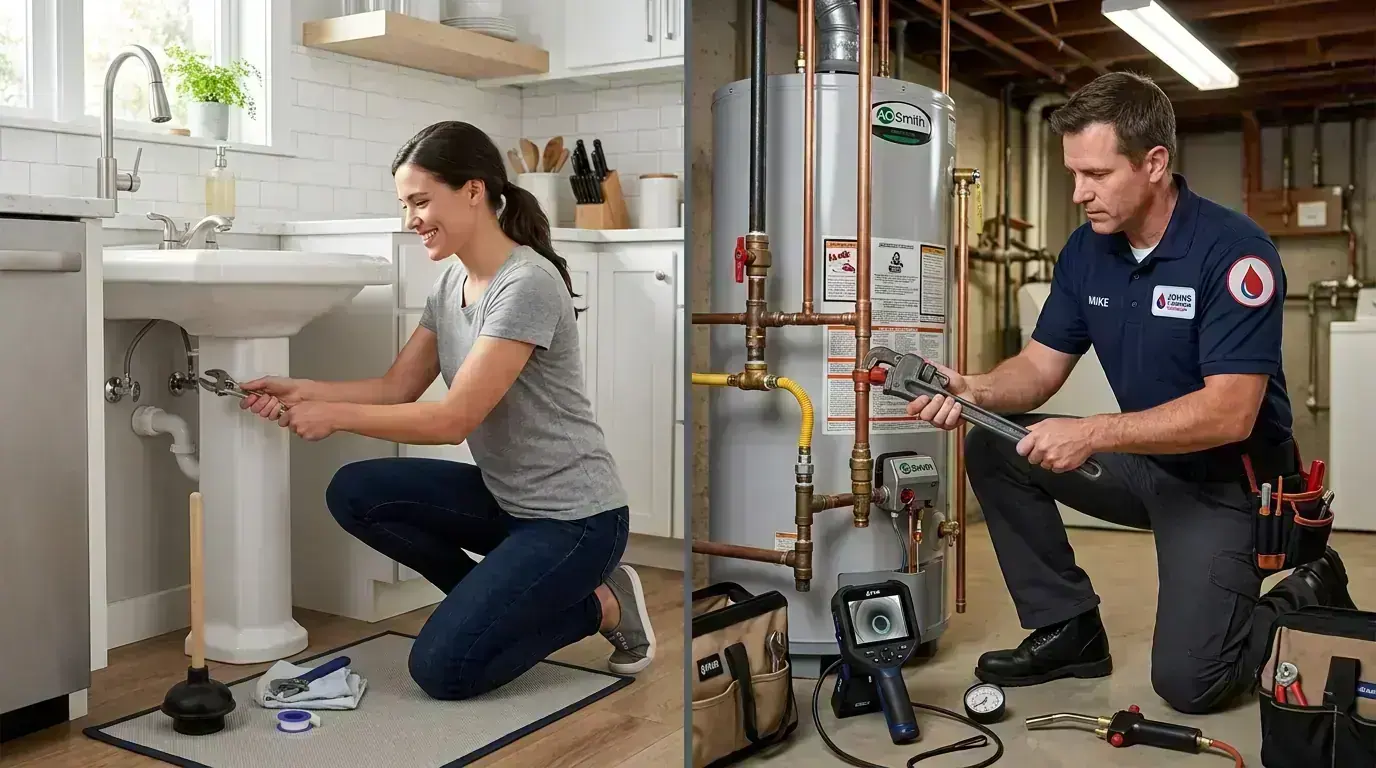
Simple plumbing tasks like unclogging a drain with a plunger or replacing a toilet flapper are DIY-appropriate for Detroit homeowners. Work requiring permits, involving gas lines or main water systems, or affecting hidden plumbing infrastructure needs licensed professional service to protect your home, maintain insurance coverage, and comply with Michigan plumbing codes.
DIY-Appropriate Tasks
Unclogging drains with plunger or drain snake: Surface clogs in sinks, tubs, or toilets respond to basic plunging or manual snake work. Safe for homeowners because the problem is accessible and reversible, if the clog doesn't clear after 10-15 minutes of effort, stop and call a professional before forcing tools deeper and risking pipe damage.
Replacing faucet aerators or showerheads: These screw-on fixtures require only hand-tightening or basic wrench work. No permit needed, no hidden systems affected. Limitation: if removing the old aerator reveals corroded threads or the fixture itself leaks after replacement, the faucet body may need professional repair.
Tightening visible pipe connections: If you spot a dripping compression fitting or loose supply line under a sink, tightening the nut with an adjustable wrench often stops minor leaks. Stop if the leak persists after snugging the connection. Over-tightening cracks fittings, and persistent leaks indicate thread damage requiring professional repair or replacement.
Professional-Only Scenarios
Water heater work: Michigan requires permits for water heater installation and replacement. Tank water heaters involve gas line connections (explosion risk), electrical wiring (shock hazard), and pressure relief systems that prevent tank rupture.
Incorrect installation voids manufacturer warranties and homeowner insurance claims. Detroit's hard water accelerates sediment buildup, licensed plumbers flush tanks properly and inspect anode rods during maintenance.
Gas line repairs or installation: All gas line work in Michigan requires a licensed plumber. Natural gas leaks cause explosions and carbon monoxide poisoning.
DIY gas work violates state law, voids insurance, and creates immediate life-safety hazards. If you smell gas (rotten egg odor), evacuate immediately, call 911 from outside, then call (313) 736-9553 after the gas company secures the scene.
Main water line or sewer line work: Repairs affecting the main water service line or sewer connection require City of Detroit permits and inspections. These systems run underground, often beneath driveways or landscaping.
Improper excavation damages municipal infrastructure, violates Detroit BSEED regulations, and results in permit violations with fines. Licensed plumbers coordinate required inspections and ensure code-compliant backfill and restoration.
Re-piping or pipe replacement: Replacing sections of pipe inside walls, ceilings, or foundation requires Detroit plumbing permits. Work involves pressure testing to verify leak-free connections and often affects multiple fixtures. Hidden access means errors aren't visible until water damage appears.
Detroit homes with aging galvanized pipes need licensed assessment before replacement. Corroded interior surfaces make proper cutting and threading critical for long-term reliability.
Decision Framework
If work requires a permit → Call a licensed professional. Detroit BSEED requires permits for water heaters, gas lines, main line work, re-piping, and any work requiring wall or floor opening. Unpermitted work discovered during home sales forces correction before closing.
If it involves gas lines or main water/sewer systems → Call a professional. These systems operate under pressure or carry hazardous materials. Errors cause property damage, health hazards, and legal liability.
If it requires opening walls, floors, or specialized tools → Call a professional. Hidden plumbing work demands knowledge of pipe routing, structural members, and proper restoration methods. Specialized tools like hydro-jetters, camera inspection equipment, or pipe threading machines aren't cost-effective for one-time homeowner use.
If it affects insurance-covered systems → Call a professional to protect coverage. Homeowner policies require licensed work for water heaters, gas systems, and main lines. DIY failures on these systems often result in claim denials, insurance adjusters verify permit records and contractor licensing during damage assessments.
For work requiring permits or involving gas or main lines, call (313) 736-9553 for licensed service. Not sure if your issue is DIY-safe? Call (313) 736-9553 for a free assessment. We'll tell you honestly whether it's something you can handle or needs professional attention.
Licensed & Insured Plumber Requirements in Michigan
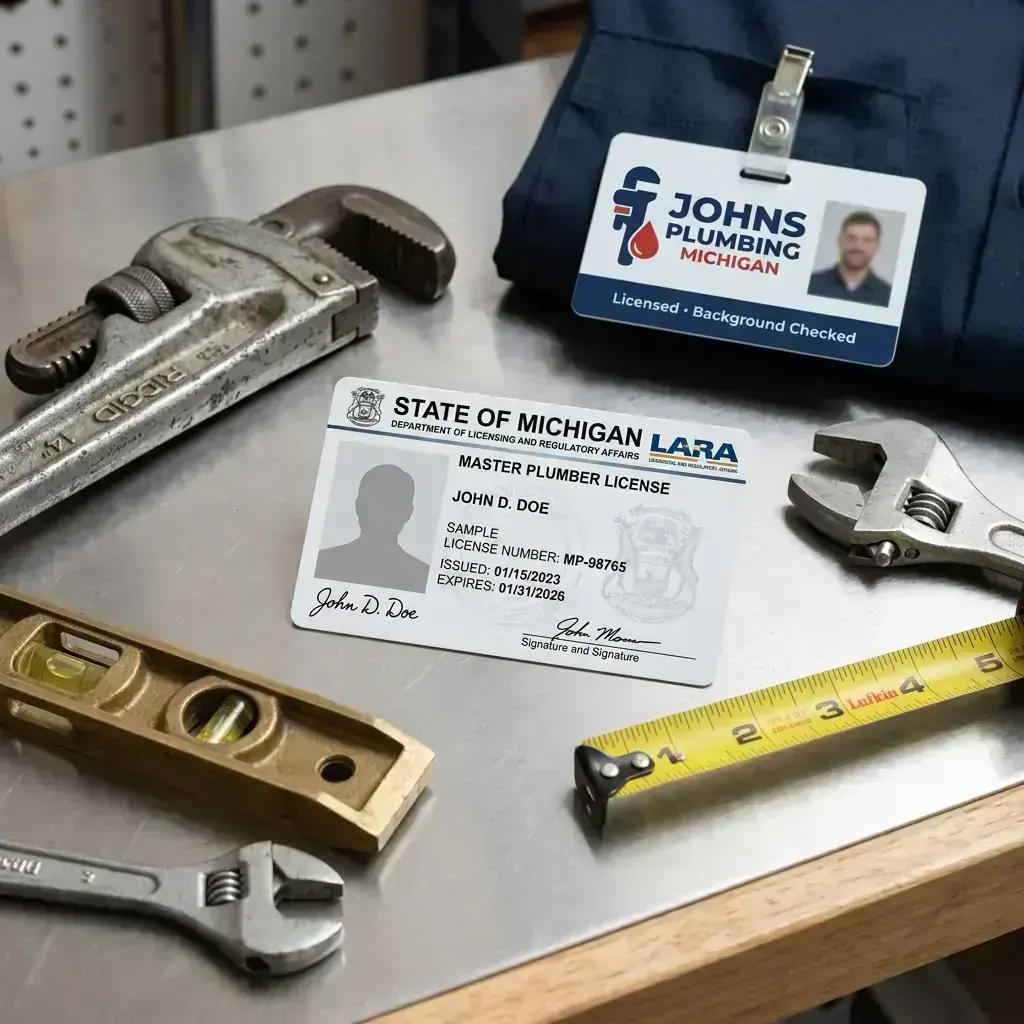
Michigan requires all plumbers to hold a state-issued license through the Michigan Department of Licensing and Regulatory Affairs (LARA). A Journeyman Plumber license requires a 4-year apprenticeship under a Master Plumber plus passing a state examination. A Master Plumber license requires 2 additional years of Journeyman experience plus a separate Master examination.
gov/lara. Enter their name or license number to confirm active status.
Insurance requirements protect Detroit homeowners from liability. Licensed plumbers must carry general liability insurance covering property damage and bodily injury, plus workers' compensation insurance for their technicians.
If an unlicensed handyman gets injured on your property or causes water damage during repairs, you may face financial responsibility. Licensed contractors' insurance covers these scenarios, transferring risk away from the homeowner.
Detroit Water and Sewerage Department requires permit applications to include the contractor's Master Plumber license number. Work performed without proper licensing voids permits and may require expensive re-work to pass inspection. Unlicensed plumbers cannot pull permits legally in Detroit, leaving homeowners unable to sell their property until unpermitted work is corrected and re-inspected.
When scheduling service, ask for the plumber's Michigan license number before they arrive. Licensed Master Plumber serving Detroit. Call (313) 736-9553 for guaranteed code-compliant work backed by proper licensing and insurance coverage.
Nearby Cities We Serve
Johns Plumbing Michigan serves Detroit as our primary base and responds throughout Wayne County, typically reaching customers within 15 miles of downtown Detroit in 60-90 minutes or less. We provide the same licensed residential plumbing services to Highland Park, Hamtramck, Hazel Park, Ferndale, Pleasant Ridge, Oak Park, Dearborn, and Warren, all within our standard service radius.
Many Detroit metro homeowners live near municipal boundaries and need confirmation we'll respond without hesitation. Whether you're in River Rouge (7.7 miles southwest), Huntington Woods (7.6 miles north), or Center Line (7.7 miles northeast), you're within our typical 25-minute drive time from central Detroit. Emergency calls from any of these areas receive the same priority response as calls from downtown ZIP codes.
Call (313) 736-9553 to confirm coverage for your specific address. We'll let you know exact response time based on current call volume and your location within the metro region.
FAQ
How much does emergency plumbing cost in Detroit?
Emergency plumbing service calls in Detroit run $225-$600 depending on the issue and time of day. Standard emergencies (burst pipes, sewage backups) during business hours typically cost $225-$400, while after-hours calls (nights, weekends, holidays) add $75-$200 to base rates. Winter frozen pipe emergencies can cost more due to increased demand and access difficulty in Wayne County's harsh December-February conditions.
Do I need a permit for water heater replacement in Detroit?
Yes. All water heater installations and replacements in Detroit require a plumbing permit from the Buildings, Safety Engineering and Environmental Department (BSEED) before work begins.
Your licensed plumber handles permit applications, which must include a Master Plumber license number. Inspections include rough-in (before concealing pipes) and final inspection before the system can be used legally.
How quickly can you respond to plumbing emergencies in Detroit?
We typically arrive within 60-90 minutes for emergency calls throughout Detroit and Wayne County, including Highland Park, Hamtramck, Dearborn, and Warren. Response times can extend during severe winter weather events (January-February deep freezes) or when I-75/I-94 traffic is affected by stadium events downtown or construction detours. We dispatch based on your location and current call volume.
What are signs my cast iron sewer line is failing?
Detroit homes built before 1980 often have cast iron sewer lines that fail after 60-80 years. Warning signs include multiple drains backing up simultaneously, gurgling toilets when other fixtures drain, sewage odor in your yard or basement, soggy patches in the lawn above the sewer line, and water backing up through basement floor drains during heavy rain or spring thaw.
How do I prevent basement flooding during spring thaw in Detroit?
Detroit's combined sewer system can overwhelm during spring snowmelt and heavy rain, pushing water back through basement floor drains. Install a backwater valve on your main drain line (requires permit), ensure sump pump operates properly before spring, keep floor drains clear, and consider having your sewer line camera-inspected if your home was built before 1980 to identify tree root intrusion or deterioration before flooding occurs.
Should I replace galvanized pipes in my older Detroit home?
Galvanized steel pipes installed before 1960-1980 corrode internally after 40-50 years, causing low water pressure, rust-colored water, and pinhole leaks. If your home has original galvanized plumbing and you're experiencing these symptoms, or planning major renovations, replacing with copper or PEX prevents cascading failures. Detroit Water and Sewerage Department also offers no-cost lead service line replacement for qualifying properties.
Are you licensed to work in Detroit, Michigan?
Yes. Johns Plumbing Michigan holds Michigan Master Plumber and Journeyman Plumber licenses issued by the Michigan Department of Licensing and Regulatory Affairs (LARA). We carry full liability insurance and workers' compensation coverage as required for Detroit plumbing work.
You can verify our credentials through LARA's public license lookup before we arrive. We provide our license number upon request.
How long does a typical water heater last in Detroit?
Tank water heaters in Detroit typically last 8-12 years due to hard water from the Great Lakes region accelerating mineral buildup and corrosion. Homes with well water or untreated hard water see shorter lifespans (6-10 years).
Annual flushing and anode rod replacement every 3-5 years can extend lifespan. If your water heater approaches 10 years old and shows rust-colored water, strange noises, or insufficient hot water, schedule replacement before it fails.
Questions not answered here? Call (313) 736-9553 to speak with a licensed Detroit plumber who can address your specific situation.
Johns Plumbing Michigan has served Detroit homeowners with Michigan-licensed, fully insured residential plumbing services available 24/7, including weekends and holidays. From emergency burst pipe repairs to routine fixture work, our experienced technicians typically arrive within 60-90 minutes for urgent calls throughout Wayne County and provide written estimates before starting any work. Call (313) 736-9553 now to schedule service or request a free estimate. We're ready to help with any plumbing issue in Detroit, Michigan.