Call to confirm current availability in Grand Rapids
Kent CountyWest Michigan
Grand Rapids Plumber | Licensed Residential Plumbing Services
Johns Plumbing Michigan provides licensed residential plumbing services throughout Grand Rapids and Kent County.
Michigan-licensed and fully insured, we're available 24/7 for emergency repairs, drain cleaning, water heater service, leak detection, sewer line work, and all residential plumbing needs. Call (313) 736-9553 anytime for same-day service in Grand Rapids.
Michigan licensed Master Plumber serving Grand Rapids since 2012. Fully insured with general liability and workers' compensation coverage. Available 24/7 for emergency service with typical arrival within 90 minutes throughout Kent County.
Residential Plumbing Services in Grand Rapids
Johns Plumbing Michigan handles every residential plumbing need for Grand Rapids homeowners, from emergency repairs and drain cleaning to water heater service, leak detection, sewer line work, fixture installation, and gas line services throughout Kent County.
Our service range covers both urgent problems and planned upgrades. Emergency work includes burst pipes, sewage backups, frozen pipe thawing, and gas leak response.
Scheduled services include water heater replacement, sewer camera inspections, fixture upgrades, re-piping projects, and preventive maintenance. Whether you're dealing with a slow drain in Heritage Hill or planning a bathroom renovation in Eastown, we bring the same residential-focused expertise to every call in Grand Rapids.
Michigan winters and aging infrastructure create specific challenges for Grand Rapids homes, frozen pipes in crawl spaces, root intrusion from mature trees along established streets, basement flooding in low-lying areas near the Grand River, and corroded cast iron drain stacks in historic properties. We match solutions to local conditions rather than applying generic fixes.
A sewer line issue in a 1920s Creston home requires different materials and methods than the same problem in a newer Wyoming subdivision. Call (313) 736-9553 for service anywhere in Grand Rapids, Kent County.
Emergency Plumbing Services in Grand Rapids, Michigan
Johns Plumbing Michigan responds to plumbing emergencies 24/7 throughout Grand Rapids and Kent County, typically arriving within 90 minutes of your call. We handle burst pipes, sewage backups, gas leaks, basement flooding, frozen pipe crises, and major leaks that demand immediate professional attention.
Burst pipes from Michigan's freeze-thaw cycles rank among the most urgent calls we receive. When temperatures drop well below freezing, common from late fall through early spring, pipes in crawl spaces, exterior walls, and poorly insulated basements can freeze and rupture.
If you see water spraying from walls or ceilings, shut off your main water valve immediately and call (313) 736-9553. Burst pipes flood homes rapidly, causing thousands of dollars in water damage within hours.
Sewage backing up into your basement or ground-floor drains requires immediate response. This often signals a main sewer line blockage, frequently caused by tree root intrusion from mature maples and oaks common in Heritage Hill, Creston, and Eastown.
Sewage contains dangerous bacteria; evacuate affected areas and contact us at (313) 736-9553 right away. We bring specialized equipment to clear main line blockages and restore safe drainage.
Gas leaks demand the fastest response. If you smell rotten eggs (the odorant added to natural gas), hear hissing near gas lines, or experience nausea and dizziness indoors, evacuate immediately, call 911 from outside, then call (313) 736-9553.
Never use light switches, phones, or anything that could create a spark inside the home. We coordinate with utility companies to shut off gas safely and repair damaged lines.
Basement flooding hits Grand Rapids homes hard during spring snowmelt and severe storms, especially in low-lying neighborhoods near the Grand River like Roosevelt Park and South Hill. Sump pump failures cause most basement floods.
If you notice water rising in your basement, check whether your sump pump is running. Call (313) 736-9553 for emergency pump replacement or backup system installation before water reaches furnaces, water heaters, or electrical panels.
No hot water during Michigan winters constitutes an emergency. Homes become uninhabitable quickly without functioning heat and hot water when outdoor temperatures drop below freezing.
If your water heater stops producing hot water, leaks heavily, or makes loud banging sounds, call (313) 736-9553 immediately. We carry replacement units on our trucks for same-day water heater installation when repairs aren't viable.
Frozen pipes that haven't burst yet still require urgent attention. If one faucet stops flowing while others work normally, or if you see frost on exposed pipes, that pipe has likely frozen. Attempting to thaw pipes yourself risks rupturing them if heat is applied unevenly.
Call (313) 736-9553. We use professional thawing equipment that safely restores flow without damaging pipes.
Available 24/7 at (313) 736-9553 for any plumbing emergency in Grand Rapids, Kent County, and surrounding communities including East Grand Rapids, Wyoming, Kentwood, and Walker.
How fast do you need someone?
Check all situations that apply in your Grand Rapids home. We'll determine the fastest, most appropriate response.
Johns Plumbing Michigan handles the full spectrum of residential plumbing work across Grand Rapids, from routine drain cleaning and fixture repairs to complex water heater replacements and sewer line services. Our residential-focused approach addresses the unique challenges Michigan homeowners face, aging infrastructure in Heritage Hill and Creston, freeze-thaw damage from harsh winters, and root intrusion from mature tree canopies throughout established neighborhoods.
Drain Cleaning & Clog Removal clears kitchen sinks, bathroom drains, main sewer lines, and floor drains using cable snaking and hydro jetting methods. Grand Rapids' mature trees (maples, oaks, and elms common in Eastown and Heritage Hill) drive roots into deteriorated pipe joints, causing recurring blockages that demand professional clearing.
Water Heater Repair & Replacement covers tank and tankless systems, addressing no-hot-water emergencies, efficiency upgrades, and full replacements. Michigan's hard water accelerates sediment buildup, shortening water heater lifespan and requiring more frequent maintenance than in softer-water regions.
Leak Detection & Pipe Repair locates hidden leaks behind walls, under slabs, and in crawl spaces using acoustic and thermal imaging tools, then repairs or replaces damaged sections. Freeze-thaw cycles shift pipe joints throughout Michigan winters, creating leaks that worsen without prompt professional attention.
Sewer Line Services include camera inspection, cleaning, root removal, and trenchless or traditional replacement for aging clay and cast iron laterals common in mid-century Grand Rapids neighborhoods. Roosevelt Park and South Hill's low-lying areas face additional backup risk during spring snowmelt.
Fixture Installation & Repair handles toilets, faucets, garbage disposals, sinks, tubs, and sump pumps, addressing running toilets, dripping faucets, and basement flooding prevention. Sump pump failures rank among the most common emergency calls during heavy rain and rapid thaw events.
Gas Line Services cover installation for water heaters, dryers, stoves, and fireplaces, plus leak detection, pressure testing, and repairs. Any gas smell requires immediate evacuation and professional response, never attempt DIY gas work.
See detailed service information in the sections below for specific symptoms, timing guidance, and what to expect from each service.
Complete Plumbing Service Guide for Grand Rapids Homeowners
Johns Plumbing Michigan provides comprehensive residential plumbing services throughout Grand Rapids, addressing everything from routine maintenance to complex system replacements. Grand Rapids homeowners face unique challenges, aging infrastructure in Heritage Hill and Creston, freeze-thaw pipe damage from Michigan winters, root intrusion from mature tree canopies, and basement flooding in low-lying areas near the Grand River. Below is detailed coverage of each major service category, including technical methods, when each service applies, and decision factors specific to Kent County homes.
Drain Cleaning & Clog Removal Services in Grand Rapids
When multiple drains slow simultaneously or you notice gurgling sounds from fixtures, the problem often extends beyond a single clog to your main sewer line, especially in Grand Rapids neighborhoods with mature trees. We address kitchen sink, bathroom sink, tub, shower, toilet, and floor drain clogs using cable snaking for straightforward blockages and hydro jetting for stubborn buildup or root intrusion.
Cable snaking works for most localized clogs, hair and soap in bathroom drains, food debris in kitchen lines, paper buildup in toilet traps. The rotating cable breaks through blockages and restores flow quickly.
Hydro jetting becomes necessary when scale, grease, or tree roots create recurring problems. High-pressure water streams (up to 4,000 PSI) scour pipe walls clean, removing years of accumulated buildup and cutting through root masses that cable snaking cannot eliminate.
For Grand Rapids homes in Heritage Hill, Creston, and Eastown (neighborhoods where mature maples, oaks, and elms dominate) root intrusion ranks among the most common drain issues. Roots penetrate deteriorated pipe joints seeking moisture, then expand inside the line and trap debris flowing downstream.
Camera inspection reveals root location and severity before we choose the appropriate cleaning method. When roots reappear within months after cable cleaning, hydro jetting followed by root treatment chemicals extends the time between service calls.
Main line clogs require immediate attention when multiple fixtures back up simultaneously or sewage odors emerge indoors. These scenarios indicate the shared drain line to the street has blocked completely, forcing wastewater back through floor drains and lower fixtures.
Call (313) 736-9553 immediately if you experience multi-fixture backups. This is not a situation where waiting helps.
Floor drains in basements and garages trap sediment, construction debris, and organic matter that cable snaking handles effectively. We recommend annual preventive cleaning for floor drains in Grand Rapids homes with sump pumps, since sediment accumulation can redirect water away from the sump pit during heavy rain or spring snowmelt.
Water Heater Repair & Replacement Services
Grand Rapids homeowners choose between tank water heater repair, tankless installation, or full replacement based on unit age, failure mode, and household hot water demand. Tank water heaters typically last 8-12 years in Kent County. Hard water accelerates sediment buildup and anode rod corrosion, shortening lifespan compared to national averages.
Repair makes sense when: the water heater is under 7 years old, the problem is isolated (pilot light won't stay lit, thermostat malfunction, minor leak from drain valve or temperature-pressure relief valve), and the tank shows no rust or structural compromise. Pilot light issues often trace to thermocouple failure, a $150-$250 repair versus $1,200-$2,500 for full replacement. Thermostat replacement runs $120-$280 and restores consistent temperature control.
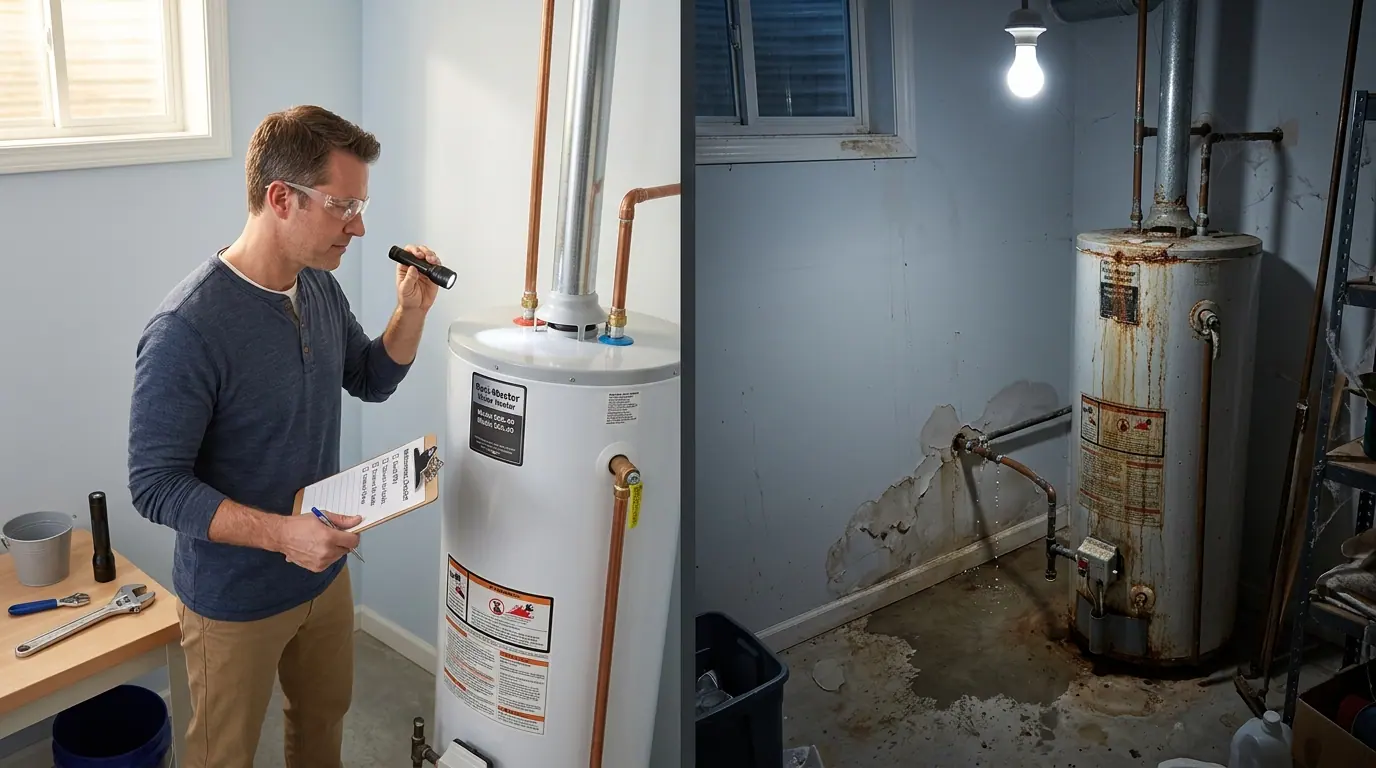
Replacement becomes necessary when: the unit exceeds 10 years, rust appears in hot water, the tank leaks from the bottom or sides (indicates internal corrosion), or repair costs approach 50% of replacement cost. Once rust penetrates the tank lining, failure is inevitable, better to replace on your schedule than during an emergency when the tank ruptures and floods your basement.
Tankless water heaters appeal to Grand Rapids homeowners seeking endless hot water and space savings in utility closets or basements. Gas tankless units require adequate venting and gas line capacity.
We verify both before installation. Tankless water heaters cost more upfront ($2,500-$4,500 installed) but eliminate standby heat loss and provide hot water for multiple simultaneous uses, ideal for families with back-to-back showers or large soaking tubs.
Sizing matters regardless of tank or tankless choice. A 40-gallon tank serves 2-3 people adequately; 50-gallon handles 3-4 people; 75-gallon covers larger families or homes with whirlpool tubs. Tankless sizing depends on flow rate (gallons per minute) and temperature rise needed, Michigan groundwater averages 45-50°F, requiring greater heating capacity than southern states to reach 120°F output.
Anode rod replacement extends tank water heater life by 3-5 years. The sacrificial magnesium or aluminum rod attracts corrosive minerals, protecting the steel tank lining.
When the anode rod depletes completely (typically after 5-7 years in Grand Rapids' moderately hard water), corrosion attacks the tank itself. We inspect anode rods during maintenance visits and recommend replacement when less than half the original rod remains.
Leak Detection & Pipe Repair Services
Hidden leaks waste water, damage building materials, and create mold growth before homeowners notice obvious symptoms. We use visual inspection for accessible pipes, acoustic listening devices for leaks behind walls, and thermal imaging cameras to identify temperature anomalies indicating water movement where it shouldn't exist.
Slab leaks, breaks in pipes embedded in concrete foundation slabs, reveal themselves through warm spots on floors (hot water line leaks), unexplained water meter activity when all fixtures are off, or cracks in concrete foundation. Slab leak repair requires accessing the pipe through the concrete, a decision we make after confirming leak location with electronic detection equipment. When slab leaks occur in homes over 40 years old with original galvanized steel or polybutylene piping, whole-house re-piping may be more cost-effective than repeated slab access repairs.
Underground leaks between the house and street main line show up as soggy yard patches, foundation settlement, or persistent low water pressure. We excavate to expose the damaged section, then decide between spot repair (replacing 2-4 feet of pipe) or full water service line replacement based on pipe material and condition. Cast iron and galvanized steel lines from pre-1970 construction corrode from inside and outside simultaneously, once we find one break, others typically follow within months.
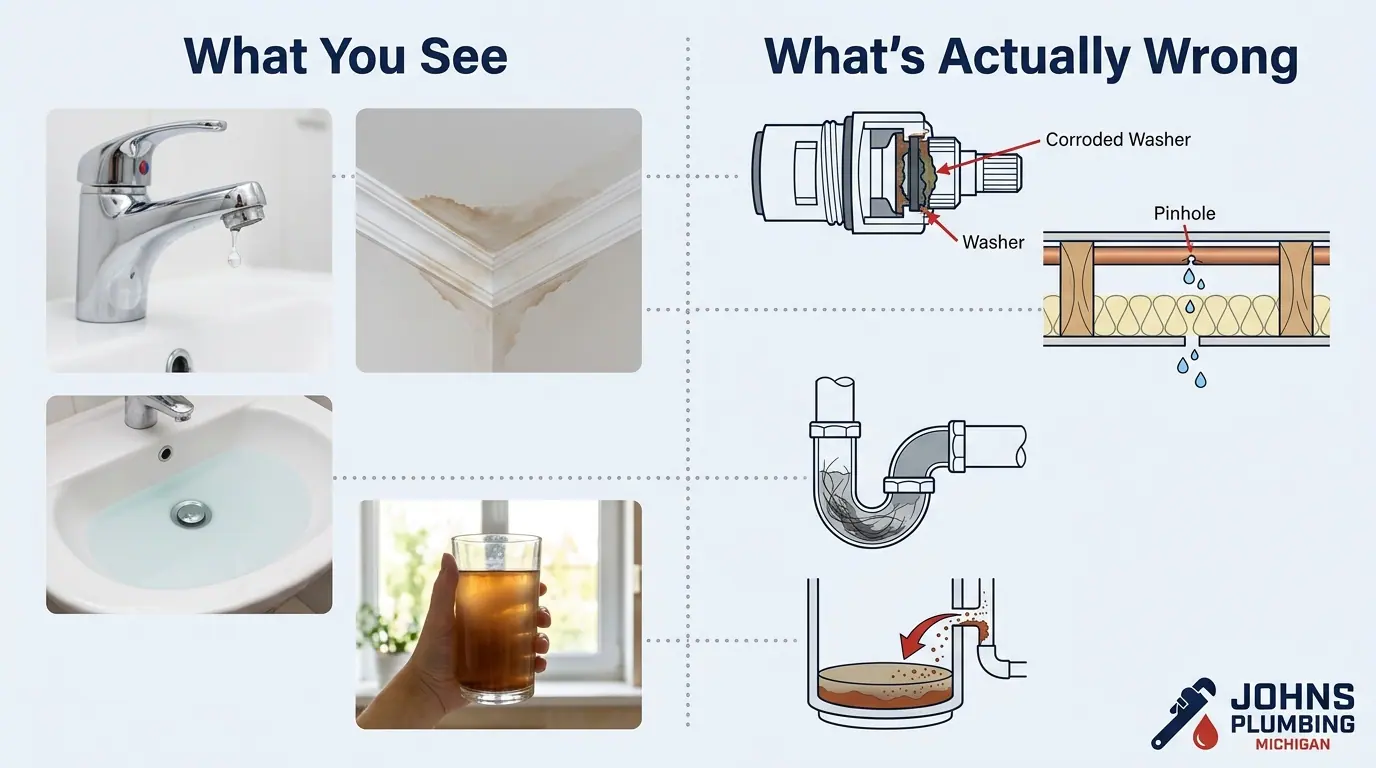
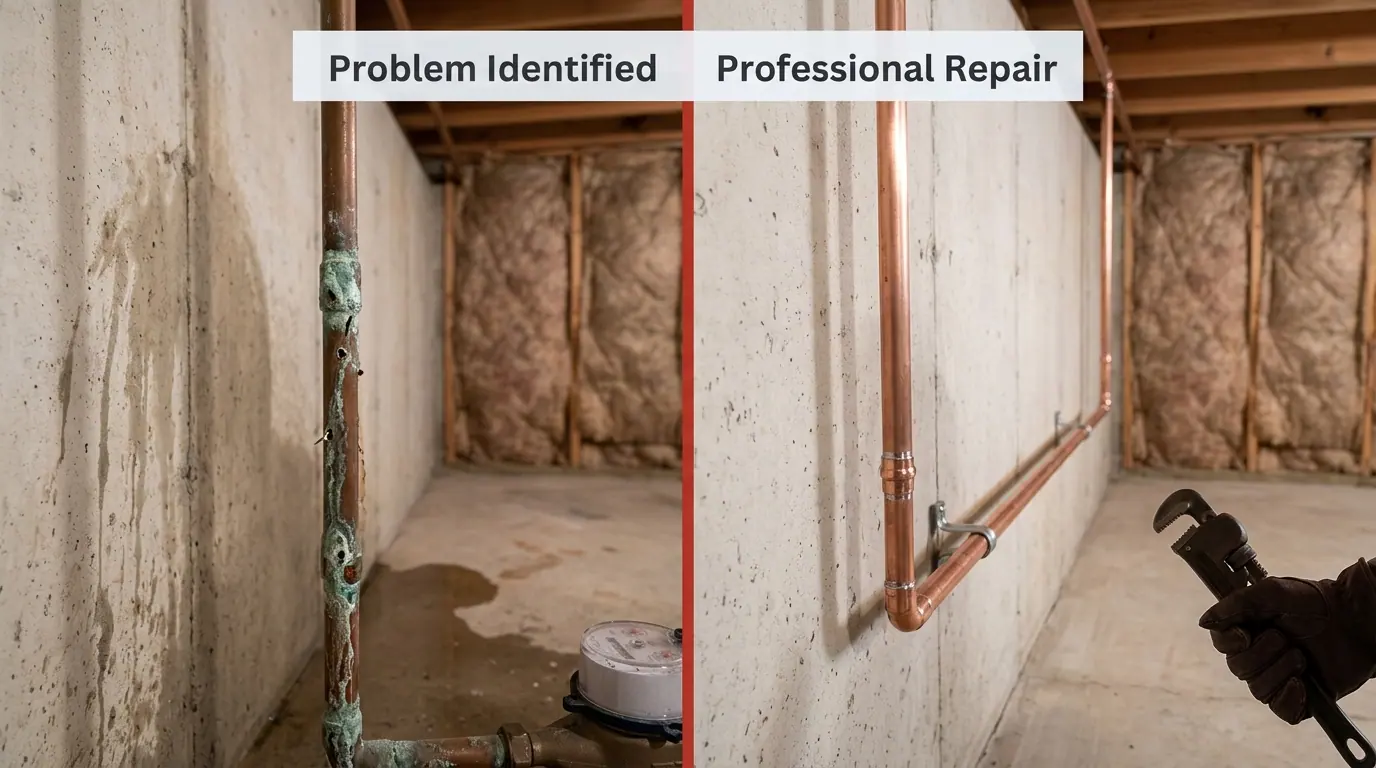
Wall and ceiling leaks often originate from supply line pinhole corrosion, loose fittings that vibrate over time, or frozen pipe damage. Drywall water stains, peeling paint, and mold growth signal chronic moisture. After identifying the leak source, we assess repair versus replacement: soldering repairs work for copper pipe pinhole leaks; compression fittings handle small sections; PEX re-piping makes sense for multiple leaks or widespread corrosion.
Frozen pipe repair in Grand Rapids peaks from January through March when arctic air masses push temperatures well below zero for extended periods. Pipes in exterior walls, unheated crawl spaces, and uninsulated attics freeze first. We thaw pipes using heat guns or electric heating cables, then inspect for cracks.
If a frozen pipe cracked but hasn't burst yet, we replace the damaged section immediately, once it thaws, water sprays everywhere. Prevention matters more than repair: we insulate vulnerable pipes, seal foundation cracks allowing cold air infiltration, and recommend leaving cabinet doors open during extreme cold to circulate warm air around plumbing.
Main water line repair becomes urgent when you lose water pressure throughout the house or see water pooling near the street. The service line from curb stop to house foundation belongs to the homeowner, not the city. Breaks here are your responsibility.
We coordinate with the city to shut off water at the street, excavate to expose the damaged section, and replace with PEX or copper depending on local code and your budget. Call (313) 736-9553 if you suspect a main line issue. The longer water runs, the more foundation and landscaping damage accumulates.
Sewer Line Services
Sewer camera inspection shows exactly what's happening inside your drain line, root intrusion, pipe collapse, grease buildup, bellied sections holding standing water, or cracks from soil settlement. We insert a high-resolution camera through a cleanout or toilet opening, recording video as we push through the line to the street connection. The footage reveals whether cleaning solves the problem or whether repair/replacement is necessary.
Root removal and line cleaning: Mature trees throughout Heritage Hill, Creston, and Eastown send roots into sewer lines through deteriorated joints in clay tile and cast iron pipe common in homes built before 1970. Hydro jetting cuts roots flush with pipe walls and scours away decades of grease and scale buildup. We follow jetting with root treatment chemicals that inhibit regrowth for 12-18 months.
Annual or biennial preventive jetting makes sense in neighborhoods where every home battles root intrusion. Proactive cleaning costs less than emergency backup service.
Repair versus replacement decision: When camera inspection reveals isolated cracks, root entry points at specific joints, or small sections of collapsed pipe, spot repair saves money compared to full line replacement. We excavate to access the damaged section, cut out the compromised pipe, and install new PVC or cast iron. Trenchless pipe lining (cured-in-place pipe) offers a no-dig alternative.
We insert a resin-saturated liner through the existing pipe, inflate it, and cure it with UV light or hot water, creating a new pipe inside the old one without excavation. Trenchless costs more per foot but eliminates landscape destruction, driveway removal, and lengthy restoration work.
Full sewer line replacement becomes necessary when: multiple sections show damage throughout the line's length, the pipe material has reached end-of-life (clay tile and cast iron from 1950s-1970s typically fail after 50-70 years), or repeated repairs approach the cost of replacement. Traditional excavation replacement requires trenching from house to street.
We remove the old line and install new Schedule 40 PVC. Pipe bursting offers another trenchless option: we pull a bursting head through the old pipe while simultaneously pulling new HDPE pipe behind it, fracturing the old pipe outward into the surrounding soil.
Grand Rapids completed a major sewer separation project in 2015, eliminating combined sewer overflows (CSOs) by separating sanitary and storm systems. However, private sewer laterals, the line from your house to the city main, remain the homeowner's responsibility.
If your lateral was installed before separation, it may still connect to what was the combined system. We coordinate with the city to verify connection points before starting repair work.
Bellied pipe, sagging sections where soil settlement created low spots, holds standing water that traps debris and accelerates corrosion. Camera inspection reveals bellies clearly. Repair requires excavating to lift and support the pipe properly, restoring slope for drainage.
Fixture Installation & Repair Services
Toilets, faucets, garbage disposals, sinks, tubs, showers, and sump pumps each have distinct repair-versus-replace thresholds based on age, failure mode, and part availability.
Toilet repair handles running toilets (flapper valve replacement, fill valve adjustment), weak flush (flapper or flush valve replacement), and leaks at tank-bowl connection (new gaskets and bolts). Repair makes sense when the toilet is under 15 years old and the porcelain shows no cracks. Replacement becomes necessary when cracks appear, the toilet rocks despite re-tightening, or you want water efficiency upgrades, modern WaterSense toilets use 1.28 gallons per flush versus 3.5-7 gallons for pre-1994 models.
Faucet repair addresses dripping (worn cartridge or O-ring replacement), low flow (aerator cleaning), and leaks at base (O-ring or cartridge replacement). Single-handle faucets use cartridges that last 5-10 years in Grand Rapids' moderately hard water. When cartridge replacement costs approach $150-$200 and the faucet is over 10 years old, replacing with a modern unit offering better flow control and finish durability makes financial sense.
Garbage disposal repair covers jams (removing trapped objects, resetting thermal overload), leaks at mounting flange (re-sealing), and electrical issues (checking breaker and reset button). When the motor burns out or the grinding chamber cracks, replacement is the only option.
We install 3/4-horsepower disposals with stainless steel grinding chambers for Kent County homes on septic systems. These units handle food waste more completely than lower-powered models, reducing septic maintenance frequency.
Sump pump installation and repair matters greatly in Grand Rapids, where basement flooding ranks among the most common plumbing emergencies, especially in Roosevelt Park and South Hill near the Grand River. Sump pumps fail from float switch problems, impeller clogs, motor burnout, or check valve failure.
We install primary and battery backup pumps for homes in flood-prone areas, when spring snowmelt or severe storms knock out power, the battery backup prevents basement flooding. Annual pre-season testing in March catches problems before you need the pump most.
Shower and tub fixture installation ranges from simple showerhead replacement to complete valve and trim upgrades. Leaking shower valves require accessing the valve body behind the wall, a job that involves tile or wall panel removal and reinstallation. We recommend replacing worn single-handle cartridge valves with pressure-balance or thermostatic valves that prevent scalding when other fixtures draw water.
Gas Line Services
Gas line work requires specialized licensing beyond standard plumbing, Michigan law restricts gas line installation, repair, and testing to licensed plumbers with gas certification. We install gas lines for water heaters, dryers, ranges, ovens, fireplaces, and garage heaters; detect and repair gas leaks; perform pressure testing; and install emergency shut-off valves.
Gas leak detection and emergency shutoff: If you smell gas (mercaptan additive creates the distinctive rotten-egg odor), hear hissing near gas appliances or piping, or experience nausea, headaches, or dizziness indoors, evacuate immediately and call 911 from outside, then contact (313) 736-9553 for emergency gas line service. We use electronic gas detectors and soap-bubble testing to pinpoint leak locations, then shut off gas at the meter or appliance valve before starting repairs.
Gas line leaks can occur at threaded connections, corroded iron pipe, or damaged flex connectors. Repairs range from tightening connections to replacing entire sections with black iron pipe or CSST (corrugated stainless steel tubing).
Gas line installation for new appliances requires calculating BTU demand, sizing pipe diameter appropriately, and obtaining mechanical permits. A standard 40-gallon gas water heater requires 40,000 BTU input; gas ranges need 65,000 BTU; tankless water heaters demand 150,000-200,000 BTU.
We verify your existing gas meter capacity handles the additional load before installing new lines. Black iron pipe remains the most common material for exposed installations; CSST works well inside walls and through joists where rigid pipe is difficult to route.
Pressure testing confirms system integrity after repairs or new installations. We pressurize the line above operating pressure and monitor for drops indicating leaks.
Michigan code requires pressure testing and inspection before concealing gas piping. We coordinate with local inspectors to schedule these required visits.
Safety protocols and permits: Gas line work requires mechanical permits in Grand Rapids. Homeowners cannot pull permits for gas work. Licensed contractors must apply.
We handle permit applications, inspections, and code compliance documentation as part of every gas line project. Gas line installation and repair carry liability that unqualified handymen cannot legally assume. Verify contractor gas certification before allowing anyone to work on your gas system.
Natural gas serves most Grand Rapids neighborhoods through utility distribution. Some rural areas surrounding the city rely on propane tanks, our gas line services cover both, though propane systems require regulators, tank placement code compliance, and different connection methods than natural gas.
Repair or Replace? Decision Framework for Grand Rapids
Honest guidance based on equipment age, repair cost, and expected remaining life. We recommend what makes sense for you, not what maximizes our invoice.
Tank Water HeaterLifespan: 10-12 years
When repair makes sense
Age < 8 years and repair < $500
When replacement is better
Age 10+ years, or repair > $600, or multiple issues
Replacement benefits
New units: 15-20% energy savings, warranty coverage, avoid emergency breakdown
Michigan local context
Hard water in Michigan shortens tank lifespan—flush annually
Tankless Water HeaterLifespan: 15-20 years
When repair makes sense
Age < 12 years and single component failure
When replacement is better
Age 15+ years, or heat exchanger failure (typically $800-$1,200)
Symptom Diagnosis & Problem Recognition in Grand Rapids, Michigan
Several observable symptoms indicate underlying plumbing problems requiring professional evaluation. Water pressure changes, persistent slow drains, unusual noises, water discoloration, and unexplained moisture are the most common warning signs. Recognizing these symptoms early and understanding their urgency level helps Grand Rapids homeowners prevent minor issues from becoming costly emergencies, especially important in a city where aging infrastructure, freeze-thaw cycles, and mature tree roots create recurring plumbing challenges.
Water Pressure Problems
Sudden drops in water pressure throughout your home typically signal main line issues, either mineral buildup inside aging pipes or leaks reducing system pressure. Heritage Hill and Creston homes built before 1960 often have galvanized steel supply lines that corrode from the inside, gradually narrowing the pipe diameter until water barely trickles from fixtures. This differs from single-fixture pressure loss, which usually means a clogged aerator or shutoff valve partially closed.
If water pressure drops suddenly and doesn't recover, check for visible leaks first, wet spots on walls, ceilings, or foundation areas suggest active pipe failure. Call (313) 736-9553 immediately if you find wetness paired with pressure loss, as hidden leaks cause water damage that escalates rapidly.
Gradual pressure decline over months points to corrosion inside aging pipes, a routine replacement matter rather than an emergency. Low pressure affecting only hot water indicates sediment buildup in your water heater tank, solvable through flushing or element replacement.
Multiple Slow Drains
When several drains throughout your home slow down simultaneously, the problem sits in your main sewer line, not individual fixtures. This pattern (kitchen sink, bathroom sink, and shower all draining slowly within days of each other) means a developing blockage in the line serving your entire house. Grand Rapids homeowners in neighborhoods with mature maples, oaks, and elms face this scenario frequently as tree roots infiltrate deteriorated pipe joints, gradually narrowing the passage until water barely flows.
Single slow drains indicate fixture-level clogs treatable with simple methods. Multiple drains suggest main line obstruction requiring professional camera inspection to locate the blockage.
If toilets begin gurgling when you run water elsewhere, or if floor drains back up when you shower, the main line blockage has progressed to urgent status. Schedule service within 48 hours before complete backup occurs.
Water Discoloration and Odors
Rusty or brown water from cold taps signals corroding galvanized or cast iron pipes, common in Heritage Hill homes built between 1840s-1900s. The rust flakes travel through your system, staining fixtures and clothing while indicating pipe deterioration that eventually leads to pinhole leaks and failures.
Discoloration appearing only from hot water means sediment and corrosion inside your water heater tank. The tank's anode rod has likely depleted, allowing the steel lining to rust.
Yellow or murky water suggests sediment disturbance in pipes, often appearing after municipal water main work or pressure changes. This usually clears within hours. Persistent discoloration requires investigation.
Call (313) 736-9553 for assessment. Black or gray water with metallic taste indicates serious pipe corrosion requiring immediate replacement.
Sewage odors from drains without visible backup point to dry trap seals (the water barrier in your drain's P-trap evaporated) or vent stack blockages preventing proper air circulation. Pour water down rarely-used drains to restore trap seals.
If odors persist after refilling traps, vent blockage requires professional clearing, especially common during winter when ice can plug roof vents. Sewage smell indoors without identifiable drain source may indicate cracked sewer line under your foundation, an immediate health hazard requiring emergency response.
Strange Noises and Vibrations
Banging pipes when you shut off water, called water hammer, indicates loose pipes or failing pressure-regulating equipment. The sudden pressure spike when water flow stops causes pipes to slam against framing.
While annoying, water hammer rarely constitutes an emergency. Schedule repair to prevent eventual joint loosening and leak development.
Gurgling from drains signals air pressure imbalances in your plumbing system. If toilets gurgle when you run the washing machine or shower, blocked vent stacks prevent air from entering the system as water drains.
Michigan winters freeze moisture in vent pipes extending through roofs, creating blockages that resolve when temperatures rise. Persistent gurgling even in warm weather means debris blocks the vent, requiring professional clearing.
Whistling or screaming from faucets indicates worn washers or loose components vibrating as water passes through. Replace washers or cartridges to stop the noise.
Rumbling from your water heater as it heats suggests sediment buildup on tank bottom, minerals precipitate from heated water, forming an insulating layer that reduces efficiency and eventually causes tank failure. Schedule flushing if your water heater rumbles.
Visible Leak Indicators
Water stains on ceilings directly below bathrooms indicate supply line or drain leaks from above. Brown or yellow rings grow larger over time as water repeatedly saturates ceiling material.
Small stains may represent minor leaks that only occur during fixture use, while expanding stains suggest active continuous leaking. Check the floor in the room above for softness or visible water, if you find dampness, shut off water to that bathroom and call (313) 736-9553 immediately.
Wet basement walls or floors indicate foundation leaks, which escalate during spring snowmelt when Grand Rapids area groundwater tables rise. If wetness appears after heavy rain, foundation waterproofing rather than plumbing may be needed.
Continuous moisture regardless of weather suggests underground supply line failure or sewer line infiltration. Unexplained water pooling near your water heater, washing machine connections, or under sinks requires immediate shutoff of the nearest water valve and professional inspection.
Emergency Warning Signs
Certain symptoms demand immediate professional response regardless of time or day. Sewage backing up into your home through floor drains, toilets, or tubs creates health hazards from bacteria and pathogens, evacuate the area and call (313) 736-9553 immediately. Do not use any plumbing fixtures until professionals clear the blockage.
Gas smell anywhere indoors or near gas lines requires immediate action. Natural gas contains added odorant (mercaptan) producing a distinctive rotten-egg or sulfur smell.
If you smell gas, evacuate immediately without turning lights on or off (spark risk), call 911 from outside, then call your gas utility and (313) 736-9553. Do not re-enter until authorities clear the building.
No water throughout your home during Michigan winter likely means frozen main line or meter, this progresses to burst pipes within hours as ice expands inside the line. Call (313) 736-9553 immediately for emergency thawing before catastrophic pipe failure occurs. Water actively spraying from pipes, ceiling flooding, or water running down walls constitutes burst pipe emergency requiring immediate shutoff at main valve and emergency repair.
When Symptoms Can Wait
Not every plumbing symptom requires emergency response. Dripping faucets, running toilets, and slow single drains can wait for scheduled appointments during business hours.
Even small visible leaks under sinks or at shutoff valves tolerate short delays if you place a bucket underneath and monitor water loss. Schedule service within a few days to prevent water damage accumulation.
Water heater noises without leaks, low-but-adequate water pressure, and seasonal gurgling from vents can be addressed during routine service calls. If you're uncertain whether your symptom needs immediate attention, call (313) 736-9553 for assessment. We'll help you determine appropriate timing and provide temporary guidance if the issue can wait safely.
Match your symptom to its likely cause
Find the symptom closest to what you are seeing in Grand Rapids. Click to reveal the diagnosis and urgency level.
Cost & Pricing Transparency for Plumbing Services in Grand Rapids, Michigan
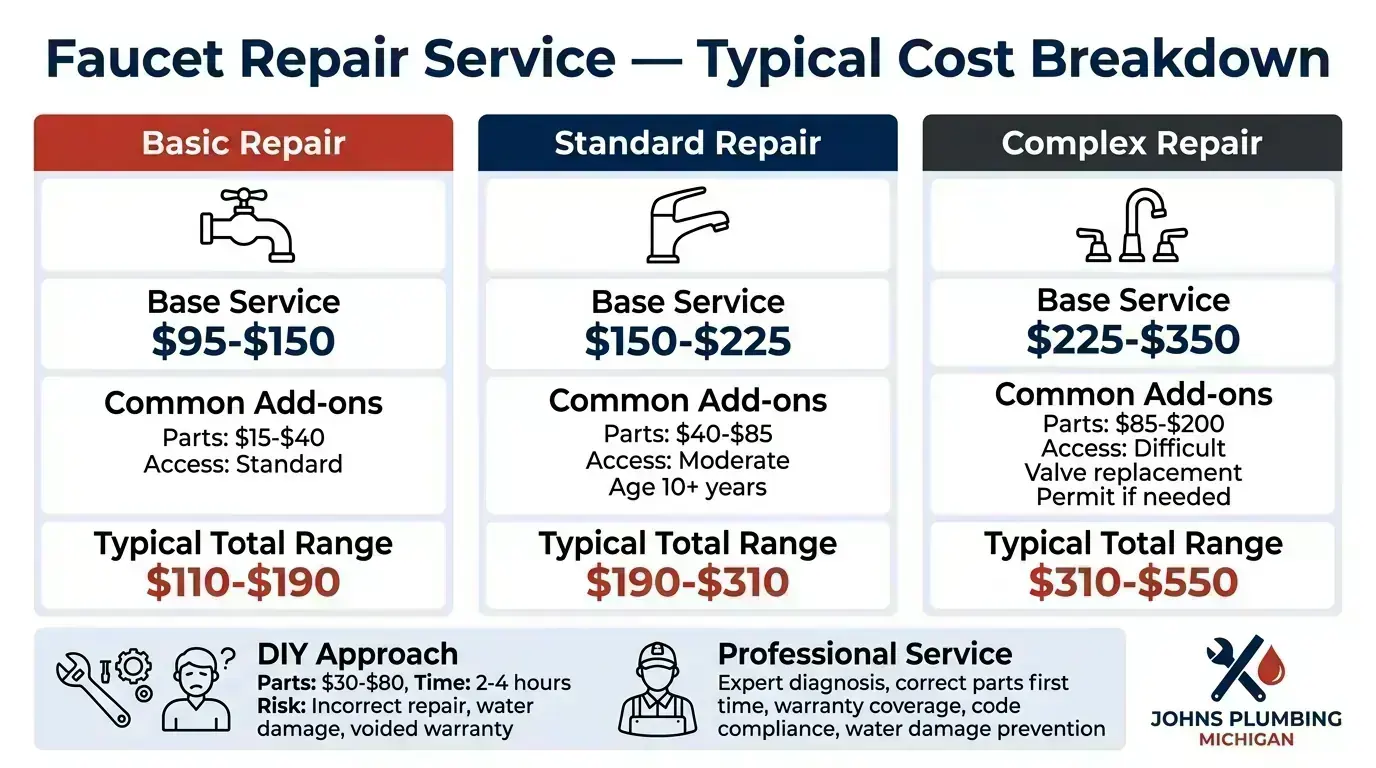
Residential plumbing service in Grand Rapids typically costs $125-$600 for most jobs, depending on service complexity and parts required. Emergency calls after business hours add dispatch fees. The final price depends on job scope, access difficulty, parts needed, and whether work requires permits in Kent County.
Service Call and Diagnostic Fees
Most plumbing companies charge $85-$150 for a standard service call, covering travel time and initial diagnosis. This fee typically applies toward repair costs if you proceed with the work. Emergency calls after hours or on weekends often include higher dispatch fees, usually $50-$100 additional, reflecting technician availability outside normal schedules.
Diagnostic work that requires specialized equipment (camera inspection, pressure testing, leak detection technology) may cost $150-$300 depending on tools used and time involved. These diagnostics often save money by pinpointing exact problems instead of exploratory work.
Drain Cleaning Services
Kitchen and bathroom drain cleaning runs $150-$300 for straightforward clogs near fixtures. Main line cleaning costs more, $250-$600, because it requires longer cables, more time, and often involves outdoor access to cleanouts. Hydro jetting for severe blockages or preventive maintenance ranges $350-$600.
Tree root intrusion adds complexity and cost. Grand Rapids' mature maples, oaks, and elms in Heritage Hill, Creston, and Eastown push roots into deteriorated pipe joints. Root removal requires specialized equipment and often leads to follow-up camera inspection ($150-$250) to assess pipe condition after cleaning.
Access difficulty matters. First-floor drain work is straightforward. Basement drains or crawl space access takes longer. Multi-story buildings add time and equipment challenges, increasing labor costs.
Water Heater Repair and Replacement
Water heater repairs average $200-$450 depending on the component needing replacement. Thermostat and heating element replacements sit at the lower end. Gas valve, pressure relief valve, or ignition system work costs more due to safety requirements and part complexity.
Full water heater replacement ranges $900-$2,400 installed. Standard 40-50 gallon tank units with installation run $900-$1,500. Tankless systems cost $1,500-$2,400 installed, factoring in gas line modifications, venting work, and electrical requirements most Grand Rapids homes need for proper tankless operation.
Hard water throughout much of Kent County shortens water heater lifespan through sediment buildup, meaning Grand Rapids homeowners often face replacement around 8-10 years instead of the typical 10-12 year expectation. Factor this into long-term budgeting.
Permit requirements add $50-$100 to water heater installation costs. Kent County requires permits for all water heater work under Michigan Plumbing Code Rule 735. Gas-fired water heaters also need mechanical permits.
Leak Detection and Pipe Repair
Basic leak detection for visible access points (under sinks, around fixtures, exposed basement pipes) typically runs $100-$200. Hidden leak detection requiring thermal imaging, acoustic equipment, or wall/ceiling investigation costs $250-$450 depending on search complexity and time required.
Pipe repairs vary widely based on location and damage extent. Exposed pipe repairs (basement, crawl space) average $150-$400. Wall or ceiling repairs requiring drywall removal and restoration cost $400-$800 due to access work, repair time, and finish restoration.
Re-piping sections of a home runs $1,500-$4,000 depending on pipe length, material choice (PEX vs copper), and access difficulty. Heritage Hill homes with aging cast iron drain stacks and galvanized supply lines often need partial or full re-piping. Multi-story homes with limited crawl space access push costs higher.
Freeze damage from Michigan winters adds unpredictability. A single frozen pipe caught early might cost $150-$300 to thaw and inspect. Burst pipe repairs with water damage mitigation can reach $800-$2,500 depending on damage extent and affected building materials.
Sewer Line Services
Sewer camera inspection costs $200-$400 depending on line length and access point difficulty. This diagnostic step identifies root intrusion, pipe deterioration, bellied sections, and joint separation, common problems in Grand Rapids neighborhoods with aging clay and cast iron laterals.
Sewer line cleaning without structural repair runs $300-$600 for routine blockages. Root intrusion requiring hydro jetting and mechanical cutting adds time and equipment costs, pushing toward the higher end.
Sewer line repair or replacement costs vary dramatically based on method. Trenchless repair (pipe lining or pipe bursting) typically runs $3,000-$8,000 for a standard residential lateral, avoiding major excavation. Traditional excavation replacement costs $4,000-$12,000 depending on depth, soil conditions, landscaping restoration, and concrete or driveway work required.
Creston, Eastown, and other mid-century neighborhoods often have clay tile or cast iron laterals vulnerable to soil movement from freeze-thaw cycles. These aging systems frequently need replacement rather than repair once problems surface.
Permits for sewer line work add $100-$200 to project costs. Grand Rapids requires permits for all sewer lateral repairs and replacements, with inspections before backfilling.
Fixture Installation and Repair
Toilet repairs range $125-$300 for common issues, flapper replacement, fill valve work, wax ring replacement, or handle mechanisms. Toilet installation costs $200-$450 including removal of old fixture, wax ring, supply line, and basic connection to existing drain.
Faucet repairs run $100-$250 depending on fixture type and parts availability. Cartridge replacements, valve seat work, or aerator service fall toward the lower end. Complete faucet installation averages $200-$400 including fixture removal, supply line connections, and installation labor.
Garbage disposal installation costs $200-$450 depending on unit size and electrical requirements. Some installations need new electrical circuits if existing wiring doesn't meet current code, adding $150-$300 to the project.
Sump pump installation ranges $400-$900 depending on system type, basin work required, and discharge line routing. Battery backup systems add $300-$500 to base installation costs. Given basement flooding risk in Roosevelt Park, South Hill, and other low-lying Grand Rapids areas, sump pump reliability matters, factor quality equipment into cost decisions.
What Affects Your Project Cost
Job complexity drives pricing more than any other factor. A kitchen sink drain clog near the trap takes 30 minutes and minimal equipment. A main sewer line backup requiring 100 feet of cable, multiple cleanout attempts, and root cutting takes 2-3 hours with specialized equipment.
Access difficulty significantly impacts labor time. Crawl spaces with limited clearance, finished basement ceilings hiding pipes, or multi-story homes with restricted access all increase the time technicians need to complete work. Heritage Hill homes with original plumbing hidden behind plaster walls and period woodwork require extra care, adding time and cost.
Parts and materials vary in price based on quality tier, manufacturer, and compatibility with existing systems. Standard residential fixtures and materials keep costs reasonable. Custom finishes, specific brands for matching existing fixtures, or commercial-grade components increase material costs.
Permit and inspection requirements add fees and scheduling considerations. Kent County mandates permits for water heater installation, sewer line work, gas line modifications, and fixture additions. Permit costs range $50-$200 depending on project scope. Inspection scheduling may extend project timelines.
Emergency vs. Scheduled Service Pricing
Emergency service outside business hours includes dispatch fees reflecting technician availability at nights, weekends, and holidays. Standard emergency dispatch adds $75-$150 to base service costs. Major holidays may include higher premiums.
Response time commitments factor into emergency pricing. Same-day service for urgent problems (burst pipes, sewage backups, gas leaks) prioritizes your call over scheduled work, justifying premium dispatch rates.
Scheduled service during business hours avoids emergency fees and often allows better planning for parts availability and project coordination. Non-urgent work benefits from scheduled appointments and standard rates.
Transparent Pricing Philosophy
Johns Plumbing Michigan provides written estimates before starting non-emergency work, explaining scope, materials, labor, and permits required. Emergency situations requiring immediate action receive verbal estimates when possible, with full documentation following initial crisis resolution.
No hidden fees surprise you after work completion. Our estimates include all anticipated costs, labor, materials, permits, and disposal fees where applicable. If additional work becomes necessary during a project (hidden damage, code compliance requirements discovered during installation), we discuss it with you before proceeding.
Payment options include cash, check, and major credit cards. Financing is available for larger projects through approved lenders. Insurance claim assistance is provided when plumbing emergencies cause property damage.
For an accurate estimate based on your specific situation in Grand Rapids, call (313) 736-9553. We'll discuss your plumbing needs, schedule a diagnostic visit if needed, and provide transparent pricing before starting work.
Typical price ranges in Grand Rapids
Ranges reflect access difficulty, parts, time and whether a permit applies. Select a category below to view costs.
Service Process & What to Expect in Grand Rapids, Michigan
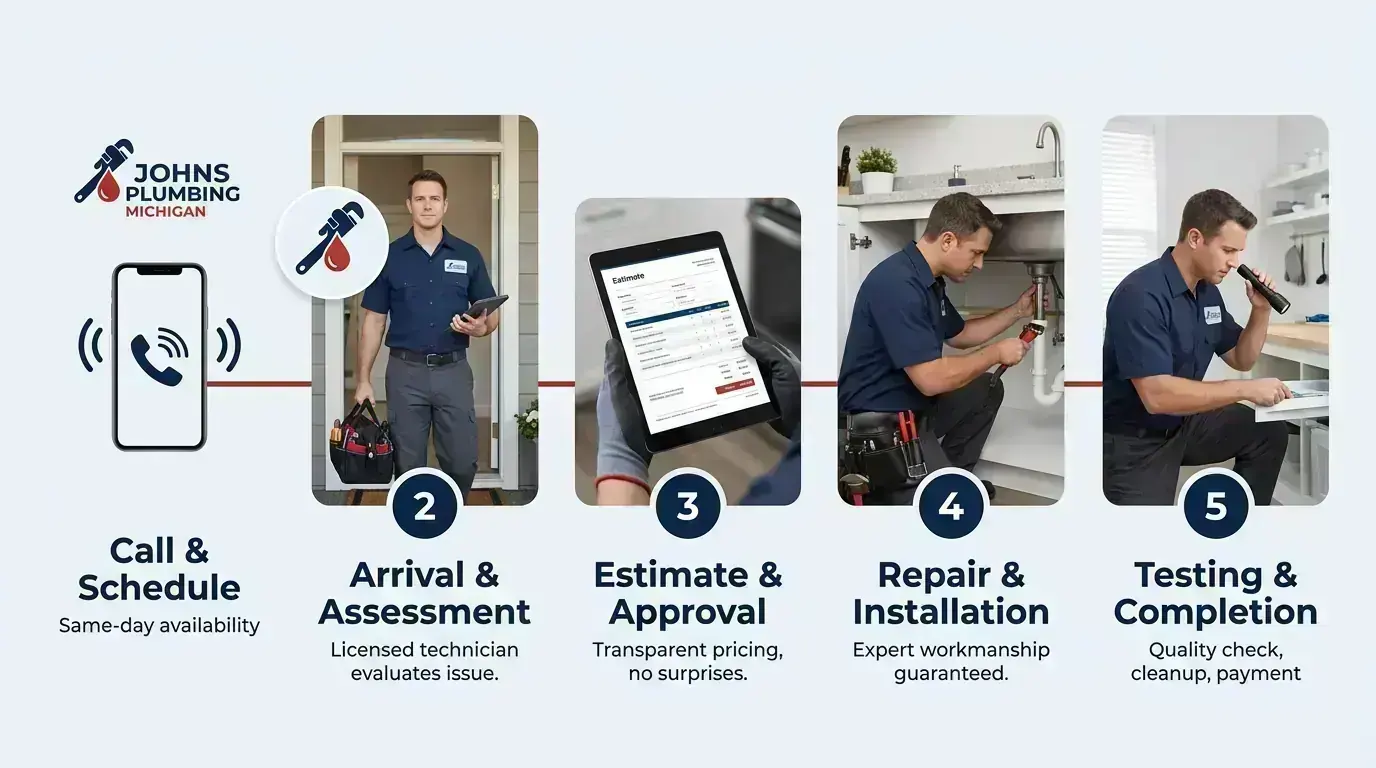
Call (313) 736-9553 and you reach a live person 24/7 who asks about your plumbing issue, location in Grand Rapids, and urgency level. Within minutes, we schedule a service window (same-day for emergencies, next available opening for routine work) and send arrival confirmation by text.
Scheduling Your Service Appointment
Most non-emergency appointments in Grand Rapids schedule within 24-48 hours. We offer morning (8 AM-12 PM) and afternoon (1 PM-5 PM) windows to match your availability.
Emergency calls dispatch immediately, with technicians typically arriving within 90 minutes throughout Kent County. You receive a call 30 minutes before arrival confirming the technician is en route.
Technician Arrival and Property Access
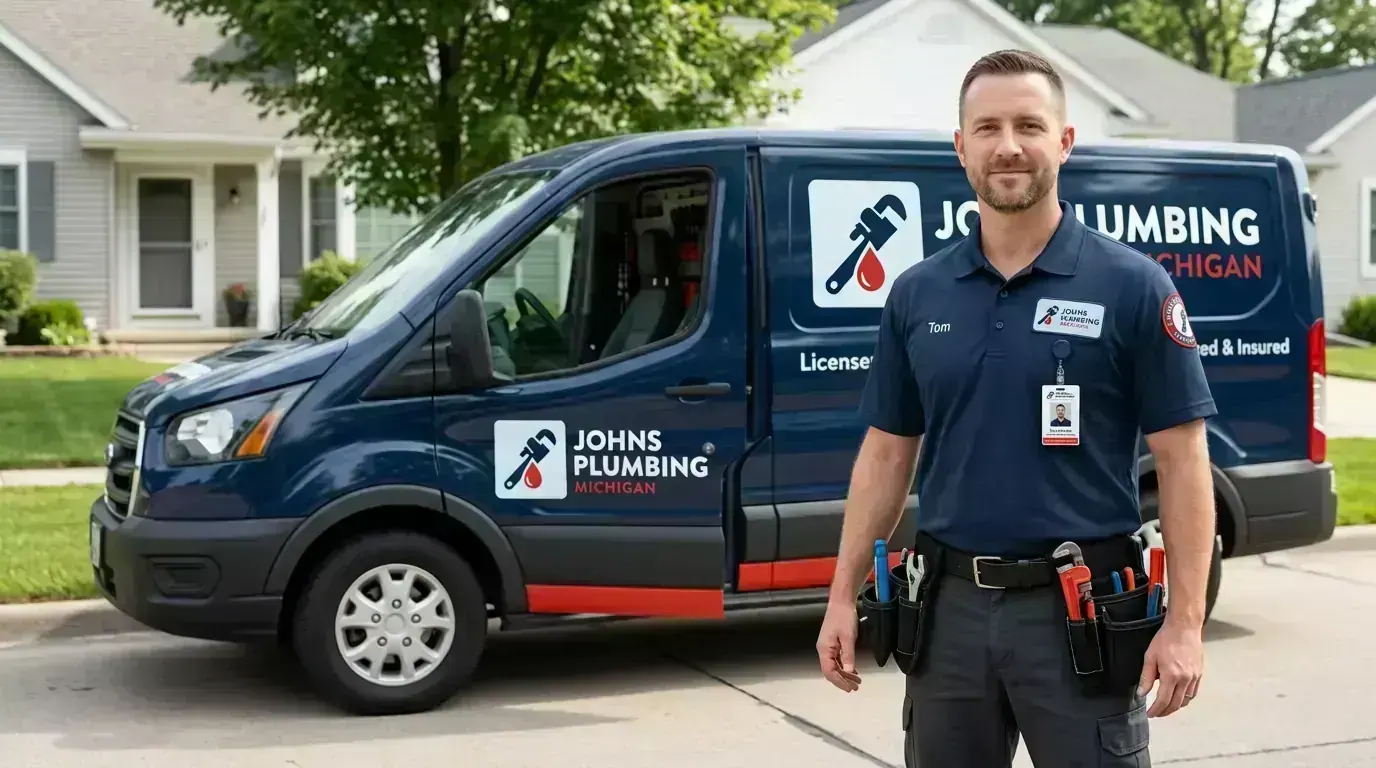
Our technician arrives in a marked service vehicle, introduces himself, shows his Michigan plumbing license, and asks to see the problem area. He wears shoe covers before entering and brings diagnostic tools, cameras for drain inspection, pressure gauges for leak detection, and testing equipment for gas work. For basement or crawl space access, he explains what equipment he'll need to bring inside and where he'll set up his work area.
Assessment and Detailed Estimate
The technician diagnoses the problem using visual inspection and diagnostic tools, camera inspection for drains, pressure testing for leaks, or thermal imaging for hidden water damage. He explains what he found, what caused it, and what repair options exist. You receive a written estimate showing labor, parts, disposal fees, and permit costs if Grand Rapids requires one for your specific work.
No work begins until you approve the estimate. If you want time to think or get a second opinion, that's fine. There's no pressure.
During the Repair or Installation
Once you approve the estimate, the technician lays down drop cloths and floor protection before starting work. For water heater replacement or major pipe work, he shuts off water to the affected area and alerts you before cutting water supply. You'll hear pipe cutting, wrench work, or soldering depending on the job.
For gas line work, he tests for leaks using soap solution and pressure gauges after completing connections. Most drain cleaning takes 30-60 minutes; water heater replacement runs 2-4 hours; sewer line work varies by access and depth.
Quality Testing and Cleanup
After completing repairs, the technician tests the work runs water through drains to verify flow, checks water heater temperature and pressure relief valve operation, or pressure-tests gas lines per Michigan code. For sewer line work, he may run a camera through the line showing you the clear pipe on a tablet screen.
He removes all old parts, cleans up debris, and hauls away the old water heater or fixture. The work area is left clean with tools and materials removed.
Payment, Warranty, and Follow-Up
Payment is due when work is complete. We accept cash, checks, and major credit cards. Every job includes a written invoice showing work performed, parts installed, and warranty terms. Standard repairs carry a one-year warranty on labor and manufacturer warranty on parts.
Water heater installations include manufacturer warranty (typically 6-12 years) plus our installation warranty. If you notice any issues after we leave, call (313) 736-9553. We return to address warranty work at no additional charge. For maintenance-eligible systems like water heaters, we note recommended service intervals on your invoice.
Grand Rapids permit requirements apply to water heater installation, sewer line work beyond the property line, and gas line installation. When permits are needed, we coordinate the application, schedule inspections, and ensure the work passes Kent County code compliance before considering the job complete.
Risk Prevention and Maintenance in Grand Rapids, Michigan
Grand Rapids homeowners need proactive plumbing maintenance to address the city's specific risk factors: Michigan's freeze-thaw cycles that stress pipe joints, mature tree roots from oaks and maples infiltrating sewer lines in Heritage Hill and Creston, and aging cast-iron infrastructure in pre-1950 homes. Regular maintenance prevents the costly emergencies these conditions create.
Winter Pipe Protection
Pipes freeze when temperatures drop well below 32°F, typically late November through March in Grand Rapids. Insulate exposed pipes in crawl spaces, basements, and exterior walls with foam sleeves or fiberglass wrapping. Focus on north-facing walls and unheated spaces.
Keep cabinet doors under sinks open during cold snaps to allow warm air circulation. Let faucets drip slightly during severe cold (when temps hit single digits or below) to maintain water movement and relieve pressure. Disconnect and drain outdoor hoses by mid-October; shut off interior valves supplying outdoor faucets and open the exterior spigot to drain residual water.
Water Heater Flushing
Flush your water heater every 6-12 months to remove sediment buildup that reduces efficiency and accelerates tank corrosion. Turn off power (circuit breaker for electric, gas valve to pilot for gas units), connect a garden hose to the drain valve, run the hose to a floor drain or outside, and drain several gallons until water runs clear.
Sediment accumulates faster in Grand Rapids homes with well water or areas experiencing hard water. Inspect the anode rod every 3-4 years, it sacrifices itself to prevent tank corrosion and should be replaced when less than half an inch of core wire remains exposed.
Drain Maintenance
Pour hot water down kitchen drains weekly to flush grease before it solidifies and causes clogs. Use drain screens in showers and tubs to catch hair and soap buildup, clean screens weekly.
Avoid chemical drain cleaners for routine maintenance; they corrode pipes over time, particularly problematic in Grand Rapids homes with aging cast-iron drain stacks. For slow drains that persist despite these measures, schedule professional cleaning before minor clogs become complete blockages.
Root Prevention for Established Neighborhoods
If your Grand Rapids home has mature maples, oaks, or elms within 20 feet of your sewer line (common in Heritage Hill, Creston, and Eastown) roots likely infiltrate aging clay or cast-iron sewer laterals through deteriorated joints. Schedule camera inspection every 3-5 years to catch root intrusion early.
Once roots establish, schedule professional root removal and consider copper sulfate root treatments or mechanical cutting every 12-18 months to prevent recurring backups. Severe cases may require sewer line replacement.
Sump Pump Testing
Test your sump pump before spring thaw (late March) when basement flooding risk peaks in low-lying Grand Rapids neighborhoods near the Grand River. Pour water into the pit until the float rises and activates the pump, it should discharge water quickly and shut off automatically. Clean the inlet screen of debris.
Check the discharge line for ice blockage in late winter. Battery backup systems need testing twice yearly; replace batteries every 3-5 years even if they haven't failed.
Early Warning Signs
Watch for subtle changes indicating developing problems: gradually increasing water bills suggest hidden leaks; recurring clogs in the same drain often mean deeper line issues rather than simple blockages; discolored water from specific fixtures points to pipe corrosion; damp spots on walls or ceilings near plumbing indicate slow leaks before they become visible floods.
Professional Inspection Value
Annual plumbing inspections catch problems before they cause water damage or emergency repairs. Inspections include checking exposed pipes for corrosion, testing water pressure, evaluating water heater condition, inspecting visible drain lines, and identifying areas vulnerable to freeze damage. For homes built before 1980 in Heritage Hill or Creston, camera inspection of main sewer lines every 3-5 years identifies deterioration and root intrusion before sewage backs up into your basement.
For professional preventive maintenance or to address issues beyond DIY care, call (313) 736-9553 to schedule an inspection.
Service Area Coverage in Grand Rapids, Michigan
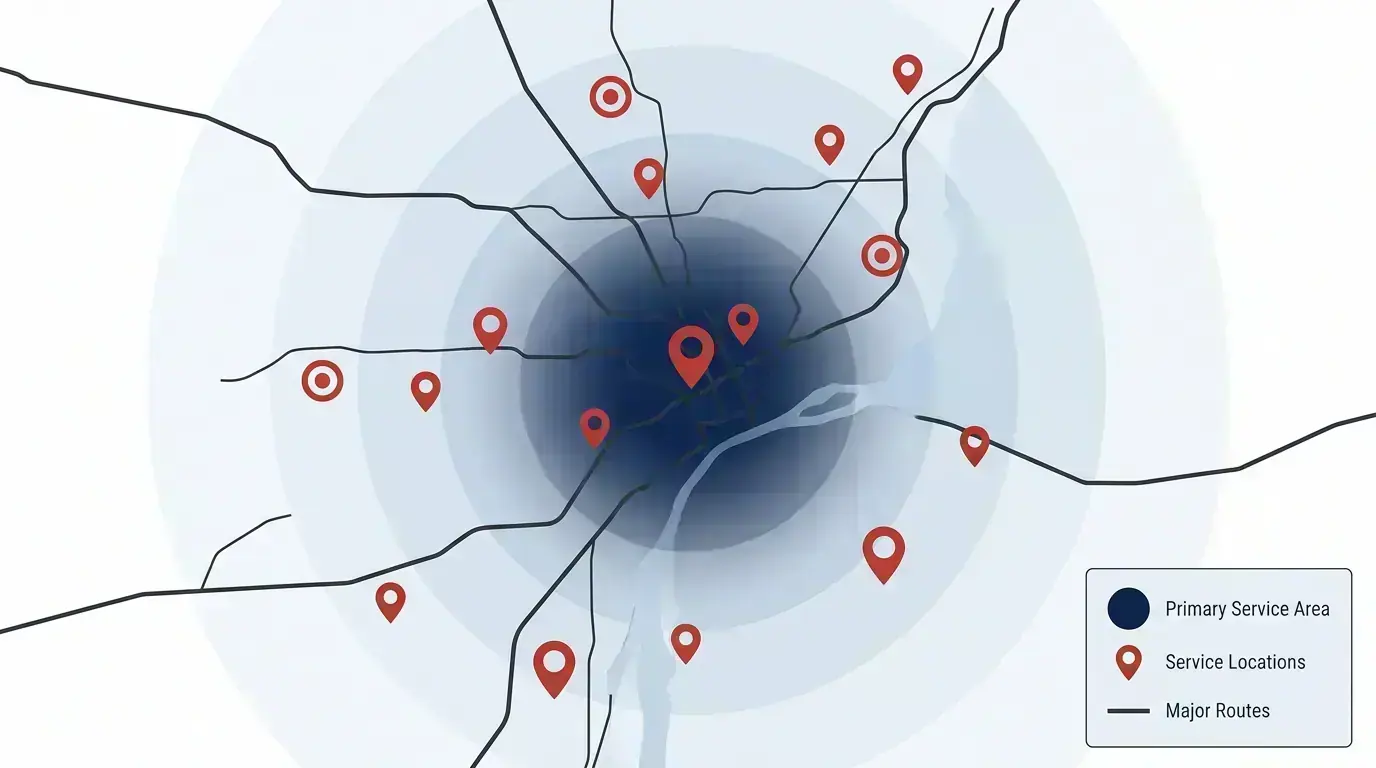
Johns Plumbing Michigan serves all of Grand Rapids and Kent County, with coverage extending approximately 15 miles from downtown Grand Rapids. We respond to calls across ZIP codes 49546, 49507, 49505, 49503, 49506, 49504, 49508, 49501, 49502, 49514, 49515, 49523, 49555, 49588, and 49599.
Our service area includes surrounding communities within 10 miles of Grand Rapids: East Grand Rapids (2.6 miles), Walker (4.8 miles), Wyoming (5.5 miles), Comstock Park (5.8 miles), Kentwood (6.2 miles), Northview (6.2 miles), Grandville (6.6 miles), Forest Hills (8.4 miles), Cutlerville (8.4 miles), and Jenison (9.5 miles). Calls from Byron Center (11 miles) and Cannonsburg (11.3 miles) also fall within our regular service radius.
Emergency response covers the entire Kent County area. Same-day service appointments are available throughout Grand Rapids and immediately adjacent communities. For locations near the outer edge of our service area, we confirm coverage and provide estimated arrival times when you call, most addresses within our 15-mile radius receive service the same day for urgent needs, next business day for routine appointments.
Serving all of Grand Rapids and Kent County. Call (313) 736-9553 to confirm we cover your specific address and schedule service.
Local Plumbing Challenges in Grand Rapids, Michigan
Grand Rapids homeowners face a specific combination of plumbing challenges: mature tree roots infiltrating aging sewer laterals in Heritage Hill and Creston, freeze-thaw cycles shifting pipe joints throughout Michigan winters, and basement flooding in low-lying neighborhoods near the Grand River. These aren't universal plumbing problems. They're infrastructure and environmental realities shaped by Grand Rapids' housing stock, clay soil, and climate.
Mature Tree Root Intrusion in Established Neighborhoods
Heritage Hill, Creston, and Eastown host some of Grand Rapids' most beautiful tree canopies, maples, oaks, and elms that planted decades ago now reach full maturity. Those same roots push into deteriorated sewer lateral joints, especially where original clay tile or early cast-iron connections have weakened over 50-70 years.
Unlike newer subdivisions with modern PVC sewer lines installed in the 1990s-2000s, these mid-century neighborhoods experience recurring drain blockages that hydro-jetting temporarily clears but root barriers or pipe replacement ultimately solve. If you notice multiple slow drains or gurgling toilets during summer (peak root growth season), roots likely infiltrated your sewer line.
Freeze-Thaw Pipe Joint Movement
Michigan winters drive frost 42 inches or deeper into Grand Rapids' clay soil. As groundwater freezes and thaws repeatedly from November through March, underground pipe joints shift incrementally. Enough to misalign connections, crack older materials, and create future leak points.
This cycle affects homes across all neighborhoods but hits hardest where galvanized steel supply lines (common in pre-1970 construction) already weakened from interior corrosion. The result: pinhole leaks and joint failures that surface in spring after joints endured months of freeze-thaw stress. Homes with crawl spaces or exterior wall plumbing also face direct pipe freezing during extreme cold snaps, especially when temperatures drop below 10°F for extended periods.
Basement Flooding in Low-Lying Areas
Roosevelt Park and South Hill sit closer to the Grand River floodplain, making these neighborhoods particularly vulnerable to basement flooding during spring snowmelt and severe rain events. While Grand Rapids completed a major sewer separation project in 2015 that eliminated combined sewer overflows during heavy rain, individual homes still rely on sump pumps and foundation drains to handle groundwater infiltration.
Sump pump failures during March-April thaw periods consistently rank among the most common plumbing emergencies in these areas. If your basement has flooded before, your drainage system likely needs capacity upgrades or backup pump installation before the next spring thaw cycle.
Aging Sewer Laterals in Historic Districts
Heritage Hill homes built between 1840s-early 1900s often retain original clay tile sewer laterals or early cast-iron connections. These materials absorbed 80-150+ years of soil movement, root pressure, and ground settling.
Combined with Michigan's freeze-thaw cycles, the result is sewer lines with separated joints, bellied sections where pipes sagged, and tree roots exploiting every crack. Camera inspection reveals the extent of deterioration, and trenchless replacement methods now make sewer line renewal feasible without destroying historic landscaping, critical in Heritage Hill where property aesthetics and historical integrity matter to homeowners.
Dealing with root intrusion, freeze damage, or basement flooding specific to Grand Rapids' infrastructure? Call (313) 736-9553 for solutions based on Kent County conditions and your neighborhood's housing era.
DIY vs Professional Plumber: When to Call a Grand Rapids Plumber
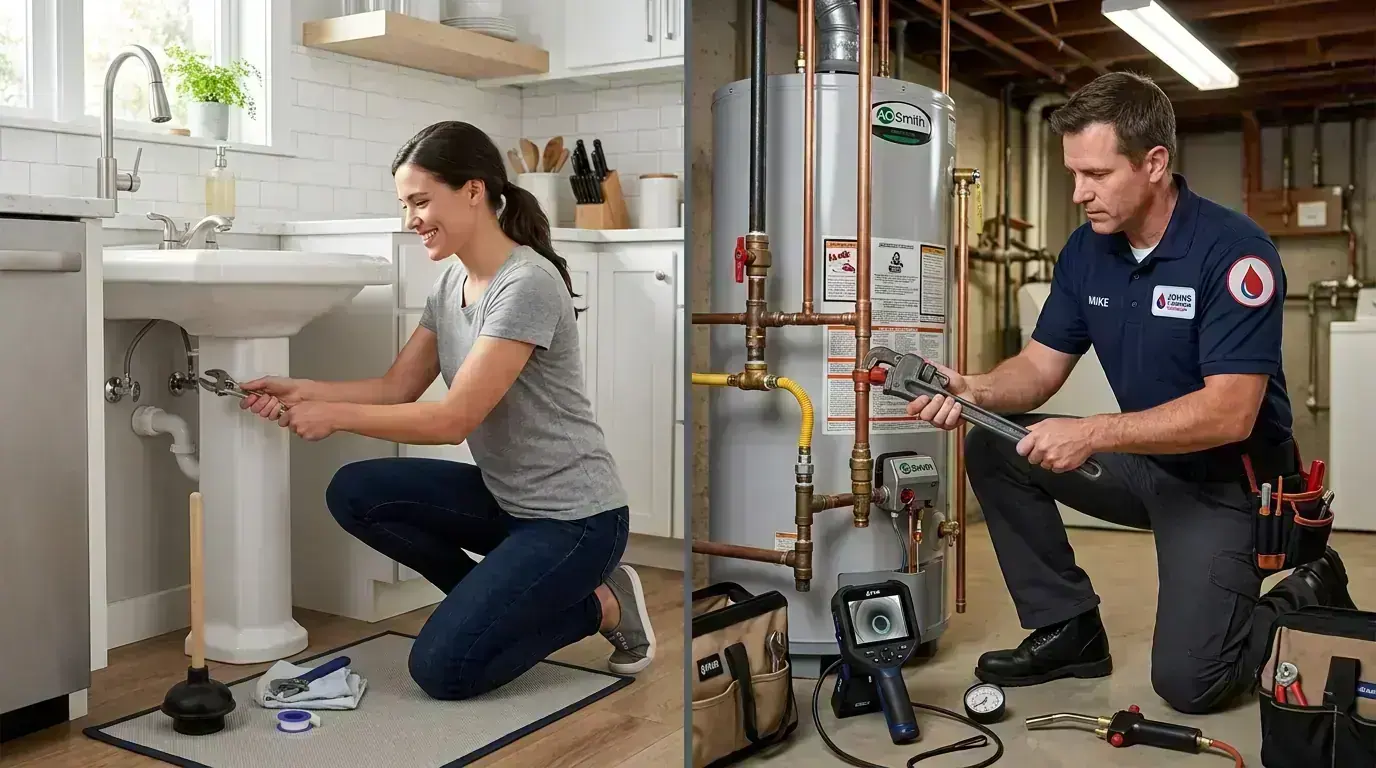
Simple repairs like unclogging sink drains with a plunger, replacing toilet flappers, or tightening visible pipe connections are DIY-appropriate. Professional service becomes essential for work requiring permits, involving gas lines or main water systems, or affecting hidden plumbing, where mistakes trigger code violations, insurance denials, or hidden damage costs that dwarf the original repair.
DIY-Safe Tasks:
Homeowners can handle basic drain clearing with plungers or hand-crank augers for single-fixture clogs, faucet aerator replacement to restore water pressure, and toilet flapper or fill valve replacement for running toilets. These tasks use standard tools, don't require permits in Kent County, and stay reversible if you hit complications. Stop and call (313) 736-9553 if the clog won't clear after three attempts, if you encounter corroded fittings that won't budge, or if water damage appears during the work.
Professional-Only Scenarios:
Water heater work requires both plumbing and mechanical permits under Michigan code, involves gas line connections (explosion risk) or 240V electrical (shock hazard), and demands pressure relief valve expertise. DIY water heater installation voids manufacturer warranties and insurance coverage if failure causes property damage.
Gas line repairs or extensions require Michigan Master Plumber licensing. Improper gas work creates carbon monoxide and explosion risks. Insurance policies specifically exclude coverage for unlicensed gas work. A leak traced to DIY installation leaves you liable for property damage and injury costs.
Main water line or sewer line work requires permits, affects municipal connections, and involves buried systems where access errors cause foundation settlement or contaminate soil. Kent County inspectors reject unpermitted sewer work, forcing complete reinstallation at your expense.
Re-piping, pipe replacement behind walls, or drain work requiring wall/floor removal all need permits and code-compliant installation. Hidden leaks from improper soldering or fitting installation cause structural damage before you notice symptoms, turning a $400 repair into $8,000+ water damage remediation.
Decision Framework:
If work requires a permit → call licensed professional. If it involves gas lines, main water systems, or water heaters → call professional to protect insurance coverage.
If it requires opening walls, specialized tools like pipe threaders, or affects systems you can't see → call professional to avoid hidden damage. If you're not certain whether permits apply in Grand Rapids → call (313) 736-9553 for free assessment before starting work.
For work requiring permits or involving gas/main lines, call (313) 736-9553 for licensed service that protects your home, insurance coverage, and resale value.
Licensed & Insured Plumber Requirements in Michigan
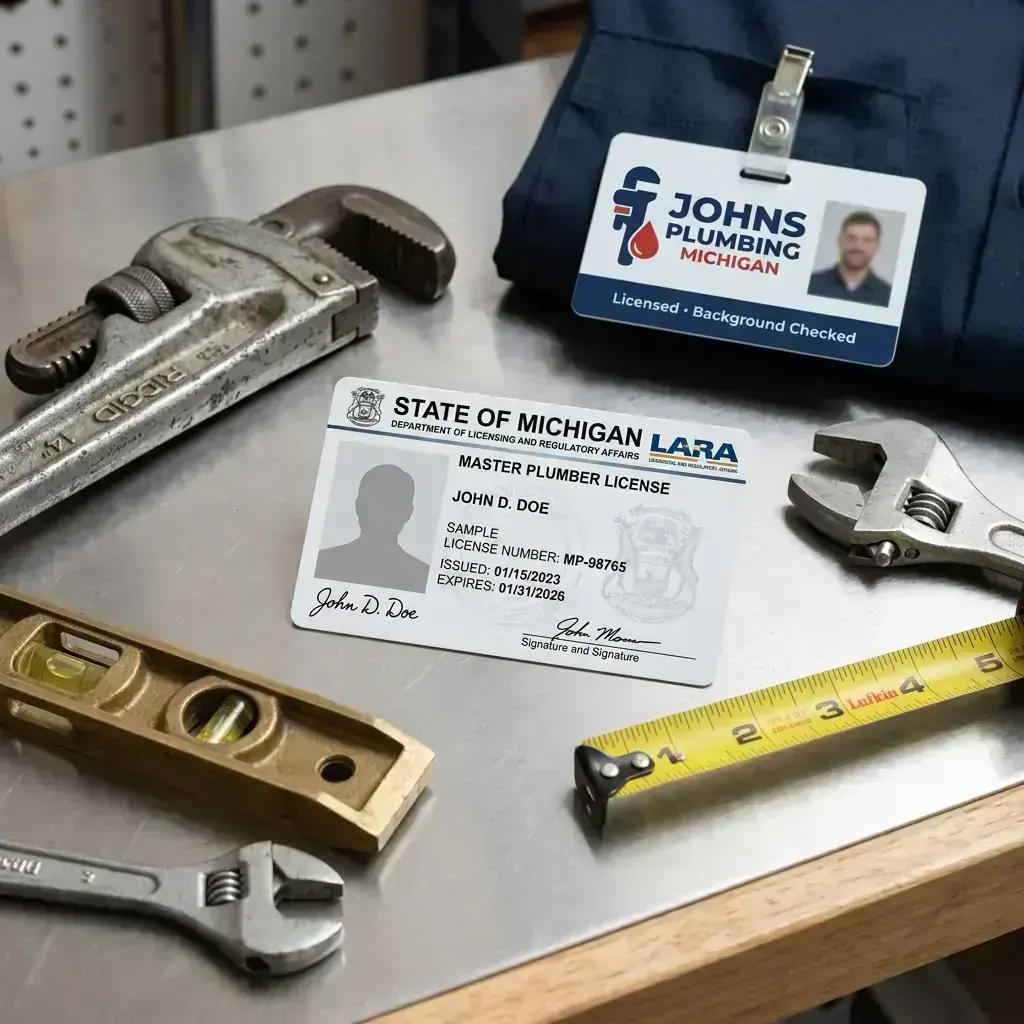
Michigan requires plumbers to hold either a Journeyman license (4-year apprenticeship plus state exam) or Master license (2 additional years as Journeyman plus Master exam) issued by the Michigan Department of Licensing and Regulatory Affairs (LARA). Before hiring any plumber in Grand Rapids, verify credentials through LARA's public license lookup at michigan.gov/lara or ask for the plumber's license number directly. Proper licensing protects you from code violations, insurance claim denials, and liability for work-related injuries.
Michigan Plumber Licensing Authority
LARA oversees all plumbing licensing in Michigan. The agency examines apprenticeship completion records, tests technical knowledge of the Michigan Plumbing Code, and maintains the public license database.
Work performed by unlicensed individuals violates state law and typically voids homeowner insurance coverage if problems occur. Grand Rapids code enforcement can halt unlicensed work and require full system inspection before approving occupancy permits.
Journeyman vs Master Plumber
A Journeyman Plumber completes a state-registered 4-year apprenticeship (8,000 hours minimum) under a Master Plumber's supervision, then passes the Journeyman examination covering pipe sizing, venting requirements, water supply systems, and drainage design. Journeymen can perform all residential plumbing repairs and installations but work under a Master Plumber's oversight.
Master Plumbers work independently after logging 2 additional years as licensed Journeymen and passing the Master examination, which adds business management, code interpretation, and complex system design. Only Master Plumbers can pull permits for new construction or major alterations in Kent County without supervision.
Insurance Requirements
Michigan law requires licensed plumbers to carry general liability insurance covering property damage and errors in workmanship, plus workers' compensation insurance if they employ others. These protect homeowners from financial responsibility if a technician is injured on your property or if faulty work causes damage after the plumber leaves.
Unlicensed handymen typically carry neither, shifting all liability to you. Request proof of both before work begins.
Licensed Master Plumber serving Grand Rapids. Call (313) 736-9553 for guaranteed code-compliant work you can verify through Michigan LARA.
Nearby Cities We Serve
Johns Plumbing Michigan serves Grand Rapids as our primary service base, with coverage extending to East Grand Rapids (2.6 miles), Walker (4.8 miles), Wyoming (5.5 miles), Comstock Park (5.8 miles), Kentwood (6.2 miles), Northview (6.2 miles), Grandville (6.6 miles), and Forest Hills (8.4 miles). Most calls within our 15-mile service radius receive same-day response, with emergency arrivals typically within 90 minutes throughout Kent County.
We handle the same aging infrastructure challenges (root intrusion from mature trees, freeze-thaw pipe damage, and clay sewer laterals) across all surrounding communities. Call (313) 736-9553 to confirm coverage for your specific location or schedule service in Grand Rapids and beyond.
FAQ
How much does a plumber cost in Grand Rapids?
Most residential plumbing jobs in Grand Rapids range from $125-$600 depending on service complexity. Service calls typically run $85-$150, which applies toward repair costs.
Drain cleaning averages $170-$600, water heater work $102-$745, and emergency calls may include after-hours dispatch fees. The final price depends on parts needed, access difficulty, and whether Kent County permits are required for the work.
What are the most common plumbing problems in Grand Rapids?
Frozen and burst pipes during Michigan winters top the list, followed by tree root intrusion into aging sewer laterals in Heritage Hill and Creston neighborhoods. Basement flooding from spring snowmelt affects low-lying areas near the Grand River, while aging cast-iron drain systems in pre-1950 homes cause recurring blockages and leaks.
How quickly can a plumber arrive for an emergency in Grand Rapids?
Emergency calls throughout Grand Rapids typically receive technician arrival within 90 minutes of your call. Response time varies based on current demand and your location within our Kent County service area. We dispatch 24/7 year-round for burst pipes, sewage backups, gas leaks, and other urgent plumbing failures.
Do I need a permit for plumbing work in Grand Rapids?
Yes, all plumbing work including water heater installation, sewer line repairs, and fixture additions requires a permit in Grand Rapids. Homeowners can pull permits for their primary residence, but landlords must use licensed contractors. No work should start before permit approval, and no work can be concealed until inspected and approved by the city.
When do pipes typically freeze in Grand Rapids?
Pipes begin freezing when temperatures drop well below 32°F, typically from late fall through early spring in Grand Rapids. Michigan winters drive frost depths to 42 inches or deeper during severe cold snaps. Pipes in crawl spaces, exterior walls, and poorly insulated basements face the highest freeze risk throughout December through February.
What plumbing problems affect Heritage Hill historic homes?
Heritage Hill homes built between the 1840s-early 1900s often have original cast-iron drain stacks and galvanized supply lines that corrode internally over decades. This causes reduced water pressure, recurring blockages, pinhole leaks, and potential lead contamination from aging service lines. These homes frequently need re-piping to replace deteriorated infrastructure.
Why does my basement flood during spring thaw in Grand Rapids?
Spring snowmelt overwhelms older drainage systems in low-lying Grand Rapids neighborhoods like Roosevelt Park and South Hill. Combined with heavy rain, snowmelt can exceed sump pump capacity or flood through aging foundation drains. Sump pump failures during peak demand create the most severe basement flooding emergencies.
How do I prevent frozen pipes during Michigan winters?
Keep interior temperatures at 55°F minimum throughout your home, even when away. Insulate pipes in crawl spaces, attics, and exterior walls with foam sleeves.
Disconnect and drain outdoor faucets by mid-November. During extreme cold below 10°F, let faucets drip slightly overnight to maintain water movement through vulnerable pipes.
Questions not answered here? Call (313) 736-9553 for expert guidance on your specific Grand Rapids plumbing concern.
Johns Plumbing Michigan has served Grand Rapids homeowners since 2012 with Michigan-licensed residential plumbing services available 24/7 including weekends and holidays. From emergency burst pipe repairs to routine water heater maintenance, our experienced technicians typically arrive within 90 minutes for urgent calls throughout Kent County and provide upfront pricing before starting any work. Call (313) 736-9553 now to schedule service or request a free estimate. We're ready to help with any plumbing issue in Grand Rapids, Michigan.